Q99326
Gene name |
YOR338W (O6265) |
Protein name |
SWIRM domain-containing protein YOR338W |
Names |
|
Species |
Saccharomyces cerevisiae (strain ATCC 204508 / S288c) (Baker's yeast) |
KEGG Pathway |
sce:YOR338W |
EC number |
|
Protein Class |
|
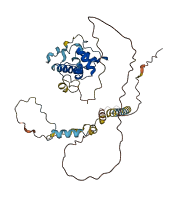
Descriptions
The autoinhibited protein was predicted that may have potential autoinhibitory elements via cis-regPred.
Autoinhibitory domains (AIDs)
Target domain |
|
Relief mechanism |
|
Assay |
cis-regPred |
Accessory elements
No accessory elements
Autoinhibited structure

Activated structure
1 structures for Q99326
| Entry ID | Method | Resolution | Chain | Position | Source |
|---|---|---|---|---|---|
| AF-Q99326-F1 | Predicted | AlphaFoldDB |
11 variants for Q99326
| Variant ID(s) | Position | Change | Description | Diseaes Association | Provenance |
|---|---|---|---|---|---|
| s15-956950 | 19 | G>E | No | SGRP | |
| s15-957199 | 102 | N>S | No | SGRP | |
| s15-957204 | 104 | E>K | No | SGRP | |
| s15-957316 | 141 | R>Q | No | SGRP | |
| s15-957388 | 165 | N>T | No | SGRP | |
| s15-957457 | 188 | E>G | No | SGRP | |
| s15-957474 | 194 | S>P | No | SGRP | |
| s15-957498 | 202 | A>T | No | SGRP | |
| s15-957531 | 213 | I>V | No | SGRP | |
| s15-957535 | 214 | R>H | No | SGRP | |
| s15-957714 | 274 | P>S | No | SGRP |
No associated diseases with Q99326
2 GO annotations of cellular component
| Name | Definition |
|---|---|
| nucleus | A membrane-bounded organelle of eukaryotic cells in which chromosomes are housed and replicated. In most cells, the nucleus contains all of the cell's chromosomes except the organellar chromosomes, and is the site of RNA synthesis and processing. In some species, or in specialized cell types, RNA metabolism or DNA replication may be absent. |
| SAGA-type complex | A histone acetyltransferase complex that acetylates nucleosomal histones H2B, H3, or H4 and is required for the expression of a subset of Pol II-transcribed genes. This complex includes the acetyltransferases GCN5/KAT2A or PCAF/KAT2B, several proteins of the ADA, SGF and SPT families, and several TBP-associate proteins (TAFs). |
2 GO annotations of molecular function
| Name | Definition |
|---|---|
| chromatin binding | Binding to chromatin, the network of fibers of DNA, protein, and sometimes RNA, that make up the chromosomes of the eukaryotic nucleus during interphase. |
| transcription coactivator activity | A transcription coregulator activity that activates or increases the transcription of specific gene sets via binding to a DNA-bound DNA-binding transcription factor, either on its own or as part of a complex. Coactivators often act by altering chromatin structure and modifications. For example, one class of transcription coactivators modifies chromatin structure through covalent modification of histones. A second class remodels the conformation of chromatin in an ATP-dependent fashion. A third class modulates interactions of DNA-bound DNA-binding transcription factors with other transcription coregulators. A fourth class of coactivator activity is the bridging of a DNA-binding transcription factor to the general (basal) transcription machinery. The Mediator complex, which bridges sequence-specific DNA binding transcription factors and RNA polymerase, is also a transcription coactivator. |
5 GO annotations of biological process
| Name | Definition |
|---|---|
| ascospore formation | The process in which cells that are products of meiosis acquire the specialized features of ascospores. Ascospores are generally found in clusters of four or eight spores within a single mother cell, the ascus, and are characteristic of the ascomycete fungi (phylum Ascomycota). |
| chromatin remodeling | A dynamic process of chromatin reorganization resulting in changes to chromatin structure. These changes allow DNA metabolic processes such as transcriptional regulation, DNA recombination, DNA repair, and DNA replication. |
| positive regulation of histone acetylation | Any process that activates or increases the frequency, rate or extent of the addition of an acetyl group to a histone protein. |
| positive regulation of transcription by RNA polymerase II | Any process that activates or increases the frequency, rate or extent of transcription from an RNA polymerase II promoter. |
| regulation of transcription by RNA polymerase II | Any process that modulates the frequency, rate or extent of transcription mediated by RNA polymerase II. |
| 10 | 20 | 30 | 40 | 50 | 60 |
| MLDNMQFHSP | APEHPQLNGG | INKIPASHKI | GYKLNQQVQR | LAVVRNNIEE | RLNSMESSHG |
| 70 | 80 | 90 | 100 | 110 | 120 |
| QISDSSVVRA | IDASIDDFLI | PSPPLSPKLR | QCPIISQPQL | VNVESDHREL | IMLTPVWEAG |
| 130 | 140 | 150 | 160 | 170 | 180 |
| LNSQKYNHNT | RNFLSQYSFF | RDMKTTKRIP | NKENRKLKVV | KSVVNSEALP | KRRRYDRKIK |
| 190 | 200 | 210 | 220 | 230 | 240 |
| RRSRELYEDD | GNRSENYDEE | SAQEVPVRSV | TPIRQVKRSL | HTISSPLASQ | GVVNNVPKYI |
| 250 | 260 | 270 | 280 | 290 | 300 |
| PSMSWEKLPD | YSPPLHTLPN | SNNKVLKVEW | KGSPMDLNHD | PLKQRLHPAE | LVLAQILRLP |
| 310 | 320 | 330 | 340 | 350 | 360 |
| CDLYLDSKRR | FFLEKVHRFK | KGLPFRRTDA | QKACRIDVNK | ASRLFAAFEK | VGWLQDKHFE |
| KYL |