Q94527
Gene name |
Rel |
Protein name |
Nuclear factor NF-kappa-B p110 subunit |
Names |
Rel-p110, Relish protein |
Species |
Rattus norvegicus (Rat) |
KEGG Pathway |
dme:Dmel_CG11992 |
EC number |
|
Protein Class |
|
Descriptions
Autoinhibitory domains (AIDs)
Target domain |
147-446 (RHD); 452-457 (Nuclear localization signal) |
Relief mechanism |
Cleavage |
Assay |
Split protein assay |
Accessory elements
No accessory elements
References
- Stöven S et al. (2000) "Activation of the Drosophila NF-kappaB factor Relish by rapid endoproteolytic cleavage", EMBO reports, 1, 347-52
- Huguet C et al. (1997) "Rel/NF-kappa B transcription factors and I kappa B inhibitors: evolution from a unique common ancestor", Oncogene, 15, 2965-74
- Siebenlist U et al. (1994) "Structure, regulation and function of NF-kappa B", Annual review of cell biology, 10, 405-55
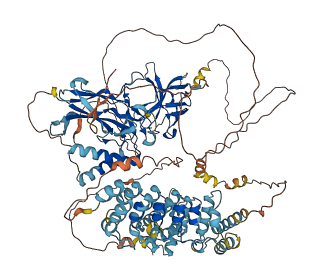
Autoinhibited structure

Activated structure
1 structures for Q94527
| Entry ID | Method | Resolution | Chain | Position | Source |
|---|---|---|---|---|---|
| AF-Q94527-F1 | Predicted | AlphaFoldDB |
5 variants for Q94527
| Variant ID(s) | Position | Change | Description | Diseaes Association | Provenance |
|---|---|---|---|---|---|
| 82 | N>S | strain: Zim2 [UniProt] | No | ||
| 110 | F>L | strain: Zim3 [UniProt] | No | ||
| 699 | T>I | strain: Zim8 [UniProt] | No | ||
| 845 | E>G | strain: Zim1 [UniProt] | No | ||
| 862 | S>N | strain: Zim8 [UniProt] | No |
No associated diseases with Q94527
5 GO annotations of cellular component
| Name | Definition |
|---|---|
| cytoplasm | The contents of a cell excluding the plasma membrane and nucleus, but including other subcellular structures. |
| cytosol | The part of the cytoplasm that does not contain organelles but which does contain other particulate matter, such as protein complexes. |
| euchromatin | A dispersed and relatively uncompacted form of chromatin that is in a transcription-competent conformation. |
| nucleoplasm | That part of the nuclear content other than the chromosomes or the nucleolus. |
| nucleus | A membrane-bounded organelle of eukaryotic cells in which chromosomes are housed and replicated. In most cells, the nucleus contains all of the cell's chromosomes except the organellar chromosomes, and is the site of RNA synthesis and processing. In some species, or in specialized cell types, RNA metabolism or DNA replication may be absent. |
5 GO annotations of molecular function
| Name | Definition |
|---|---|
| DNA-binding transcription activator activity, RNA polymerase II-specific | A DNA-binding transcription factor activity that activates or increases transcription of specific gene sets transcribed by RNA polymerase II. |
| DNA-binding transcription factor activity, RNA polymerase II-specific | A DNA-binding transcription factor activity that modulates the transcription of specific gene sets transcribed by RNA polymerase II. |
| identical protein binding | Binding to an identical protein or proteins. |
| RNA polymerase II cis-regulatory region sequence-specific DNA binding | Binding to a specific upstream regulatory DNA sequence (transcription factor recognition sequence or binding site) located in cis relative to the transcription start site (i.e., on the same strand of DNA) of a gene transcribed by RNA polymerase II. |
| RNA polymerase II transcription regulatory region sequence-specific DNA binding | Binding to a specific sequence of DNA that is part of a regulatory region that controls the transcription of a gene or cistron by RNA polymerase II. |
24 GO annotations of biological process
| Name | Definition |
|---|---|
| cellular response to amino acid starvation | Any process that results in a change in state or activity of a cell (in terms of movement, secretion, enzyme production, gene expression, etc.) as a result of deprivation of amino acids. |
| cellular response to DNA damage stimulus | Any process that results in a change in state or activity of a cell (in terms of movement, secretion, enzyme production, gene expression, etc.) as a result of a stimulus indicating damage to its DNA from environmental insults or errors during metabolism. |
| defense response to bacterium | Reactions triggered in response to the presence of a bacterium that act to protect the cell or organism. |
| defense response to Gram-negative bacterium | Reactions triggered in response to the presence of a Gram-negative bacterium that act to protect the cell or organism. |
| defense response to virus | Reactions triggered in response to the presence of a virus that act to protect the cell or organism. |
| dendrite morphogenesis | The process in which the anatomical structures of a dendrite are generated and organized. |
| immune response | Any immune system process that functions in the calibrated response of an organism to a potential internal or invasive threat. |
| innate immune response | Innate immune responses are defense responses mediated by germline encoded components that directly recognize components of potential pathogens. |
| negative regulation of stem cell proliferation | Any process that stops, prevents or reduces the frequency, rate or extent of stem cell proliferation. |
| peptidoglycan recognition protein signaling pathway | The series of molecular signals initiated by binding of peptidoglycan to a receptor and ending with regulation of a downstream cellular process. The main outcome of the Imd signaling is the production of antimicrobial peptides. |
| peripheral nervous system neuron development | The process whose specific outcome is the progression of a neuron whose cell body is located in the peripheral nervous system, from initial commitment of the cell to a neuronal fate, to the fully functional differentiated neuron. |
| positive regulation of antibacterial peptide biosynthetic process | Any process that activates or increases the frequency, rate, or extent of antibacterial peptide biosynthesis. |
| positive regulation of antifungal peptide biosynthetic process | Any process that activates or increases the frequency, rate, or extent of antifungal peptide biosynthesis. |
| positive regulation of antimicrobial peptide production | Any process that activates or increases the frequency, rate, or extent of antimicrobial peptide production. |
| positive regulation of biosynthetic process of antibacterial peptides active against Gram-negative bacteria | Any process that activates or increases the frequency, rate, or extent of biosynthesis of antibacterial peptides active against Gram-negative bacteria. |
| positive regulation of defense response to virus by host | Any host process that results in the promotion of antiviral immune response mechanisms, thereby limiting viral replication. |
| positive regulation of gene expression | Any process that increases the frequency, rate or extent of gene expression. Gene expression is the process in which a gene's coding sequence is converted into a mature gene product (protein or RNA). |
| positive regulation of innate immune response | Any process that activates or increases the frequency, rate or extent of the innate immune response, the organism's first line of defense against infection. |
| positive regulation of nitric oxide biosynthetic process | Any process that activates or increases the frequency, rate or extent of the chemical reactions and pathways resulting in the formation of nitric oxide. |
| positive regulation of phagocytosis | Any process that activates or increases the frequency, rate or extent of phagocytosis. |
| positive regulation of transcription by RNA polymerase II | Any process that activates or increases the frequency, rate or extent of transcription from an RNA polymerase II promoter. |
| regulation of innate immune response | Any process that modulates the frequency, rate or extent of the innate immune response, the organism's first line of defense against infection. |
| regulation of transcription by RNA polymerase II | Any process that modulates the frequency, rate or extent of transcription mediated by RNA polymerase II. |
| response to bacterium | Any process that results in a change in state or activity of a cell or an organism (in terms of movement, secretion, enzyme production, gene expression, etc.) as a result of a stimulus from a bacterium. |
17 homologous proteins in AiPD
| UniProt AC | Gene Name | Protein Name | Species | Evidence Code |
|---|---|---|---|---|
| P98150 | NFKB2 | Nuclear factor NF-kappa-B p100 subunit | Gallus gallus (Chicken) | SS |
| Q04861 | NFKB1 | Nuclear factor NF-kappa-B p105 subunit | Gallus gallus (Chicken) | SS |
| Q6F3J0 | NFKB1 | Nuclear factor NF-kappa-B p105 subunit | Canis lupus familiaris (Dog) (Canis familiaris) | SS |
| Q99549 | MPHOSPH8 | M-phase phosphoprotein 8 | Homo sapiens (Human) | PR |
| Q8N9B4 | ANKRD42 | Ankyrin repeat domain-containing protein 42 | Homo sapiens (Human) | PR |
| Q6ZVZ8 | ASB18 | Ankyrin repeat and SOCS box protein 18 | Homo sapiens (Human) | PR |
| Q00653 | NFKB2 | Nuclear factor NF-kappa-B p100 subunit | Homo sapiens (Human) | SS |
| P19838 | NFKB1 | Nuclear factor NF-kappa-B p105 subunit | Homo sapiens (Human) | SS |
| Q04206 | RELA | Transcription factor p65 | Homo sapiens (Human) | EV |
| Q9CZK6 | Anks3 | Ankyrin repeat and SAM domain-containing protein 3 | Mus musculus (Mouse) | PR |
| Q8VHA6 | Asb18 | Ankyrin repeat and SOCS box protein 18 | Mus musculus (Mouse) | PR |
| P25799 | Nfkb1 | Nuclear factor NF-kappa-B p105 subunit [Cleaved into: Nuclear factor NF-kappa-B p50 subunit] | Mus musculus (Mouse) | EV |
| Q9WTK5 | Nfkb2 | Nuclear factor NF-kappa-B p100 subunit [Cleaved into: Nuclear factor NF-kappa-B p52 subunit] | Mus musculus (Mouse) | EV |
| Q04207 | Rela | Transcription factor p65 | Mus musculus (Mouse) | SS |
| Q9TZM3 | lrk-1 | Leucine-rich repeat serine/threonine-protein kinase 1 | Caenorhabditis elegans | SS |
| O22265 | CAO | Signal recognition particle 43 kDa protein, chloroplastic | Arabidopsis thaliana (Mouse-ear cress) | PR |
| Q9SZI3 | NPR2 | Regulatory protein NPR2 | Arabidopsis thaliana (Mouse-ear cress) | PR |
| 10 | 20 | 30 | 40 | 50 | 60 |
| MSDYENDDEC | WSALESFRVK | LISVIDPSRI | TPYLRQCKVL | NPDDEEQVLS | DPNLVIRKRK |
| 70 | 80 | 90 | 100 | 110 | 120 |
| VGVLLDILQR | TGHKGYVAFL | ESLELYYPQL | YRKVTGKEPA | RVFSMIIDAS | GESGLTQLLM |
| 130 | 140 | 150 | 160 | 170 | 180 |
| TEVMKLQKKV | QDLTALLSSK | DDFIKELRVK | DSLLRKHQER | VQRLKEECEL | SSAELKRCKD |
| 190 | 200 | 210 | 220 | 230 | 240 |
| ENYDLAMRLA | HLSEEKGAAL | MRNRDLQLEV | DQLRHSLMKA | EDDCKVERKH | TLKLRHAMEQ |
| 250 | 260 | 270 | 280 | 290 | 300 |
| RPSQELLWDL | QQERDLLQAR | VQELEVSVQE | GKLHRNSPYI | QVLEEDWRQA | LQEHQEQAST |
| 310 | 320 | 330 | 340 | 350 | 360 |
| IFSLRKDLRQ | AEALRTRCME | EKEMFELQCL | ALRKDAKMYK | DRIEAILQQM | EEVSIERDQA |
| 370 | 380 | 390 | 400 | 410 | 420 |
| MTSREELHAQ | CAQSFQDKDK | LRKQVRELDE | KADELQLQLF | QTESRLLAAE | GRLKQQQLDM |
| 430 | 440 | 450 | 460 | 470 | 480 |
| LILSSDLEDS | SPRNSQELSL | PQDLEEDAQL | SDKGVLADRE | SPEQPFVVLN | KKHLSQTHDT |
| 490 | 500 | 510 | 520 | 530 | |
| VPSSSEPPEK | ERRRLKESFE | NYRRKRALRK | MQNSWRQGEG | DHGNTTGSDN | TDTEGS |