Q91WG5
Gene name |
Prkag2 |
Protein name |
5'-AMP-activated protein kinase subunit gamma-2 |
Names |
AMPK gamma2, AMPK subunit gamma-2 |
Species |
Mus musculus (Mouse) |
KEGG Pathway |
mmu:108099 |
EC number |
|
Protein Class |
|
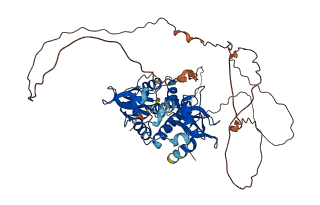
Descriptions
The autoinhibited protein was predicted that may have potential autoinhibitory elements via cis-regPred.
Autoinhibitory domains (AIDs)
Target domain |
|
Relief mechanism |
|
Assay |
cis-regPred |
Accessory elements
No accessory elements
Autoinhibited structure

Activated structure
1 structures for Q91WG5
| Entry ID | Method | Resolution | Chain | Position | Source |
|---|---|---|---|---|---|
| AF-Q91WG5-F1 | Predicted | AlphaFoldDB |
13 variants for Q91WG5
| Variant ID(s) | Position | Change | Description | Diseaes Association | Provenance |
|---|---|---|---|---|---|
| rs3388748722 | 63 | V>M | No | EVA | |
| rs33476996 | 170 | T>I | No | EVA | |
| rs3388734839 | 210 | S>T | No | EVA | |
| rs252553547 | 229 | V>A | No | EVA | |
| rs3388740384 | 315 | L>F | No | EVA | |
| rs3388722171 | 320 | F>V | No | EVA | |
| rs3388745200 | 333 | V>I | No | EVA | |
| rs3395197779 | 370 | A>F | No | EVA | |
| rs3388742348 | 385 | I>F | No | EVA | |
| rs3388742360 | 411 | D>V | No | EVA | |
| rs3388744150 | 536 | D>Y | No | EVA | |
| rs3388744281 | 552 | I>T | No | EVA | |
| rs3388722178 | 566 | E>K | No | EVA |
No associated diseases with Q91WG5
9 regional properties for Q91WG5
| Type | Name | Position | InterPro Accession |
|---|---|---|---|
| repeat | HEAT repeat | 604 - 627 | IPR000357 |
| repeat | WD40 repeat | 1012 - 1050 | IPR001680-1 |
| repeat | WD40 repeat | 1052 - 1097 | IPR001680-2 |
| repeat | WD40 repeat | 1105 - 1151 | IPR001680-3 |
| repeat | WD40 repeat | 1154 - 1194 | IPR001680-4 |
| repeat | WD40 repeat | 1200 - 1240 | IPR001680-5 |
| repeat | WD40 repeat | 1246 - 1281 | IPR001680-6 |
| repeat | WD40 repeat | 1283 - 1329 | IPR001680-7 |
| domain | Raptor, N-terminal CASPase-like domain | 54 - 207 | IPR029347 |
5 GO annotations of cellular component
| Name | Definition |
|---|---|
| cytoplasm | The contents of a cell excluding the plasma membrane and nucleus, but including other subcellular structures. |
| cytosol | The part of the cytoplasm that does not contain organelles but which does contain other particulate matter, such as protein complexes. |
| nucleoplasm | That part of the nuclear content other than the chromosomes or the nucleolus. |
| nucleotide-activated protein kinase complex | A protein complex that possesses nucleotide-dependent protein kinase activity. The nucleotide can be AMP (in S. pombe and human) or ADP (in S. cerevisiae). |
| nucleus | A membrane-bounded organelle of eukaryotic cells in which chromosomes are housed and replicated. In most cells, the nucleus contains all of the cell's chromosomes except the organellar chromosomes, and is the site of RNA synthesis and processing. In some species, or in specialized cell types, RNA metabolism or DNA replication may be absent. |
10 GO annotations of molecular function
| Name | Definition |
|---|---|
| ADP binding | Binding to ADP, adenosine 5'-diphosphate. |
| AMP binding | Binding to AMP, adenosine monophosphate. |
| AMP-activated protein kinase activity | Catalysis of the reaction: ATP + a protein = ADP + a phosphoprotein. This reaction requires the presence of AMP. |
| ATP binding | Binding to ATP, adenosine 5'-triphosphate, a universally important coenzyme and enzyme regulator. |
| cAMP-dependent protein kinase inhibitor activity | Binds to and stops, prevents or reduces the activity of a cAMP-dependent protein kinase. |
| cAMP-dependent protein kinase regulator activity | Modulation of the activity of the enzyme cAMP-dependent protein kinase. |
| phosphorylase kinase regulator activity | Modulation of the activity of the enzyme phosphorylase kinase. |
| protein kinase activator activity | Binds to and increases the activity of a protein kinase, an enzyme which phosphorylates a protein. |
| protein kinase binding | Binding to a protein kinase, any enzyme that catalyzes the transfer of a phosphate group, usually from ATP, to a protein substrate. |
| protein kinase regulator activity | Modulates the activity of a protein kinase, an enzyme which phosphorylates a protein. |
12 GO annotations of biological process
| Name | Definition |
|---|---|
| cellular response to glucose starvation | Any process that results in a change in state or activity of a cell (in terms of movement, secretion, enzyme production, gene expression, etc.) as a result of deprivation of glucose. |
| cellular response to nutrient levels | Any process that results in a change in state or activity of a cell (in terms of movement, secretion, enzyme production, gene expression, etc.) as a result of a stimulus reflecting the presence, absence, or concentration of nutrients. |
| fatty acid biosynthetic process | The chemical reactions and pathways resulting in the formation of a fatty acid, any of the aliphatic monocarboxylic acids that can be liberated by hydrolysis from naturally occurring fats and oils. Fatty acids are predominantly straight-chain acids of 4 to 24 carbon atoms, which may be saturated or unsaturated; branched fatty acids and hydroxy fatty acids also occur, and very long chain acids of over 30 carbons are found in waxes. |
| glycogen metabolic process | The chemical reactions and pathways involving glycogen, a polydisperse, highly branched glucan composed of chains of D-glucose residues in alpha-(1->4) glycosidic linkage, joined together by alpha-(1->6) glycosidic linkages. |
| intracellular signal transduction | The process in which a signal is passed on to downstream components within the cell, which become activated themselves to further propagate the signal and finally trigger a change in the function or state of the cell. |
| negative regulation of protein kinase activity | Any process that stops, prevents, or reduces the frequency, rate or extent of protein kinase activity. |
| positive regulation of peptidyl-threonine phosphorylation | Any process that increases the frequency, rate or extent of peptidyl-threonine phosphorylation. Peptidyl-threonine phosphorylation is the phosphorylation of peptidyl-threonine to form peptidyl-O-phospho-L-threonine. |
| positive regulation of protein kinase activity | Any process that activates or increases the frequency, rate or extent of protein kinase activity. |
| protein phosphorylation | The process of introducing a phosphate group on to a protein. |
| regulation of catalytic activity | Any process that modulates the activity of an enzyme. |
| regulation of fatty acid metabolic process | Any process that modulates the frequency, rate or extent of the chemical reactions and pathways involving fatty acids. |
| regulation of glycolytic process | Any process that modulates the frequency, rate or extent of glycolysis. |
| 10 | 20 | 30 | 40 | 50 | 60 |
| MGSAAMDTKK | KKEVSSPGGS | SGKKNPSLKR | RSLRVHIPDL | SSFAMPLLDG | DVENSEKHSS |
| 70 | 80 | 90 | 100 | 110 | 120 |
| RKVDSPFSSG | SPSRGLFSRG | PQPRPSSPVS | APVRPKTSPG | SPKTVFPFSY | QESPPRSPRR |
| 130 | 140 | 150 | 160 | 170 | 180 |
| MSFSGIFRSS | SKESSPNSNP | STSPGGIRFF | SRSRKTSSVS | SSPSTPTQVT | KQHPFPLESY |
| 190 | 200 | 210 | 220 | 230 | 240 |
| KQEPERPESR | IYASSSPPDT | GQRFCLAFQS | PARPPLASPT | YHAPLRTAVL | AAAPGPAEAG |
| 250 | 260 | 270 | 280 | 290 | 300 |
| MLEKLEFQEE | EDSESGVYMR | FMRSHKCYDI | VPTSSKLVVF | DTTLQVKKAF | FALVANGVRA |
| 310 | 320 | 330 | 340 | 350 | 360 |
| APLWESKKQS | FVGMLTITDF | INILHRYYKS | PMVQIYELEE | HKIETWRELY | LQETFKPLVN |
| 370 | 380 | 390 | 400 | 410 | 420 |
| ISPDASLFDA | VYSLIKNKIH | RLPVIDPISG | NALYILTHKR | ILKFLQLFMS | DMPKPAFMKQ |
| 430 | 440 | 450 | 460 | 470 | 480 |
| NLDELGIGTY | HNIAFIHPDT | PIIKALNIFV | ERRISALPVV | DESGKVVDIY | SKFDVINLAA |
| 490 | 500 | 510 | 520 | 530 | 540 |
| EKTYNNLDIT | VTQALQHRSQ | YFEGVVKCSK | LETLETIVDR | IVRAEVHRLV | VVNEADSIVG |
| 550 | 560 | ||||
| IISLSDILQA | LILTPAGAKQ | KETETE |