Q8WTY4
Gene name |
Ciapin1 |
Protein name |
Anamorsin |
Names |
Cytokine-induced apoptosis inhibitor 1, Fe-S cluster assembly protein DRE2 homolog |
Species |
Mus musculus (Mouse) |
KEGG Pathway |
mmu:109006 |
EC number |
|
Protein Class |
|
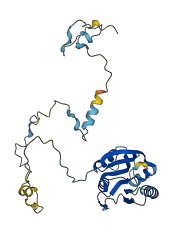
Descriptions
The autoinhibited protein was predicted that may have potential autoinhibitory elements via cis-regPred.
Autoinhibitory domains (AIDs)
Target domain |
|
Relief mechanism |
|
Assay |
cis-regPred |
Accessory elements
No accessory elements
Autoinhibited structure

Activated structure
1 structures for Q8WTY4
| Entry ID | Method | Resolution | Chain | Position | Source |
|---|---|---|---|---|---|
| AF-Q8WTY4-F1 | Predicted | AlphaFoldDB |
14 variants for Q8WTY4
| Variant ID(s) | Position | Change | Description | Diseaes Association | Provenance |
|---|---|---|---|---|---|
| rs3389000139 | 8 | P>T | No | EVA | |
| rs218544887 | 39 | E>K | No | EVA | |
| rs3399477974 | 85 | R>Q | No | EVA | |
| rs3389002804 | 117 | S>* | No | EVA | |
| rs3389007334 | 143 | V>M | No | EVA | |
| rs3388981714 | 149 | Y>H | No | EVA | |
| rs218350604 | 155 | R>H | No | EVA | |
| rs3389000127 | 177 | P>S | No | EVA | |
| rs233649393 | 208 | V>L | No | EVA | |
| rs3388989610 | 268 | K>* | No | EVA | |
| rs3388999882 | 280 | F>L | No | EVA | |
| rs3389000077 | 289 | G>R | No | EVA | |
| rs3389007363 | 305 | N>S | No | EVA | |
| rs3389002796 | 307 | Q>L | No | EVA |
No associated diseases with Q8WTY4
3 regional properties for Q8WTY4
| Type | Name | Position | InterPro Accession |
|---|---|---|---|
| domain | Methyltransferase type 11 | 43 - 94 | IPR013216 |
| domain | Anamorsin, C-terminal | 233 - 266 | IPR046408-1 |
| domain | Anamorsin, C-terminal | 267 - 300 | IPR046408-2 |
5 GO annotations of cellular component
| Name | Definition |
|---|---|
| cytoplasm | The contents of a cell excluding the plasma membrane and nucleus, but including other subcellular structures. |
| mitochondrial intermembrane space | The region between the inner and outer lipid bilayers of the mitochondrial envelope. |
| mitochondrion | A semiautonomous, self replicating organelle that occurs in varying numbers, shapes, and sizes in the cytoplasm of virtually all eukaryotic cells. It is notably the site of tissue respiration. |
| nucleolus | A small, dense body one or more of which are present in the nucleus of eukaryotic cells. It is rich in RNA and protein, is not bounded by a limiting membrane, and is not seen during mitosis. Its prime function is the transcription of the nucleolar DNA into 45S ribosomal-precursor RNA, the processing of this RNA into 5.8S, 18S, and 28S components of ribosomal RNA, and the association of these components with 5S RNA and proteins synthesized outside the nucleolus. This association results in the formation of ribonucleoprotein precursors; these pass into the cytoplasm and mature into the 40S and 60S subunits of the ribosome. |
| nucleoplasm | That part of the nuclear content other than the chromosomes or the nucleolus. |
5 GO annotations of molecular function
| Name | Definition |
|---|---|
| 2 iron, 2 sulfur cluster binding | Binding to a 2 iron, 2 sulfur (2Fe-2S) cluster; this cluster consists of two iron atoms, with two inorganic sulfur atoms found between the irons and acting as bridging ligands. |
| 4 iron, 4 sulfur cluster binding | Binding to a 4 iron, 4 sulfur (4Fe-4S) cluster; this cluster consists of four iron atoms, with the inorganic sulfur atoms found between the irons and acting as bridging ligands. |
| electron transfer activity | Any molecular entity that serves as an electron acceptor and electron donor in an electron transport chain. An electron transport chain is a process in which a series of electron carriers operate together to transfer electrons from donors to any of several different terminal electron acceptors to generate a transmembrane electrochemical gradient. |
| metal ion binding | Binding to a metal ion. |
| methyltransferase activity | Catalysis of the transfer of a methyl group to an acceptor molecule. |
4 GO annotations of biological process
| Name | Definition |
|---|---|
| apoptotic process | A programmed cell death process which begins when a cell receives an internal (e.g. DNA damage) or external signal (e.g. an extracellular death ligand), and proceeds through a series of biochemical events (signaling pathway phase) which trigger an execution phase. The execution phase is the last step of an apoptotic process, and is typically characterized by rounding-up of the cell, retraction of pseudopodes, reduction of cellular volume (pyknosis), chromatin condensation, nuclear fragmentation (karyorrhexis), plasma membrane blebbing and fragmentation of the cell into apoptotic bodies. When the execution phase is completed, the cell has died. |
| hemopoiesis | The process whose specific outcome is the progression of the myeloid and lymphoid derived organ/tissue systems of the blood and other parts of the body over time, from formation to the mature structure. The site of hemopoiesis is variable during development, but occurs primarily in bone marrow or kidney in many adult vertebrates. |
| iron-sulfur cluster assembly | The incorporation of iron and exogenous sulfur into a metallo-sulfur cluster. |
| negative regulation of apoptotic process | Any process that stops, prevents, or reduces the frequency, rate or extent of cell death by apoptotic process. |
| 10 | 20 | 30 | 40 | 50 | 60 |
| MEEFGISPGQ | LVAVFWDKSS | PEEALKKLVA | RLQELTGSEG | QVFMENVTQL | LQSSHKESSF |
| 70 | 80 | 90 | 100 | 110 | 120 |
| DVILSGVVPG | STSLHSAEVL | AEMARILRPG | GCLFLKEPVE | TAEVNNDKMK | TASKLCSALT |
| 130 | 140 | 150 | 160 | 170 | 180 |
| LSGLVEIKEL | QREALSPEEV | QSVQEHLGYH | SDSLRSVRVT | GKKPNFEVGS | SSQLKLPNKK |
| 190 | 200 | 210 | 220 | 230 | 240 |
| SSSVKPVVDP | AAAKLWTLSA | NDMEDDSVDL | IDSDELLDPE | DLKRPDPASL | KAPSCGEGKK |
| 250 | 260 | 270 | 280 | 290 | 300 |
| RKACKNCTCG | LAEELEREQS | KAQSSQPKSA | CGNCYLGDAF | RCANCPYLGM | PAFKPGEQVL |
| LSNSNLQDA |