Q8R4E9
Gene name |
Cdt1 |
Protein name |
DNA replication factor Cdt1 |
Names |
Double parked homolog, DUP, Retroviral insertion site 2 protein |
Species |
Mus musculus (Mouse) |
KEGG Pathway |
mmu:67177 |
EC number |
|
Protein Class |
|
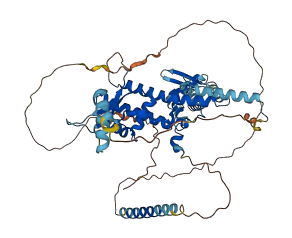
Descriptions
The autoinhibited protein was predicted that may have potential autoinhibitory elements via cis-regPred.
Autoinhibitory domains (AIDs)
Target domain |
|
Relief mechanism |
|
Assay |
cis-regPred |
Accessory elements
No accessory elements
Autoinhibited structure

Activated structure
5 structures for Q8R4E9
| Entry ID | Method | Resolution | Chain | Position | Source |
|---|---|---|---|---|---|
| 2KLO | NMR | - | A | 420-557 | PDB |
| 2RQQ | NMR | - | A | 450-557 | PDB |
| 2ZXX | X-ray | 280 A | C/F | 172-368 | PDB |
| 3A4C | X-ray | 189 A | A | 452-557 | PDB |
| AF-Q8R4E9-F1 | Predicted | AlphaFoldDB |
41 variants for Q8R4E9
| Variant ID(s) | Position | Change | Description | Diseaes Association | Provenance |
|---|---|---|---|---|---|
| rs236696657 | 62 | L>P | No | EVA | |
| rs3389020525 | 86 | A>V | No | EVA | |
| rs3389017871 | 95 | S>R | No | EVA | |
| rs3389022760 | 95 | S>T | No | EVA | |
| rs3388986291 | 98 | A>T | No | EVA | |
| rs230195243 | 99 | D>E | No | EVA | |
| rs3388967218 | 99 | D>H | No | EVA | |
| rs262671157 | 104 | V>I | No | EVA | |
| rs222913835 | 118 | Y>C | No | EVA | |
| rs3389016290 | 120 | G>A | No | EVA | |
| rs240989096 | 123 | P>R | No | EVA | |
| rs241131006 | 132 | V>A | No | EVA | |
| rs218562229 | 132 | V>I | No | EVA | |
| rs3399819370 | 141 | R>Q | No | EVA | |
| rs3389017942 | 147 | A>T | No | EVA | |
| rs3389014717 | 149 | A>V | No | EVA | |
| rs3388992354 | 182 | A>T | No | EVA | |
| rs214697906 | 182 | A>V | No | EVA | |
| rs262849803 | 192 | P>H | No | EVA | |
| rs250152304 | 207 | V>A | No | EVA | |
| rs243911233 | 211 | R>H | No | EVA | |
| rs3389020569 | 215 | T>I | No | EVA | |
| rs33460056 | 258 | T>M | No | EVA | |
| rs246884007 | 312 | Q>K | No | EVA | |
| rs3388986285 | 320 | E>* | No | EVA | |
| rs3389010902 | 334 | A>T | No | EVA | |
| rs3389023702 | 357 | P>R | No | EVA | |
| rs3389023634 | 365 | V>L | No | EVA | |
| rs3388992340 | 371 | T>I | No | EVA | |
| rs3389010878 | 398 | S>P | No | EVA | |
| rs3389017960 | 417 | A>T | No | EVA | |
| rs3389023700 | 421 | A>D | No | EVA | |
| rs3389023618 | 440 | A>V | No | EVA | |
| rs3389014700 | 462 | R>W | No | EVA | |
| rs246803800 | 475 | N>S | No | EVA | |
| rs3389011685 | 497 | S>R | No | EVA | |
| rs3389017926 | 534 | K>M | No | EVA | |
| rs31785357 | 539 | V>A | No | EVA | |
| rs230848929 | 542 | A>T | No | EVA | |
| rs255250601 | 545 | T>A | No | EVA | |
| rs232947024 | 552 | V>I | No | EVA |
No associated diseases with Q8R4E9
4 GO annotations of cellular component
| Name | Definition |
|---|---|
| kinetochore | A multisubunit complex that is located at the centromeric region of DNA and provides an attachment point for the spindle microtubules. |
| nuclear body | Extra-nucleolar nuclear domains usually visualized by confocal microscopy and fluorescent antibodies to specific proteins. |
| nucleoplasm | That part of the nuclear content other than the chromosomes or the nucleolus. |
| nucleus | A membrane-bounded organelle of eukaryotic cells in which chromosomes are housed and replicated. In most cells, the nucleus contains all of the cell's chromosomes except the organellar chromosomes, and is the site of RNA synthesis and processing. In some species, or in specialized cell types, RNA metabolism or DNA replication may be absent. |
3 GO annotations of molecular function
| Name | Definition |
|---|---|
| chromatin binding | Binding to chromatin, the network of fibers of DNA, protein, and sometimes RNA, that make up the chromosomes of the eukaryotic nucleus during interphase. |
| DNA binding | Any molecular function by which a gene product interacts selectively and non-covalently with DNA (deoxyribonucleic acid). |
| DNA polymerase binding | Binding to a DNA polymerase. |
21 GO annotations of biological process
| Name | Definition |
|---|---|
| attachment of mitotic spindle microtubules to kinetochore | The cell cycle process in which spindle microtubules become physically associated with the proteins making up the kinetochore complex as part of mitotic metaphase plate congression. |
| cell division | The process resulting in division and partitioning of components of a cell to form more cells; may or may not be accompanied by the physical separation of a cell into distinct, individually membrane-bounded daughter cells. |
| chromosome segregation | The process in which genetic material, in the form of chromosomes, is organized into specific structures and then physically separated and apportioned to two or more sets. In eukaryotes, chromosome segregation begins with the condensation of chromosomes, includes chromosome separation, and ends when chromosomes have completed movement to the spindle poles. |
| deactivation of mitotic spindle assembly checkpoint | A positive regulation of the mitotic metaphase/anaphase transition that results from deactivation of the mitotic spindle assembly checkpoint. |
| DNA replication checkpoint signaling | A signal transduction process that contributes to a DNA replication checkpoint, that prevents the initiation of nuclear division until DNA replication is complete, thereby ensuring that progeny inherit a full complement of the genome. |
| DNA replication preinitiation complex assembly | The aggregation, arrangement and bonding together of a set of components to form the DNA replication preinitiation complex, a protein-DNA complex that is assembled at DNA replication origins immediately prior to the initiation of DNA replication. The complex consists of proteins that initiate the DNA binding, melt the helix and enable helicase activity. |
| kinetochore organization | A process that is carried out at the cellular level which results in the assembly, arrangement of constituent parts, or disassembly of the kinetochore, a multisubunit complex that is located at the centromeric region of DNA and provides an attachment point for the spindle microtubules. |
| mitotic cell cycle | Progression through the phases of the mitotic cell cycle, the most common eukaryotic cell cycle, which canonically comprises four successive phases called G1, S, G2, and M and includes replication of the genome and the subsequent segregation of chromosomes into daughter cells. In some variant cell cycles nuclear replication or nuclear division may not be followed by cell division, or G1 and G2 phases may be absent. |
| negative regulation of cell cycle | Any process that stops, prevents or reduces the rate or extent of progression through the cell cycle. |
| negative regulation of DNA-templated DNA replication | Any process that stops, prevents, or reduces the frequency, rate or extent of DNA-dependent DNA replication. |
| negative regulation of protein localization to kinetochore | Any process that stops, prevents or reduces the frequency, rate or extent of protein localization to kinetochore. |
| positive regulation of chromatin binding | Any process that increases the frequency, rate or extent of chromatin binding. Chromatin binding is the selective interaction with chromatin, the network of fibers of DNA, protein, and sometimes RNA, that make up the chromosomes of the eukaryotic nucleus during interphase. |
| positive regulation of DNA replication | Any process that activates or increases the frequency, rate or extent of DNA replication. |
| positive regulation of DNA-templated DNA replication | Any process that activates or increases the frequency, rate or extent of DNA-templated DNA replication. |
| positive regulation of protein localization to kinetochore | Any process that activates or increases the frequency, rate or extent of protein localization to kinetochore. |
| positive regulation of protein-containing complex assembly | Any process that activates or increases the frequency, rate or extent of protein complex assembly. |
| regulation of chromosome organization | Any process that modulates the frequency, rate or extent of a process involved in the formation, arrangement of constituent parts, or disassembly of a chromosome. |
| regulation of DNA replication origin binding | Any process that modulates the frequency, rate or extent of DNA replication origin binding. |
| regulation of DNA-templated DNA replication initiation | Any process that modulates the frequency, rate or extent of initiation of DNA-dependent DNA replication; the process in which DNA becomes competent to replicate. In eukaryotes, replication competence is established in early G1 and lost during the ensuing S phase. |
| regulation of nuclear cell cycle DNA replication | Any process that modulates the frequency, rate or extent of The DNA-dependent DNA replication that occurs in the nucleus of eukaryotic organisms as part of the cell cycle. |
| response to sorbitol | Any process that results in a change in state or activity of a cell or an organism (in terms of movement, secretion, enzyme production, gene expression, etc.) as a result of a sorbitol stimulus. |
1 homologous proteins in AiPD
| UniProt AC | Gene Name | Protein Name | Species | Evidence Code |
|---|---|---|---|---|
| Q9H211 | CDT1 | DNA replication factor Cdt1 | Homo sapiens (Human) | PR |
| 10 | 20 | 30 | 40 | 50 | 60 |
| MAQSRVTDFY | ACRRPGLTTP | RAKSICLTPS | PGGLVAPAFT | RSSSRKRARP | PAEPGSDQPA |
| 70 | 80 | 90 | 100 | 110 | 120 |
| PLARRRLRLP | GLDSCPSSLP | EPSSPAEPSP | PADPSPPADP | GSPVCPSPVK | RTKSTTVYVG |
| 130 | 140 | 150 | 160 | 170 | 180 |
| QQPGKIPSED | SVSELQSCLR | RARKLGAQAR | ALRARVQENA | VEPSTPDAKV | PTEQPCVEKA |
| 190 | 200 | 210 | 220 | 230 | 240 |
| PAYQRFHALA | QPGLPGLVLP | YKYQVLVEMF | RSMDTIVSML | HNRSETVTFA | KVKQGVQEMM |
| 250 | 260 | 270 | 280 | 290 | 300 |
| RKRFEERNVG | QIKTVYPTSY | RFRQECNVPT | FKDSIKRSDY | QLTIEPLLGQ | EAGGATQLTA |
| 310 | 320 | 330 | 340 | 350 | 360 |
| TCLLQRRQVF | RQNLVERVKE | QHKVFLASLN | PPMAVPDDQL | TRWHPRFNVD | EVPDIEPAEL |
| 370 | 380 | 390 | 400 | 410 | 420 |
| PQPPVTEKLT | TAQEVLARAR | SLMTPKMEKA | LSNLALRSAE | PGSPGTSTPP | LPATPPATPP |
| 430 | 440 | 450 | 460 | 470 | 480 |
| AASPSALKGV | SQALLERIRA | KEVQKQLARM | TRCPEQELRL | QRLERLPELA | RVLRNVFVSE |
| 490 | 500 | 510 | 520 | 530 | 540 |
| RKPALTMEVV | CARMVDSCQT | ALSPGEMEKH | LVLLAELLPD | WLSLHRIRTD | TYVKLDKAVD |
| 550 | |||||
| LAGLTARLAH | HVHAEGL |