Q8R3N6
Gene name |
Thoc1 (Hpr1) |
Protein name |
THO complex subunit 1 |
Names |
Tho1, Nuclear matrix protein p84 |
Species |
Mus musculus (Mouse) |
KEGG Pathway |
mmu:225160 |
EC number |
|
Protein Class |
|
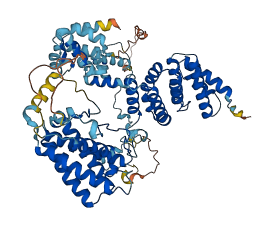
Descriptions
The autoinhibited protein was predicted that may have potential autoinhibitory elements via cis-regPred.
Autoinhibitory domains (AIDs)
Target domain |
|
Relief mechanism |
|
Assay |
cis-regPred |
Accessory elements
No accessory elements
Autoinhibited structure

Activated structure
1 structures for Q8R3N6
| Entry ID | Method | Resolution | Chain | Position | Source |
|---|---|---|---|---|---|
| AF-Q8R3N6-F1 | Predicted | AlphaFoldDB |
22 variants for Q8R3N6
| Variant ID(s) | Position | Change | Description | Diseaes Association | Provenance |
|---|---|---|---|---|---|
| rs3408130662 | 26 | N>K | No | EVA | |
| rs3389488451 | 84 | T>P | No | EVA | |
| rs3389490038 | 178 | Q>E | No | EVA | |
| rs3407872520 | 186 | V>I | No | EVA | |
| rs3389398632 | 307 | L>* | No | EVA | |
| rs3389445670 | 344 | V>I | No | EVA | |
| rs253531737 | 413 | V>L | No | EVA | |
| rs3389488416 | 430 | K>I | No | EVA | |
| rs3407265624 | 441 | L>PYYQDRDSKAL* | No | EVA | |
| rs3389488432 | 442 | W>* | No | EVA | |
| rs3389503218 | 487 | V>I | No | EVA | |
| rs3389434480 | 489 | N>K | No | EVA | |
| rs3389487597 | 503 | R>ILHTT* | No | EVA | |
| rs3389480822 | 503 | R>T | No | EVA | |
| rs3389487238 | 504 | S>R | No | EVA | |
| rs3389466369 | 574 | I>K | No | EVA | |
| rs3389498039 | 587 | I>N | No | EVA | |
| rs3389495165 | 613 | A>P | No | EVA | |
| rs3389495153 | 626 | V>F | No | EVA | |
| rs3389445655 | 634 | I>M | No | EVA | |
| rs3389487239 | 636 | A>E | No | EVA | |
| rs3389478357 | 640 | S>P | No | EVA |
No associated diseases with Q8R3N6
1 regional properties for Q8R3N6
| Type | Name | Position | InterPro Accession |
|---|---|---|---|
| domain | Death domain | 560 - 653 | IPR000488 |
Functions
8 GO annotations of cellular component
| Name | Definition |
|---|---|
| chromosome, telomeric region | The end of a linear chromosome, required for the integrity and maintenance of the end. A chromosome telomere usually includes a region of telomerase-encoded repeats the length of which rarely exceeds 20 bp each and that permits the formation of a telomeric loop (T-loop). The telomeric repeat region is usually preceded by a sub-telomeric region that is gene-poor but rich in repetitive elements. Some telomeres only consist of the latter part (for eg. D. melanogaster telomeres). |
| cytoplasm | The contents of a cell excluding the plasma membrane and nucleus, but including other subcellular structures. |
| nuclear matrix | The dense fibrillar network lying on the inner side of the nuclear membrane. |
| nuclear speck | A discrete extra-nucleolar subnuclear domain, 20-50 in number, in which splicing factors are seen to be localized by immunofluorescence microscopy. |
| nucleus | A membrane-bounded organelle of eukaryotic cells in which chromosomes are housed and replicated. In most cells, the nucleus contains all of the cell's chromosomes except the organellar chromosomes, and is the site of RNA synthesis and processing. In some species, or in specialized cell types, RNA metabolism or DNA replication may be absent. |
| THO complex | The THO complex is a nuclear complex that is required for transcription elongation through genes containing tandemly repeated DNA sequences. The THO complex is also part of the TREX (TRanscription EXport) complex that is involved in coupling transcription to export of mRNAs to the cytoplasm. In S. cerevisiae, it is composed of four subunits: Hpr1p, Tho2p, Thp1p, and Mft1p, while the human complex is composed of 7 subunits. |
| THO complex part of transcription export complex | The THO complex when it is part of the TREX (TRanscription EXport) complex that is involved in coupling transcription to export of mRNAs to the cytoplasm. In S. cerevisiae, it is composed of four subunits: Hpr1, Tho2, Thp1, and Mft1, while the human complex is composed of 7 subunits. |
| transcription export complex | The transcription export (TREX) complex couples transcription elongation by RNA polymerase II to mRNA export. The complex associates with the polymerase and travels with it along the length of the transcribed gene. TREX is composed of the THO transcription elongation complex as well as other proteins that couple THO to mRNA export proteins. The TREX complex is known to be found in a wide range of eukaryotes, including S. cerevisiae and metazoans. |
2 GO annotations of molecular function
| Name | Definition |
|---|---|
| DNA binding | Any molecular function by which a gene product interacts selectively and non-covalently with DNA (deoxyribonucleic acid). |
| RNA binding | Binding to an RNA molecule or a portion thereof. |
12 GO annotations of biological process
| Name | Definition |
|---|---|
| apoptotic process | A programmed cell death process which begins when a cell receives an internal (e.g. DNA damage) or external signal (e.g. an extracellular death ligand), and proceeds through a series of biochemical events (signaling pathway phase) which trigger an execution phase. The execution phase is the last step of an apoptotic process, and is typically characterized by rounding-up of the cell, retraction of pseudopodes, reduction of cellular volume (pyknosis), chromatin condensation, nuclear fragmentation (karyorrhexis), plasma membrane blebbing and fragmentation of the cell into apoptotic bodies. When the execution phase is completed, the cell has died. |
| mRNA export from nucleus | The directed movement of mRNA from the nucleus to the cytoplasm. |
| mRNA processing | Any process involved in the conversion of a primary mRNA transcript into one or more mature mRNA(s) prior to translation into polypeptide. |
| negative regulation of DNA damage checkpoint | Any process that stops, prevents, or reduces the frequency, rate or extent of a DNA damage checkpoint. |
| negative regulation of isotype switching to IgA isotypes | Any process that stops, prevents, or reduces the frequency, rate or extent of isotype switching to IgA isotypes. |
| positive regulation of DNA-templated transcription, elongation | Any process that activates or increases the frequency, rate or extent of transcription elongation, the extension of an RNA molecule after transcription initiation and promoter clearance by the addition of ribonucleotides catalyzed by a DNA-dependent RNA polymerase. |
| regulation of DNA recombination | Any process that modulates the frequency, rate or extent of DNA recombination, a DNA metabolic process in which a new genotype is formed by reassortment of genes resulting in gene combinations different from those that were present in the parents. |
| regulation of DNA-templated transcription elongation | Any process that modulates the frequency, rate or extent of transcription elongation, the extension of an RNA molecule after transcription initiation and promoter clearance by the addition of ribonucleotides catalyzed by a DNA-dependent RNA polymerase. |
| replication fork processing | The process in which a DNA replication fork that has stalled is restored to a functional state and replication is restarted. The stalling may be due to DNA damage, DNA secondary structure, bound proteins, dNTP shortage, or other causes. |
| RNA splicing | The process of removing sections of the primary RNA transcript to remove sequences not present in the mature form of the RNA and joining the remaining sections to form the mature form of the RNA. |
| signal transduction | The cellular process in which a signal is conveyed to trigger a change in the activity or state of a cell. Signal transduction begins with reception of a signal (e.g. a ligand binding to a receptor or receptor activation by a stimulus such as light), or for signal transduction in the absence of ligand, signal-withdrawal or the activity of a constitutively active receptor. Signal transduction ends with regulation of a downstream cellular process, e.g. regulation of transcription or regulation of a metabolic process. Signal transduction covers signaling from receptors located on the surface of the cell and signaling via molecules located within the cell. For signaling between cells, signal transduction is restricted to events at and within the receiving cell. |
| viral mRNA export from host cell nucleus | The directed movement of intronless viral mRNA from the host nucleus to the cytoplasm for translation. |
| 10 | 20 | 30 | 40 | 50 | 60 |
| MSPTPALFSL | PEARTRFTKS | TREALNNKNI | KPLLTAFSQL | PGSENEKKCT | LDQAFRGVLE |
| 70 | 80 | 90 | 100 | 110 | 120 |
| EEIINHSACE | NVLAIISLAI | GGVTESVCTA | STPFVLLGDV | LDCLPLDQCD | TIFTFVEKNV |
| 130 | 140 | 150 | 160 | 170 | 180 |
| ATWKSNTFYS | AGKNYLLRMC | NDLLRRLSKS | QNTVFCGRIQ | LFLARLFPLS | EKSGLNLQSQ |
| 190 | 200 | 210 | 220 | 230 | 240 |
| FNLENVTVFN | TNEQESTLGQ | KHTEDREEGM | DVEEGEMGDD | EAPTTCSIPI | DYNLYRKFWS |
| 250 | 260 | 270 | 280 | 290 | 300 |
| LQDYFRNPVQ | CYEKISWKTF | LKYSEEVLAV | FKSYKLDDTQ | ASRKKMEELK | TGGEHVYFAK |
| 310 | 320 | 330 | 340 | 350 | 360 |
| FLTSEKLMDL | QLSDSNFRRH | ILLQYLILFQ | YLKGQVKFKS | SNYVLTDEQS | LWIEDTTKSV |
| 370 | 380 | 390 | 400 | 410 | 420 |
| YQLLSENPPD | GERFSKMVEH | ILNTEENWNS | WKNEGCPSFV | KERASDTKPT | RVVRKRAAPE |
| 430 | 440 | 450 | 460 | 470 | 480 |
| DFLGKGPNKK | ILIGNEELTR | LWNLCPDNME | ACKSETREYM | PTLEEFFEEA | IEQADPENMV |
| 490 | 500 | 510 | 520 | 530 | 540 |
| ESEYKAVNNS | NYGWRALRLL | ARRSPHFFQP | TNQQFKSLPE | YLENMVIKLA | KELPPPSEEI |
| 550 | 560 | 570 | 580 | 590 | 600 |
| KTGEDEDEED | NDALLKENES | PDVRRDKPIT | GEQIESFANK | LGEQWKILAP | YLEIKDSDIR |
| 610 | 620 | 630 | 640 | 650 | |
| QIECDSEDMK | MRAKQLLVAW | QDQEGVHATT | DNLISALNKS | GLSDLAESLT | NDTETNS |