Q8R087
Gene name |
B4galt7 (Xgalt1) |
Protein name |
Beta-1,4-galactosyltransferase 7 |
Names |
Beta-1,4-GalTase 7, Beta4Gal-T7, b4Gal-T7, Proteoglycan UDP-galactose:beta-xylose beta1,4-galactosyltransferase I, UDP-Gal:beta-GlcNAc beta-1,4-galactosyltransferase 7, UDP-galactose:beta-N-acetylglucosamine beta-1,4-galactosyltransferase 7, UDP-galactose:beta-xylose beta-1,4-galactosyltransferase, XGPT, XGalT-1, Xylosylprotein 4-beta-galactosyltransferase, Xylosylprotein beta-1,4-galactosyltransferase |
Species |
Mus musculus (Mouse) |
KEGG Pathway |
mmu:218271 |
EC number |
2.4.1.133: Hexosyltransferases |
Protein Class |
|
Descriptions
The autoinhibited protein was predicted that may have potential autoinhibitory elements via cis-regPred.
Autoinhibitory domains (AIDs)
Target domain |
|
Relief mechanism |
|
Assay |
cis-regPred |
Accessory elements
No accessory elements
Autoinhibited structure

Activated structure
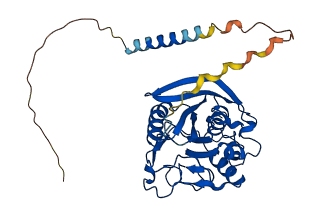
1 structures for Q8R087
| Entry ID | Method | Resolution | Chain | Position | Source |
|---|---|---|---|---|---|
| AF-Q8R087-F1 | Predicted | AlphaFoldDB |
13 variants for Q8R087
| Variant ID(s) | Position | Change | Description | Diseaes Association | Provenance |
|---|---|---|---|---|---|
| rs3389287705 | 22 | P>H | No | EVA | |
| rs3389287741 | 45 | S>F | No | EVA | |
| rs3389215111 | 62 | R>K | No | EVA | |
| rs3389253630 | 111 | F>L | No | EVA | |
| rs262157588 | 123 | R>K | No | EVA | |
| rs3389278229 | 125 | Q>K | No | EVA | |
| rs864306426 | 134 | V>A | No | EVA | |
| rs3389284755 | 187 | S>F | No | EVA | |
| rs3389301899 | 189 | E>K | No | EVA | |
| rs219779927 | 190 | L>F | No | EVA | |
| rs3389268805 | 278 | Q>H | No | EVA | |
| rs3403978876 | 292 | Y>C | No | EVA | |
| rs3389244408 | 304 | G>E | No | EVA |
No associated diseases with Q8R087
Functions
| Description | ||
|---|---|---|
| EC Number | 2.4.1.133 | Hexosyltransferases |
| Subcellular Localization |
|
|
| PANTHER Family | ||
| PANTHER Subfamily | ||
| PANTHER Protein Class | ||
| PANTHER Pathway Category | No pathway information available | |
3 GO annotations of cellular component
| Name | Definition |
|---|---|
| Golgi apparatus | A membrane-bound cytoplasmic organelle of the endomembrane system that further processes the core oligosaccharides (e.g. N-glycans) added to proteins in the endoplasmic reticulum and packages them into membrane-bound vesicles. The Golgi apparatus operates at the intersection of the secretory, lysosomal, and endocytic pathways. |
| Golgi cisterna membrane | The lipid bilayer surrounding any of the thin, flattened compartments that form the central portion of the Golgi complex. |
| integral component of membrane | The component of a membrane consisting of the gene products and protein complexes having at least some part of their peptide sequence embedded in the hydrophobic region of the membrane. |
4 GO annotations of molecular function
| Name | Definition |
|---|---|
| beta-N-acetylglucosaminylglycopeptide beta-1,4-galactosyltransferase activity | Catalysis of the reaction: UDP-galactose + N-acetyl-beta-D-glucosaminylglycopeptide = UDP + beta-D-galactosyl-(1->4)-N-acetyl-beta-D-glucosaminylglycopeptide. |
| galactosyltransferase activity | Catalysis of the transfer of a galactosyl group to an acceptor molecule, typically another carbohydrate or a lipid. |
| manganese ion binding | Binding to a manganese ion (Mn). |
| xylosylprotein 4-beta-galactosyltransferase activity | Catalysis of the reaction: UDP-galactose + O-beta-D-xylosylprotein = UDP + 4-beta-D-galactosyl-O-beta-D-xylosylprotein. |
8 GO annotations of biological process
| Name | Definition |
|---|---|
| carbohydrate metabolic process | The chemical reactions and pathways involving carbohydrates, any of a group of organic compounds based of the general formula Cx(H2O)y. |
| glycosaminoglycan biosynthetic process | The chemical reactions and pathways resulting in the formation of glycosaminoglycans, any of a group of polysaccharides that contain amino sugars. |
| glycosylation | The covalent attachment and further modification of carbohydrate residues to a substrate molecule. |
| negative regulation of fibroblast proliferation | Any process that stops, prevents, or reduces the frequency, rate or extent of multiplication or reproduction of fibroblast cells. |
| protein N-linked glycosylation | A protein glycosylation process in which a carbohydrate or carbohydrate derivative unit is added to a protein via the N4 atom of peptidyl-asparagine, the omega-N of arginine, or the N1' atom peptidyl-tryptophan. |
| proteoglycan biosynthetic process | The chemical reactions and pathways resulting in the formation of proteoglycans, any glycoprotein in which the carbohydrate units are glycosaminoglycans. |
| proteoglycan metabolic process | The chemical reactions and pathways involving proteoglycans, any glycoprotein in which the carbohydrate units are glycosaminoglycans. |
| supramolecular fiber organization | A process that is carried out at the cellular level which results in the assembly, arrangement of constituent parts, or disassembly of a supramolecular fiber, a polymer consisting of an indefinite number of protein or protein complex subunits that have polymerised to form a fiber-shaped structure. |
1 homologous proteins in AiPD
| UniProt AC | Gene Name | Protein Name | Species | Evidence Code |
|---|---|---|---|---|
| Q9UBV7 | B4GALT7 | Beta-1,4-galactosyltransferase 7 | Homo sapiens (Human) | PR |
| 10 | 20 | 30 | 40 | 50 | 60 |
| MLPSRRKAAQ | LPWEDGRARL | LPGGLRRKCS | IFHLFIAFLL | LVFFSLLWLQ | LSCSGDMAQV |
| 70 | 80 | 90 | 100 | 110 | 120 |
| TRGQGQETSG | PPRACPPEPP | PEHWEEDESW | GPHRLAVLVP | FRERFEELLV | FVPHMHRFLS |
| 130 | 140 | 150 | 160 | 170 | 180 |
| RKRIQHHIYV | LNQVDHFRFN | RAALINVGFL | ESSNSTDYIA | MHDVDLLPLN | EELDYGFPEA |
| 190 | 200 | 210 | 220 | 230 | 240 |
| GPFHVASPEL | HPLYHYKTYV | GGILLLSKQH | YQLCNGMSNR | FWGWGREDDE | FYRRIKGAGL |
| 250 | 260 | 270 | 280 | 290 | 300 |
| QLFRPSGITT | GYQTFRHLHD | PAWRKRDQKR | IAAQKQEQFK | VDREGGLNTV | KYRVDSRTAL |
| 310 | 320 | ||||
| SIGGAPCTVL | NVMLDCDKTA | TPWCIFG |