Q8R035
Gene name |
Mrpl58 |
Protein name |
Peptidyl-tRNA hydrolase ICT1, mitochondrial |
Names |
39S ribosomal protein L58, mitochondrial, MRP-L58, Immature colon carcinoma transcript 1 protein homolog |
Species |
Mus musculus (Mouse) |
KEGG Pathway |
mmu:68572 |
EC number |
3.1.1.29: Carboxylic ester hydrolases |
Protein Class |
|
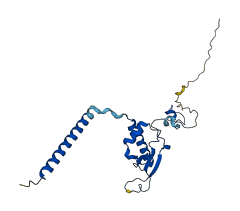
Descriptions
The autoinhibited protein was predicted that may have potential autoinhibitory elements via cis-regPred.
Autoinhibitory domains (AIDs)
Target domain |
|
Relief mechanism |
|
Assay |
cis-regPred |
Accessory elements
No accessory elements
Autoinhibited structure

Activated structure
2 structures for Q8R035
| Entry ID | Method | Resolution | Chain | Position | Source |
|---|---|---|---|---|---|
| 1J26 | NMR | - | A | 63-161 | PDB |
| AF-Q8R035-F1 | Predicted | AlphaFoldDB |
10 variants for Q8R035
| Variant ID(s) | Position | Change | Description | Diseaes Association | Provenance |
|---|---|---|---|---|---|
| rs3402715714 | 4 | A>T | No | EVA | |
| rs211712969 | 16 | T>M | No | EVA | |
| rs221404901 | 155 | R>Q | No | EVA | |
| rs3389227389 | 163 | Q>* | No | EVA | |
| rs3389220678 | 169 | S>F | No | EVA | |
| rs235912755 | 174 | R>Q | No | EVA | |
| rs3389232184 | 182 | K>* | No | EVA | |
| rs3389212383 | 192 | R>G | No | EVA | |
| rs3389212365 | 206 | D>Y | No | EVA | |
| rs3402927251 | 207 | D>E | No | EVA |
No associated diseases with Q8R035
1 regional properties for Q8R035
| Type | Name | Position | InterPro Accession |
|---|---|---|---|
| domain | Peptide chain release factor class I | 71 - 199 | IPR000352 |
Functions
| Description | ||
|---|---|---|
| EC Number | 3.1.1.29 | Carboxylic ester hydrolases |
| Subcellular Localization |
|
|
| PANTHER Family | ||
| PANTHER Subfamily | ||
| PANTHER Protein Class | ||
| PANTHER Pathway Category | No pathway information available | |
5 GO annotations of cellular component
| Name | Definition |
|---|---|
| mitochondrial inner membrane | The inner, i.e. lumen-facing, lipid bilayer of the mitochondrial envelope. It is highly folded to form cristae. |
| mitochondrial large ribosomal subunit | The larger of the two subunits of a mitochondrial ribosome. Two sites on the ribosomal large subunit are involved in translation: the aminoacyl site (A site) and peptidyl site (P site). |
| mitochondrion | A semiautonomous, self replicating organelle that occurs in varying numbers, shapes, and sizes in the cytoplasm of virtually all eukaryotic cells. It is notably the site of tissue respiration. |
| nucleoplasm | That part of the nuclear content other than the chromosomes or the nucleolus. |
| plasma membrane | The membrane surrounding a cell that separates the cell from its external environment. It consists of a phospholipid bilayer and associated proteins. |
2 GO annotations of molecular function
| Name | Definition |
|---|---|
| aminoacyl-tRNA hydrolase activity | Catalysis of the reaction: N-substituted aminoacyl-tRNA + H2O = N-substituted amino acid + tRNA. |
| translation release factor activity, codon nonspecific | A translation release factor that is not specific to particular codons; binds to guanine nucleotides. |
2 GO annotations of biological process
| Name | Definition |
|---|---|
| mitochondrial translation | The chemical reactions and pathways resulting in the formation of a protein in a mitochondrion. This is a ribosome-mediated process in which the information in messenger RNA (mRNA) is used to specify the sequence of amino acids in the protein; the mitochondrion has its own ribosomes and transfer RNAs, and uses a genetic code that differs from the nuclear code. |
| mitochondrial translational termination | The process resulting in the release of a polypeptide chain from the ribosome in a mitochondrion, usually in response to a termination codon (note that mitochondria use variants of the universal genetic code that differ between different taxa). |
1 homologous proteins in AiPD
| UniProt AC | Gene Name | Protein Name | Species | Evidence Code |
|---|---|---|---|---|
| Q14197 | MRPL58 | Peptidyl-tRNA hydrolase ICT1, mitochondrial | Homo sapiens (Human) | PR |
| 10 | 20 | 30 | 40 | 50 | 60 |
| MATAWGLRWG | LSRTGTLLLA | PPARCARRAL | HRQVDGTTFQ | SIYSLDKLYP | ESKGADTAWK |
| 70 | 80 | 90 | 100 | 110 | 120 |
| VPEHAKQASS | YIPLDRLSIS | YCRSSGPGGQ | NVNKVNSKAE | VRFHLASADW | IEEPVRQKIA |
| 130 | 140 | 150 | 160 | 170 | 180 |
| LTHKNKINKA | GELVLTSESS | RYQFRNLAEC | LQKIRDMIAE | ASQVPKEPSK | EDARLQRLRI |
| 190 | 200 | ||||
| EKMNRERLRQ | KRLNSALKTS | RRMTMD |