Q8NDF8
Gene name |
TENT4B |
Protein name |
Terminal nucleotidyltransferase 4B |
Names |
Non-canonical poly(A) RNA polymerase PAPD5, PAP-associated domain-containing protein 5, Terminal guanylyltransferase, Terminal uridylyltransferase 3, TUTase 3, Topoisomerase-related function protein 4-2, TRF4-2 |
Species |
Homo sapiens (Human) |
KEGG Pathway |
hsa:64282 |
EC number |
2.7.7.19: Nucleotidyltransferases |
Protein Class |
|
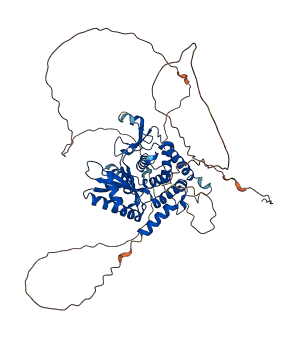
Descriptions
The autoinhibited protein was predicted that may have potential autoinhibitory elements via cis-regPred.
Autoinhibitory domains (AIDs)
Target domain |
|
Relief mechanism |
|
Assay |
cis-regPred |
Accessory elements
No accessory elements
Autoinhibited structure

Activated structure
1 structures for Q8NDF8
| Entry ID | Method | Resolution | Chain | Position | Source |
|---|---|---|---|---|---|
| AF-Q8NDF8-F1 | Predicted | AlphaFoldDB |
No variants for Q8NDF8
| Variant ID(s) | Position | Change | Description | Diseaes Association | Provenance |
|---|---|---|---|---|---|
| No variants for Q8NDF8 | |||||
No associated diseases with Q8NDF8
Functions
| Description | ||
|---|---|---|
| EC Number | 2.7.7.19 | Nucleotidyltransferases |
| Subcellular Localization |
|
|
| PANTHER Family | ||
| PANTHER Subfamily | ||
| PANTHER Protein Class | ||
| PANTHER Pathway Category | No pathway information available | |
5 GO annotations of cellular component
| Name | Definition |
|---|---|
| cytoplasm | The contents of a cell excluding the plasma membrane and nucleus, but including other subcellular structures. |
| cytosol | The part of the cytoplasm that does not contain organelles but which does contain other particulate matter, such as protein complexes. |
| nucleolus | A small, dense body one or more of which are present in the nucleus of eukaryotic cells. It is rich in RNA and protein, is not bounded by a limiting membrane, and is not seen during mitosis. Its prime function is the transcription of the nucleolar DNA into 45S ribosomal-precursor RNA, the processing of this RNA into 5.8S, 18S, and 28S components of ribosomal RNA, and the association of these components with 5S RNA and proteins synthesized outside the nucleolus. This association results in the formation of ribonucleoprotein precursors; these pass into the cytoplasm and mature into the 40S and 60S subunits of the ribosome. |
| plasma membrane | The membrane surrounding a cell that separates the cell from its external environment. It consists of a phospholipid bilayer and associated proteins. |
| TRAMP complex | A multiprotein complex having distributive polyadenylation activity of a variety of RNA substrates including hypomodified and incorrectly folded tRNAs, pre-snRNAs, pre-snoRNAs, incorrectly spliced or processed pre-mRNAs, cryptic unstable transcripts (CUTs), pre-rRNAs and rRNA fragments released as part of rRNA processing. In S. cerevisiae, the complex consists of either Pap2 (also known as Trf4) or Trf5, Air1 or Air2, and Mtr4, and is involved in RNA 3'-end processing and in RNA surveillance and quality control. |
7 GO annotations of molecular function
| Name | Definition |
|---|---|
| DNA binding | Any molecular function by which a gene product interacts selectively and non-covalently with DNA (deoxyribonucleic acid). |
| DNA-directed DNA polymerase activity | Catalysis of the reaction: deoxynucleoside triphosphate + DNA(n) = diphosphate + DNA(n+1); the synthesis of DNA from deoxyribonucleotide triphosphates in the presence of a DNA template and a 3'hydroxyl group. |
| guanylyltransferase activity | Catalysis of the transfer of a guanylyl group to an acceptor. |
| metal ion binding | Binding to a metal ion. |
| polynucleotide adenylyltransferase activity | Catalysis of the template-independent extension of the 3'- end of an RNA or DNA strand by addition of one adenosine molecule at a time. Cannot initiate a chain 'de novo'. The primer, depending on the source of the enzyme, may be an RNA or DNA fragment, or oligo(A) bearing a 3'-OH terminal group. |
| RNA binding | Binding to an RNA molecule or a portion thereof. |
| telomerase RNA binding | Binding to the telomerase RNA template. |
15 GO annotations of biological process
| Name | Definition |
|---|---|
| carbohydrate homeostasis | A homeostatic process involved in the maintenance of an internal steady state of a carbohydrate within an organism or cell. |
| cell cycle | The progression of biochemical and morphological phases and events that occur in a cell during successive cell replication or nuclear replication events. Canonically, the cell cycle comprises the replication and segregation of genetic material followed by the division of the cell, but in endocycles or syncytial cells nuclear replication or nuclear division may not be followed by cell division. |
| cell division | The process resulting in division and partitioning of components of a cell to form more cells; may or may not be accompanied by the physical separation of a cell into distinct, individually membrane-bounded daughter cells. |
| histone mRNA catabolic process | The chemical reactions and pathways resulting in the breakdown of histone messenger RNA (mRNA). |
| miRNA catabolic process | The chemical reactions and pathways resulting in the breakdown of miRNA, microRNA, a class of single-stranded RNA molecules of about 21-23 nucleotides in length, which regulates gene expression. |
| mRNA polyadenylation | The enzymatic addition of a sequence of 40-200 adenylyl residues at the 3' end of a eukaryotic mRNA primary transcript. |
| ncRNA polyadenylation | The enzymatic addition of a sequence of adenylyl residues at the 3' end of a non-coding RNA (ncRNA) molecule. In eukaryotes, substrates include nuclear non-coding RNAs such as precursors and a variety of incorrectly processed forms of snRNAs, snoRNAs, rRNAs, and tRNAs, as well as discarded RNA fragments which have been removed from ncRNA primary transcripts. Polyadenylation of precursors is often linked to termination of transcription, but polyadenylation of RNAs targeted for degradation may also occur post-transcriptionally. This polyadenylation is important both for 3'-end processing to produce mature ncRNA species and also for targeting incorrectly processed or discarded RNA molecules for degradation. |
| ncRNA polyadenylation involved in polyadenylation-dependent ncRNA catabolic process | The enzymatic addition of a sequence of adenylyl residues (polyadenylation) at the 3' end of a non-coding RNA, occurring as part of the process of polyadenylation-dependent non-coding RNA catabolism. |
| negative regulation of nuclear-transcribed mRNA poly(A) tail shortening | Any process that decreases the frequency, rate or extent of poly(A) tail shortening of a nuclear-transcribed mRNA. Poly(A) tail shortening is the decrease in length of the poly(A) tail of an mRNA from full length to an oligo(A) length. |
| negative regulation of telomere maintenance via telomerase | Any process that stops, prevents, or reduces the frequency, rate or extent of the addition of telomeric repeats by telomerase. |
| positive regulation of 3'-UTR-mediated mRNA stabilization | Any process that activates or increases the frequency, rate or extent of 3'-UTR-mediated mRNA stabilization. |
| RNA 3' uridylation | The enzymatic addition of a sequence of uridylyl residues at the 3' end of an RNA molecule. |
| RNA 3'-end processing | Any process involved in forming the mature 3' end of an RNA molecule. |
| rRNA processing | Any process involved in the conversion of a primary ribosomal RNA (rRNA) transcript into one or more mature rRNA molecules. |
| sno(s)RNA polyadenylation | The enzymatic addition of a sequence of adenylyl residues at the 3' end of snoRNA class molecule (referred to as an sRNA in Archaea). In eukaryotes, this occurs in conjunction with termination of transcription of precursor snoRNA molecules and may occur post-transcriptionally on incorrectly processed molecules targeted for degradation. |
3 homologous proteins in AiPD
| 10 | 20 | 30 | 40 | 50 | 60 |
| MYRSGERLLG | SHALPAEQRD | FLPLETTNNN | NNHHQPGAWA | RRAGSSASSP | PSASSSPHPS |
| 70 | 80 | 90 | 100 | 110 | 120 |
| AAVPAADPAD | SASGSSNKRK | RDNKASGGRA | AGGGRADGGG | VVYSGTPWKR | RNYNQGVVGL |
| 130 | 140 | 150 | 160 | 170 | 180 |
| HEEISDFYEY | MSPRPEEEKM | RMEVVNRIES | VIKELWPSAD | VQIFGSFKTG | LYLPTSDIDL |
| 190 | 200 | 210 | 220 | 230 | 240 |
| VVFGKWENLP | LWTLEEALRK | HKVADEDSVK | VLDKATVPII | KLTDSFTEVK | VDISFNVQNG |
| 250 | 260 | 270 | 280 | 290 | 300 |
| VRAADLIKDF | TKKYPVLPYL | VLVLKQFLLQ | RDLNEVFTGG | IGSYSLFLMA | VSFLQLHPRE |
| 310 | 320 | 330 | 340 | 350 | 360 |
| DACIPNTNYG | VLLIEFFELY | GRHFNYLKTG | IRIKDGGSYV | AKDEVQKNML | DGYRPSMLYI |
| 370 | 380 | 390 | 400 | 410 | 420 |
| EDPLQPGNDV | GRSSYGAMQV | KQAFDYAYVV | LSHAVSPIAK | YYPNNETESI | LGRIIRVTDE |
| 430 | 440 | 450 | 460 | 470 | 480 |
| VATYRDWISK | QWGLKNRPEP | SCNGPVSSSS | ATQSSSSDVD | SDATPCKTPK | QLLCRPSTGN |
| 490 | 500 | 510 | 520 | 530 | 540 |
| RVGSQDVSLE | SSQAVGKMQS | TQTTNTSNST | NKSQHGSARL | FRSSSKGFQG | TTQTSHGSLM |
| 550 | 560 | 570 | |||
| TNKQHQGKSN | NQYYHGKKRK | HKRDAPLSDL | CR |