Q6PB75
Gene name |
Tent4a |
Protein name |
Terminal nucleotidyltransferase 4A |
Names |
DNA polymerase sigma, Non-canonical poly(A) RNA polymerase PAPD7, PAP-associated domain-containing protein 7, TRAMP-like complex polyadenylate polymerase, Terminal guanylyltransferase |
Species |
Mus musculus (Mouse) |
KEGG Pathway |
mmu:210106 |
EC number |
2.7.7.19: Nucleotidyltransferases |
Protein Class |
|
Descriptions
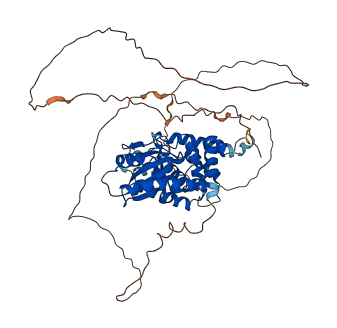
The autoinhibited protein was predicted that may have potential autoinhibitory elements via cis-regPred.
Autoinhibitory domains (AIDs)
Target domain |
|
Relief mechanism |
|
Assay |
cis-regPred |
Accessory elements
No accessory elements
Autoinhibited structure

Activated structure
1 structures for Q6PB75
| Entry ID | Method | Resolution | Chain | Position | Source |
|---|---|---|---|---|---|
| AF-Q6PB75-F1 | Predicted | AlphaFoldDB |
21 variants for Q6PB75
| Variant ID(s) | Position | Change | Description | Diseaes Association | Provenance |
|---|---|---|---|---|---|
| rs3389219931 | 2 | S>F | No | EVA | |
| rs3389218477 | 10 | M>L | No | EVA | |
| rs3389302463 | 16 | K>Q | No | EVA | |
| rs3389218471 | 58 | R>C | No | EVA | |
| rs3389302479 | 72 | N>K | No | EVA | |
| rs3389264924 | 111 | V>M | No | EVA | |
| rs3389249614 | 143 | L>M | No | EVA | |
| rs3389275891 | 162 | S>R | No | EVA | |
| rs3404322442 | 195 | N>K | No | EVA | |
| rs3404379610 | 196 | Y>* | No | EVA | |
| rs3389302465 | 236 | P>S | No | EVA | |
| rs3389264854 | 270 | R>G | No | EVA | |
| rs3389275847 | 284 | I>T | No | EVA | |
| rs3389288290 | 285 | I>N | No | EVA | |
| rs3389218453 | 294 | Y>C | No | EVA | |
| rs3389288547 | 304 | S>C | No | EVA | |
| rs3389249661 | 375 | P>R | No | EVA | |
| rs3389294086 | 383 | Y>C | No | EVA | |
| rs3389288571 | 458 | T>S | No | EVA | |
| rs3389218507 | 461 | A>T | No | EVA | |
| rs3389298104 | 489 | G>V | No | EVA |
No associated diseases with Q6PB75
Functions
| Description | ||
|---|---|---|
| EC Number | 2.7.7.19 | Nucleotidyltransferases |
| Subcellular Localization |
|
|
| PANTHER Family | ||
| PANTHER Subfamily | ||
| PANTHER Protein Class | ||
| PANTHER Pathway Category | No pathway information available | |
6 GO annotations of cellular component
| Name | Definition |
|---|---|
| Golgi apparatus | A membrane-bound cytoplasmic organelle of the endomembrane system that further processes the core oligosaccharides (e.g. N-glycans) added to proteins in the endoplasmic reticulum and packages them into membrane-bound vesicles. The Golgi apparatus operates at the intersection of the secretory, lysosomal, and endocytic pathways. |
| nuclear membrane | Either of the lipid bilayers that surround the nucleus and form the nuclear envelope; excludes the intermembrane space. |
| nucleolus | A small, dense body one or more of which are present in the nucleus of eukaryotic cells. It is rich in RNA and protein, is not bounded by a limiting membrane, and is not seen during mitosis. Its prime function is the transcription of the nucleolar DNA into 45S ribosomal-precursor RNA, the processing of this RNA into 5.8S, 18S, and 28S components of ribosomal RNA, and the association of these components with 5S RNA and proteins synthesized outside the nucleolus. This association results in the formation of ribonucleoprotein precursors; these pass into the cytoplasm and mature into the 40S and 60S subunits of the ribosome. |
| nucleoplasm | That part of the nuclear content other than the chromosomes or the nucleolus. |
| nucleus | A membrane-bounded organelle of eukaryotic cells in which chromosomes are housed and replicated. In most cells, the nucleus contains all of the cell's chromosomes except the organellar chromosomes, and is the site of RNA synthesis and processing. In some species, or in specialized cell types, RNA metabolism or DNA replication may be absent. |
| TRAMP complex | A multiprotein complex having distributive polyadenylation activity of a variety of RNA substrates including hypomodified and incorrectly folded tRNAs, pre-snRNAs, pre-snoRNAs, incorrectly spliced or processed pre-mRNAs, cryptic unstable transcripts (CUTs), pre-rRNAs and rRNA fragments released as part of rRNA processing. In S. cerevisiae, the complex consists of either Pap2 (also known as Trf4) or Trf5, Air1 or Air2, and Mtr4, and is involved in RNA 3'-end processing and in RNA surveillance and quality control. |
4 GO annotations of molecular function
| Name | Definition |
|---|---|
| ATP binding | Binding to ATP, adenosine 5'-triphosphate, a universally important coenzyme and enzyme regulator. |
| guanylyltransferase activity | Catalysis of the transfer of a guanylyl group to an acceptor. |
| metal ion binding | Binding to a metal ion. |
| polynucleotide adenylyltransferase activity | Catalysis of the template-independent extension of the 3'- end of an RNA or DNA strand by addition of one adenosine molecule at a time. Cannot initiate a chain 'de novo'. The primer, depending on the source of the enzyme, may be an RNA or DNA fragment, or oligo(A) bearing a 3'-OH terminal group. |
7 GO annotations of biological process
| Name | Definition |
|---|---|
| mRNA processing | Any process involved in the conversion of a primary mRNA transcript into one or more mature mRNA(s) prior to translation into polypeptide. |
| negative regulation of nuclear-transcribed mRNA poly(A) tail shortening | Any process that decreases the frequency, rate or extent of poly(A) tail shortening of a nuclear-transcribed mRNA. Poly(A) tail shortening is the decrease in length of the poly(A) tail of an mRNA from full length to an oligo(A) length. |
| positive regulation of 3'-UTR-mediated mRNA stabilization | Any process that activates or increases the frequency, rate or extent of 3'-UTR-mediated mRNA stabilization. |
| response to xenobiotic stimulus | Any process that results in a change in state or activity of a cell or an organism (in terms of movement, secretion, enzyme production, gene expression, etc.) as a result of a stimulus from a xenobiotic, a compound foreign to the organim exposed to it. It may be synthesized by another organism (like ampicilin) or it can be a synthetic chemical. |
| RNA 3' uridylation | The enzymatic addition of a sequence of uridylyl residues at the 3' end of an RNA molecule. |
| RNA 3'-end processing | Any process involved in forming the mature 3' end of an RNA molecule. |
| RNA polyadenylation | The enzymatic addition of a sequence of adenylyl residues at the 3' end of an RNA molecule. |
3 homologous proteins in AiPD
| 10 | 20 | 30 | 40 | 50 | 60 |
| MSPCPEEAAM | RREVVKRIET | VVKDLWPTAD | VQIFGSFSTG | LYLPTSDIDL | VVFGKWERPP |
| 70 | 80 | 90 | 100 | 110 | 120 |
| LQLLEQALRK | HNVAEPCSIK | VLDKATVPII | KLTDQETEVK | VDISFNMETG | VRAAEFIKNY |
| 130 | 140 | 150 | 160 | 170 | 180 |
| MKKYSLLPYL | ILVLKQFLLQ | RDLNEVFTGG | ISSYSLILMA | ISFLQLHPRI | DARRADENLG |
| 190 | 200 | 210 | 220 | 230 | 240 |
| MLLVEFFELY | GRNFNYLKTG | IRIKEGGAYI | AKEEIMKAMT | SGYRPSMLCI | EDPLLPGNDV |
| 250 | 260 | 270 | 280 | 290 | 300 |
| GRSSYGAMQV | KQVFDYAYIV | LSHAVSPLAR | SYPNRDSEST | LGRIIKVTQE | VIDYRRWIKE |
| 310 | 320 | 330 | 340 | 350 | 360 |
| KWGSRILPSP | DLDNRIKIKE | RITTCNGEQM | QSREPSSPYT | QRLTLSLSSP | QLLSSGSSAS |
| 370 | 380 | 390 | 400 | 410 | 420 |
| SVSSLSGSDI | DSDTPPCTTP | SVYQFSLQAP | TTLMASLPTA | LPMPSSKPQP | AASRTLIMTT |
| 430 | 440 | 450 | 460 | 470 | 480 |
| NNQTRVTIPP | PTLGVAPVPC | RQAGVDGTTS | LKAVHSVTSP | AIPSASPNPL | SSPHLYHKQH |
| 490 | 500 | 510 | 520 | 530 | 540 |
| NGMKLSMKGS | HNHTQGGGYS | SVGSGAVRPP | VGNRGHHQYN | RTGWRRKKHA | HTRDSLPVSL |
| SR |