Q8K5B1
Gene name |
Il31ra (Glmr) |
Protein name |
Interleukin-31 receptor subunit alpha |
Names |
IL-31 receptor subunit alpha, IL-31R subunit alpha, IL-31R-alpha, IL-31RA, GLM-R, mGLM-R, Gp130-like monocyte receptor, Gp130-like receptor, Novel cytokine receptor 10, NR10, ZcytoR17 |
Species |
Mus musculus (Mouse) |
KEGG Pathway |
mmu:218624 |
EC number |
|
Protein Class |
|
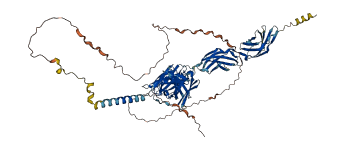
Descriptions
The autoinhibited protein was predicted that may have potential autoinhibitory elements via cis-regPred.
Autoinhibitory domains (AIDs)
Target domain |
|
Relief mechanism |
|
Assay |
cis-regPred |
Accessory elements
No accessory elements
Autoinhibited structure

Activated structure
1 structures for Q8K5B1
| Entry ID | Method | Resolution | Chain | Position | Source |
|---|---|---|---|---|---|
| AF-Q8K5B1-F1 | Predicted | AlphaFoldDB |
70 variants for Q8K5B1
| Variant ID(s) | Position | Change | Description | Diseaes Association | Provenance |
|---|---|---|---|---|---|
| rs3389311188 | 5 | A>T | No | EVA | |
| rs258801240 | 6 | L>P | No | EVA | |
| rs241017605 | 8 | A>V | No | EVA | |
| rs3389299945 | 13 | C>Y | No | EVA | |
| rs3389303877 | 29 | C>Y | No | EVA | |
| rs3389230510 | 31 | F>L | No | EVA | |
| rs3389230510 | 31 | F>V | No | EVA | |
| rs246766177 | 49 | D>G | No | EVA | |
| rs222615453 | 53 | I>T | No | EVA | |
| rs3389311245 | 65 | Y>F | No | EVA | |
| rs3389318671 | 71 | E>D | No | EVA | |
| rs3389276611 | 77 | P>S | No | EVA | |
| rs47330636 | 110 | I>T | No | EVA | |
| rs3389318661 | 124 | N>K | No | EVA | |
| rs3389305027 | 143 | G>V | No | EVA | |
| rs29586897 | 159 | H>R | No | EVA | |
| rs46716510 | 161 | T>M | No | EVA | |
| rs261865486 | 166 | E>G | No | EVA | |
| rs1132564939 | 172 | C>Y | No | EVA | |
| rs50650504 | 188 | R>Q | No | EVA | |
| rs250300407 | 205 | T>A | No | EVA | |
| rs219013212 | 206 | R>G | No | EVA | |
| rs258622379 | 207 | V>M | No | EVA | |
| rs215844471 | 253 | H>N | No | EVA | |
| rs3389286226 | 271 | T>I | No | EVA | |
| rs3389286226 | 271 | T>S | No | EVA | |
| rs226602134 | 281 | S>N | No | EVA | |
| rs3389276532 | 291 | F>L | No | EVA | |
| rs29241902 | 300 | A>T | No | EVA | |
| rs6401931 | 307 | V>A | No | EVA | |
| rs29245704 | 319 | K>Q | No | EVA | |
| rs46790817 | 321 | Y>H | No | EVA | |
| rs3389260277 | 328 | V>M | No | EVA | |
| rs3389230582 | 340 | T>S | No | EVA | |
| rs51078929 | 342 | I>V | No | EVA | |
| rs3389295926 | 349 | A>T | No | EVA | |
| rs45685981 | 366 | T>M | No | EVA | |
| rs3389311284 | 370 | I>V | No | EVA | |
| rs3389305174 | 373 | D>N | No | EVA | |
| rs245446214 | 394 | G>E | No | EVA | |
| rs3389302198 | 441 | N>S | No | EVA | |
| rs3404764569 | 450 | E>A | No | EVA | |
| rs3404748284 | 451 | G>S | No | EVA | |
| rs3404962041 | 452 | G>E | No | EVA | |
| rs3404230376 | 453 | K>N | No | EVA | |
| rs3403961987 | 453 | K>Q | No | EVA | |
| rs3389315542 | 478 | T>I | No | EVA | |
| rs3389305028 | 493 | V>M | No | EVA | |
| rs3389303921 | 546 | N>I | No | EVA | |
| rs3389318723 | 547 | P>A | No | EVA | |
| rs3389286236 | 555 | W>L | No | EVA | |
| rs29781728 | 573 | D>N | No | EVA | |
| rs46149453 | 584 | V>I | No | EVA | |
| rs249319190 | 586 | A>E | No | EVA | |
| rs3389315483 | 591 | K>T | No | EVA | |
| rs3389303880 | 596 | F>I | No | EVA | |
| rs234961765 | 604 | L>M | No | EVA | |
| rs219164869 | 610 | K>N | No | EVA | |
| rs3389276540 | 626 | S>F | No | EVA | |
| rs3389318672 | 629 | R>M | No | EVA | |
| rs3389276555 | 633 | P>S | No | EVA | |
| rs3389302227 | 635 | G>R | No | EVA | |
| rs3389303924 | 636 | K>E | No | EVA | |
| rs3389303892 | 640 | E>K | No | EVA | |
| rs29514877 | 643 | V>I | No | EVA | |
| rs46138383 | 655 | T>P | No | EVA | |
| rs256093171 | 660 | A>V | No | EVA | |
| rs47702174 | 675 | C>S | No | EVA | |
| rs246663432 | 681 | S>L | No | EVA | |
| rs3389300250 | 699 | T>A | No | EVA |
No associated diseases with Q8K5B1
4 regional properties for Q8K5B1
| Type | Name | Position | InterPro Accession |
|---|---|---|---|
| domain | Fibronectin type III | 21 - 100 | IPR003961-1 |
| domain | Fibronectin type III | 115 - 211 | IPR003961-2 |
| domain | Fibronectin type III | 325 - 394 | IPR003961-3 |
| domain | Fibronectin type III | 408 - 502 | IPR003961-4 |
6 GO annotations of cellular component
| Name | Definition |
|---|---|
| anchoring junction | A cell junction that mechanically attaches a cell (and its cytoskeleton) to neighboring cells or to the extracellular matrix. |
| axon | The long process of a neuron that conducts nerve impulses, usually away from the cell body to the terminals and varicosities, which are sites of storage and release of neurotransmitter. |
| external side of plasma membrane | The leaflet of the plasma membrane that faces away from the cytoplasm and any proteins embedded or anchored in it or attached to its surface. |
| integral component of membrane | The component of a membrane consisting of the gene products and protein complexes having at least some part of their peptide sequence embedded in the hydrophobic region of the membrane. |
| presynaptic membrane | A specialized area of membrane of the axon terminal that faces the plasma membrane of the neuron or muscle fiber with which the axon terminal establishes a synaptic junction; many synaptic junctions exhibit structural presynaptic characteristics, such as conical, electron-dense internal protrusions, that distinguish it from the remainder of the axon plasma membrane. |
| receptor complex | Any protein complex that undergoes combination with a hormone, neurotransmitter, drug or intracellular messenger to initiate a change in cell function. |
3 GO annotations of molecular function
| Name | Definition |
|---|---|
| cytokine binding | Binding to a cytokine, any of a group of proteins that function to control the survival, growth and differentiation of tissues and cells, and which have autocrine and paracrine activity. |
| cytokine receptor activity | Combining with a cytokine and transmitting the signal from one side of the membrane to the other to initiate a change in cell activity. |
| granulocyte colony-stimulating factor binding | Binding to granulocyte colony-stimulating factor, G-CSF. |
8 GO annotations of biological process
| Name | Definition |
|---|---|
| acute inflammatory response to antigenic stimulus | An acute inflammatory response to an antigenic stimulus. An acute inflammatory response occurs within a matter of minutes or hours, and either resolves within a few days or becomes a chronic inflammatory response. |
| cytokine-mediated signaling pathway | The series of molecular signals initiated by the binding of a cytokine to a receptor on the surface of a cell, and ending with the regulation of a downstream cellular process, e.g. transcription. |
| defense response to other organism | Reactions triggered in response to the presence of another organism that act to protect the cell or organism from damage caused by that organism. |
| glandular epithelial cell differentiation | The process in which a relatively unspecialized cell acquires specialized features of a glandular epithelial cell. A glandular epithelial cell is a columnar/cuboidal epithelial cell found in a two dimensional sheet with a free surface exposed to the lumen of a gland. |
| monocyte differentiation | The process in which a relatively unspecialized myeloid precursor cell acquires the specialized features of a monocyte. |
| positive regulation of cell population proliferation | Any process that activates or increases the rate or extent of cell proliferation. |
| positive regulation of tyrosine phosphorylation of STAT protein | Any process that activates or increases the frequency, rate or extent of the introduction of a phosphate group to a tyrosine residue of a STAT (Signal Transducer and Activator of Transcription) protein. |
| receptor signaling pathway via JAK-STAT | Any process in which STAT proteins (Signal Transducers and Activators of Transcription) and JAK (Janus Activated Kinase) proteins convey a signal to trigger a change in the activity or state of a cell. The receptor signaling pathway via JAK-STAT begins with activation of a receptor and proceeeds through STAT protein activation by members of the JAK family of tyrosine kinases. STAT proteins dimerize and subsequently translocate to the nucleus. The pathway ends with regulation of target gene expression by STAT proteins. |
1 homologous proteins in AiPD
| UniProt AC | Gene Name | Protein Name | Species | Evidence Code |
|---|---|---|---|---|
| Q8NI17 | IL31RA | Interleukin-31 receptor subunit alpha | Homo sapiens (Human) | PR |
| 10 | 20 | 30 | 40 | 50 | 60 |
| MWTLALWAFS | FLCKFSLAVL | PTKPENISCV | FYFDRNLTCT | WRPEKETNDT | SYIVTLTYSY |
| 70 | 80 | 90 | 100 | 110 | 120 |
| GKSNYSDNAT | EASYSFPRSC | AMPPDICSVE | VQAQNGDGKV | KSDITYWHLI | SIAKTEPPII |
| 130 | 140 | 150 | 160 | 170 | 180 |
| LSVNPICNRM | FQIQWKPREK | TRGFPLVCML | RFRTVNSSHW | TEVNFENCKQ | VCNLTGLQAF |
| 190 | 200 | 210 | 220 | 230 | 240 |
| TEYVLALRFR | FNDSRYWSKW | SKEETRVTME | EVPHVLDLWR | ILEPADMNGD | RKVRLLWKKA |
| 250 | 260 | 270 | 280 | 290 | 300 |
| RGAPVLEKTF | GYHIQYFAEN | STNLTEINNI | TTQQYELLLM | SQAHSVSVTS | FNSLGKSQEA |
| 310 | 320 | 330 | 340 | 350 | 360 |
| ILRIPDVHEK | TFQYIKSMKA | YIAEPLLVVN | WQSSIPAVDT | WIVEWLPEAA | MSKFPALSWE |
| 370 | 380 | 390 | 400 | 410 | 420 |
| SVSQVTNWTI | EQDKLKPFTC | YNISVYPVLG | HRVGEPYSIQ | AYAKEGTPLK | GPETRVENIG |
| 430 | 440 | 450 | 460 | 470 | 480 |
| LRTATITWKE | IPKSARNGFI | NNYTVFYQAE | GGKELSKTVN | SHALQCDLES | LTRRTSYTVW |
| 490 | 500 | 510 | 520 | 530 | 540 |
| VMASTRAGGT | NGVRINFKTL | SISVFEIVLL | TSLVGGGLLL | LSIKTVTFGL | RKPNRLTPLC |
| 550 | 560 | 570 | 580 | 590 | 600 |
| CPDVPNPAES | SLATWLGDGF | KKSNMKETGN | SGDTEDVVLK | PCPVPADLID | KLVVNFENFL |
| 610 | 620 | 630 | 640 | 650 | 660 |
| EVVLTEEAGK | GQASILGGEA | NEYVTSPSRP | DGPPGKSFKE | PSVLTEVASE | DSHSTCSRMA |
| 670 | 680 | 690 | 700 | 710 | |
| DEAYSELARQ | PSSSCQSPGL | SPPREDQAQN | PYLKNSVTTR | EFLVHENIPE | HSKGEV |