Q8K4D3
Gene name |
Slc36a1 |
Protein name |
Proton-coupled amino acid transporter 1 |
Names |
Proton/amino acid transporter 1, Solute carrier family 36 member 1 |
Species |
Mus musculus (Mouse) |
KEGG Pathway |
mmu:215335 |
EC number |
|
Protein Class |
|
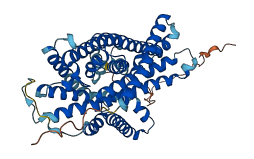
Descriptions
The autoinhibited protein was predicted that may have potential autoinhibitory elements via cis-regPred.
Autoinhibitory domains (AIDs)
Target domain |
|
Relief mechanism |
|
Assay |
cis-regPred |
Accessory elements
No accessory elements
Autoinhibited structure

Activated structure
1 structures for Q8K4D3
| Entry ID | Method | Resolution | Chain | Position | Source |
|---|---|---|---|---|---|
| AF-Q8K4D3-F1 | Predicted | AlphaFoldDB |
17 variants for Q8K4D3
| Variant ID(s) | Position | Change | Description | Diseaes Association | Provenance |
|---|---|---|---|---|---|
| rs3389121559 | 10 | D>N | No | EVA | |
| rs3389155639 | 31 | S>T | No | EVA | |
| rs3389153602 | 53 | I>F | No | EVA | |
| rs3389159115 | 58 | G>D | No | EVA | |
| rs3389167935 | 61 | G>D | No | EVA | |
| rs3410464740 | 110 | K>N | No | EVA | |
| rs26989731 | 124 | E>V | No | EVA | |
| rs3389144625 | 170 | E>K | No | EVA | |
| rs3389160437 | 175 | T>S | No | EVA | |
| rs3389157841 | 178 | N>I | No | EVA | |
| rs214490181 | 215 | V>M | No | EVA | |
| rs3389160474 | 221 | L>Q | No | EVA | |
| rs3389144669 | 254 | W>* | No | EVA | |
| rs29427203 | 289 | L>M | No | EVA | |
| rs26989698 | 298 | I>V | No | EVA | |
| rs3389159093 | 435 | K>E | No | EVA | |
| rs3389156871 | 443 | G>A | No | EVA |
No associated diseases with Q8K4D3
1 regional properties for Q8K4D3
| Type | Name | Position | InterPro Accession |
|---|---|---|---|
| domain | Amino acid transporter, transmembrane domain | 46 - 453 | IPR013057 |
Functions
5 GO annotations of cellular component
| Name | Definition |
|---|---|
| endoplasmic reticulum | The irregular network of unit membranes, visible only by electron microscopy, that occurs in the cytoplasm of many eukaryotic cells. The membranes form a complex meshwork of tubular channels, which are often expanded into slitlike cavities called cisternae. The ER takes two forms, rough (or granular), with ribosomes adhering to the outer surface, and smooth (with no ribosomes attached). |
| integral component of membrane | The component of a membrane consisting of the gene products and protein complexes having at least some part of their peptide sequence embedded in the hydrophobic region of the membrane. |
| lysosomal membrane | The lipid bilayer surrounding the lysosome and separating its contents from the cell cytoplasm. |
| lysosome | A small lytic vacuole that has cell cycle-independent morphology found in most animal cells and that contains a variety of hydrolases, most of which have their maximal activities in the pH range 5-6. The contained enzymes display latency if properly isolated. About 40 different lysosomal hydrolases are known and lysosomes have a great variety of morphologies and functions. |
| plasma membrane | The membrane surrounding a cell that separates the cell from its external environment. It consists of a phospholipid bilayer and associated proteins. |
10 GO annotations of molecular function
| Name | Definition |
|---|---|
| alanine transmembrane transporter activity | Enables the transfer of alanine from one side of a membrane to the other. Alanine is 2-aminopropanoic acid. |
| amino acid:proton symporter activity | Enables the transfer of a solute or solutes from one side of a membrane to the other according to the reaction: amino acid(out) + H+(out) = amino acid(in) + H+(in). |
| glycine transmembrane transporter activity | Enables the transfer of glycine from one side of a membrane to the other. Glycine is aminoethanoic acid. |
| L-alanine transmembrane transporter activity | Enables the transfer of L-alanine from one side of a membrane to the other. L-alanine is the L-enantiomer of 2-aminopropanoic acid. |
| L-amino acid transmembrane transporter activity | Enables the transfer of an L-amino acid from one side of a membrane to the other. L-amino acids are the L-enantiomers of amino acids. |
| L-proline transmembrane transporter activity | Enables the transfer of L-proline from one side of a membrane to the other. L-proline is pyrrolidine-2-carboxylic acid. |
| neutral amino acid transmembrane transporter activity | Enables the transfer of neutral amino acids from one side of a membrane to the other. Neutral amino acids have side chains with no charge at pH 7.3. |
| proline:proton symporter activity | Enables the transfer of a solute or solutes from one side of a membrane to the other according to the reaction: proline(out) + H+(out) = proline(in) + H+(in). |
| proton transmembrane transporter activity | Enables the transfer of a proton from one side of a membrane to the other. |
| taurine transmembrane transporter activity | Enables the transfer of taurine from one side of a membrane to the other. Taurine (2-aminoethanesulfonic acid) is a sulphur-containing amino acid derivative which is important in the metabolism of fats. |
10 GO annotations of biological process
| Name | Definition |
|---|---|
| alanine transport | The directed movement of alanine, 2-aminopropanoic acid, into, out of or within a cell, or between cells, by means of some agent such as a transporter or pore. |
| amino acid import across plasma membrane | The directed movement of an amino acid from outside of a cell, across the plasma membrane and into the cytosol. |
| amino acid transmembrane transport | The process in which an amino acid is transported across a membrane. |
| glycine transport | The directed movement of glycine, aminoethanoic acid, into, out of or within a cell, or between cells, by means of some agent such as a transporter or pore. |
| L-alanine transport | The directed movement of L-alanine, the L-enantiomer of 2-aminopropanoic acid, into, out of or within a cell, or between cells, by means of some agent such as a transporter or pore. |
| neutral amino acid transport | The directed movement of neutral amino acids, amino acids with no net charge, into, out of or within a cell, or between cells, by means of some agent such as a transporter or pore. |
| proline transmembrane transport | The directed movement of proline, pyrrolidine-2-carboxylic acid, across a membrane by means of some agent such as a transporter or pore. |
| proline transport | The directed movement of proline, pyrrolidine-2-carboxylic acid, into, out of or within a cell, or between cells, by means of some agent such as a transporter or pore. |
| proton transmembrane transport | The directed movement of a proton across a membrane. |
| taurine transport | The directed movement of taurine into, out of or within a cell, or between cells, by means of some agent such as a transporter or pore. |
| 10 | 20 | 30 | 40 | 50 | 60 |
| MSTQRLRNED | YHDYSSTDVS | PEESPSEGLG | SFSPGSYQRL | GENSSMTWFQ | TLIHLLKGNI |
| 70 | 80 | 90 | 100 | 110 | 120 |
| GTGLLGLPLA | VKNAGLLLGP | LSLLVIGIVA | VHCMGILVKC | AHHLCRRLNK | PFLDYGDTVM |
| 130 | 140 | 150 | 160 | 170 | 180 |
| YGLECSPSTW | VRNHSHWGRR | IVDFFLIVTQ | LGFCCVYFVF | LADNFKQVIE | AANGTTTNCN |
| 190 | 200 | 210 | 220 | 230 | 240 |
| NNVTVIPTPT | MDSRLYMLSF | LPFLVLLSFI | RNLRVLSIFS | LLANISMFVS | LIMIYQFIVQ |
| 250 | 260 | 270 | 280 | 290 | 300 |
| RIPDPSHLPL | VAPWKTYPLF | FGTAIFAFEG | IGVVLPLENK | MKDSQKFPLI | LYLGMAIITV |
| 310 | 320 | 330 | 340 | 350 | 360 |
| LYISLGSLGY | LQFGANIKGS | ITLNLPNCWL | YQSVKLLYSI | GIFFTYALQF | YVAAEIIIPA |
| 370 | 380 | 390 | 400 | 410 | 420 |
| IVSRVPEHFE | LMVDLCVRTA | MVCVTCVLAI | LIPRLDLVIS | LVGSVSSSAL | ALIIPPLLEV |
| 430 | 440 | 450 | 460 | 470 | |
| VTYYGEGISP | LTVTKDALIS | ILGFVGFVVG | TYESLCELIQ | PSHSDSSTNS | TSAFI |