Q8K3Y7
Gene name |
Tnfsf15 (Tl1, Vegi) |
Protein name |
Tumor necrosis factor ligand superfamily member 15 |
Names |
TNF ligand-related molecule 1, Vascular endothelial cell growth inhibitor |
Species |
Rattus norvegicus (Rat) |
KEGG Pathway |
rno:252878 |
EC number |
|
Protein Class |
|
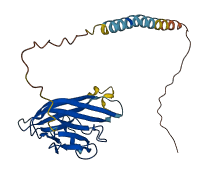
Descriptions
The autoinhibited protein was predicted that may have potential autoinhibitory elements via cis-regPred.
Autoinhibitory domains (AIDs)
Target domain |
|
Relief mechanism |
|
Assay |
cis-regPred |
Accessory elements
No accessory elements
Autoinhibited structure

Activated structure
1 structures for Q8K3Y7
| Entry ID | Method | Resolution | Chain | Position | Source |
|---|---|---|---|---|---|
| AF-Q8K3Y7-F1 | Predicted | AlphaFoldDB |
No variants for Q8K3Y7
| Variant ID(s) | Position | Change | Description | Diseaes Association | Provenance |
|---|---|---|---|---|---|
| No variants for Q8K3Y7 | |||||
No associated diseases with Q8K3Y7
1 regional properties for Q8K3Y7
| Type | Name | Position | InterPro Accession |
|---|---|---|---|
| domain | Tumour necrosis factor domain | 96 - 252 | IPR006052 |
3 GO annotations of cellular component
| Name | Definition |
|---|---|
| extracellular space | That part of a multicellular organism outside the cells proper, usually taken to be outside the plasma membranes, and occupied by fluid. |
| integral component of membrane | The component of a membrane consisting of the gene products and protein complexes having at least some part of their peptide sequence embedded in the hydrophobic region of the membrane. |
| plasma membrane | The membrane surrounding a cell that separates the cell from its external environment. It consists of a phospholipid bilayer and associated proteins. |
3 GO annotations of molecular function
| Name | Definition |
|---|---|
| cytokine activity | The activity of a soluble extracellular gene product that interacts with a receptor to effect a change in the activity of the receptor to control the survival, growth, differentiation and effector function of tissues and cells. |
| death receptor binding | Binding to a member of the death receptor (DR) family. The DR family falls within the tumor necrosis factor receptor superfamily and is characterized by a cytoplasmic region of ~80 residues termed the death domain (DD). |
| tumor necrosis factor receptor binding | Binding to a tumor necrosis factor receptor. |
5 GO annotations of biological process
| Name | Definition |
|---|---|
| activation of cysteine-type endopeptidase activity involved in apoptotic process | Any process that initiates the activity of the inactive enzyme cysteine-type endopeptidase in the context of an apoptotic process. |
| activation of NF-kappaB-inducing kinase activity | The stimulation of the activity of NF-kappaB-inducing kinase through phosphorylation at specific residues. |
| apoptotic process | A programmed cell death process which begins when a cell receives an internal (e.g. DNA damage) or external signal (e.g. an extracellular death ligand), and proceeds through a series of biochemical events (signaling pathway phase) which trigger an execution phase. The execution phase is the last step of an apoptotic process, and is typically characterized by rounding-up of the cell, retraction of pseudopodes, reduction of cellular volume (pyknosis), chromatin condensation, nuclear fragmentation (karyorrhexis), plasma membrane blebbing and fragmentation of the cell into apoptotic bodies. When the execution phase is completed, the cell has died. |
| immune response | Any immune system process that functions in the calibrated response of an organism to a potential internal or invasive threat. |
| positive regulation of cytokine production | Any process that activates or increases the frequency, rate or extent of production of a cytokine. |
1 homologous proteins in AiPD
| UniProt AC | Gene Name | Protein Name | Species | Evidence Code |
|---|---|---|---|---|
| O95150 | TNFSF15 | Tumor necrosis factor ligand superfamily member 15 | Homo sapiens (Human) | PR |
| 10 | 20 | 30 | 40 | 50 | 60 |
| MAEELGLGFG | EAVPVEMLPE | GCRHRREART | GLAARSKACL | ALTCCLLSFP | ILAGLSTLLM |
| 70 | 80 | 90 | 100 | 110 | 120 |
| TGQLRIPGKD | CMFPTVTEER | SAPSAQPVYT | PSRDKPKAHL | TIMRQTPVPH | LKNELAALHW |
| 130 | 140 | 150 | 160 | 170 | 180 |
| ENNLGMAFTK | NRMNYTNKFL | VIPESGDYFI | YSQITFRGTT | SECGDISRVR | RPKKPDSITV |
| 190 | 200 | 210 | 220 | 230 | 240 |
| VITKVADSYP | EPAHLLTGTK | SVCEISSNWF | QPIYLGAMFS | LEEGDRLMVN | VSDISLVDYT |
| 250 | |||||
| KEDKTFFGAF | LI |