Q8K2A1
Gene name |
Gulp1 (Ced6) |
Protein name |
PTB domain-containing engulfment adapter protein 1 |
Names |
Cell death protein 6 homolog, PTB domain adapter protein CED-6, Protein GULP |
Species |
Mus musculus (Mouse) |
KEGG Pathway |
mmu:70676 |
EC number |
|
Protein Class |
|
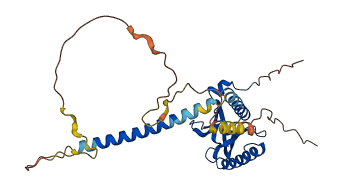
Descriptions
The autoinhibited protein was predicted that may have potential autoinhibitory elements via cis-regPred.
Autoinhibitory domains (AIDs)
Target domain |
|
Relief mechanism |
|
Assay |
cis-regPred |
Accessory elements
No accessory elements
Autoinhibited structure

Activated structure
1 structures for Q8K2A1
| Entry ID | Method | Resolution | Chain | Position | Source |
|---|---|---|---|---|---|
| AF-Q8K2A1-F1 | Predicted | AlphaFoldDB |
7 variants for Q8K2A1
| Variant ID(s) | Position | Change | Description | Diseaes Association | Provenance |
|---|---|---|---|---|---|
| rs3389916639 | 6 | S>SRKKGKNTDLAVKFSYLSFC* | No | EVA | |
| rs3389917306 | 43 | T>ASLTTSVPFGCSTSVLPRN* | No | EVA | |
| rs46365462 | 118 | S>F | No | EVA | |
| rs3388467681 | 136 | E>V | No | EVA | |
| rs3388468788 | 151 | K>* | No | EVA | |
| rs3388467660 | 151 | K>N | No | EVA | |
| rs3388468011 | 165 | Q>K | No | EVA |
No associated diseases with Q8K2A1
1 regional properties for Q8K2A1
| Type | Name | Position | InterPro Accession |
|---|---|---|---|
| domain | PTB/PI domain | 22 - 158 | IPR006020 |
1 GO annotations of cellular component
| Name | Definition |
|---|---|
| cytoplasm | The contents of a cell excluding the plasma membrane and nucleus, but including other subcellular structures. |
No GO annotations of molecular function
| Name | Definition |
|---|---|
| No GO annotations for molecular function |
3 GO annotations of biological process
| Name | Definition |
|---|---|
| apoptotic process | A programmed cell death process which begins when a cell receives an internal (e.g. DNA damage) or external signal (e.g. an extracellular death ligand), and proceeds through a series of biochemical events (signaling pathway phase) which trigger an execution phase. The execution phase is the last step of an apoptotic process, and is typically characterized by rounding-up of the cell, retraction of pseudopodes, reduction of cellular volume (pyknosis), chromatin condensation, nuclear fragmentation (karyorrhexis), plasma membrane blebbing and fragmentation of the cell into apoptotic bodies. When the execution phase is completed, the cell has died. |
| lipid transport | The directed movement of lipids into, out of or within a cell, or between cells, by means of some agent such as a transporter or pore. Lipids are compounds soluble in an organic solvent but not, or sparingly, in an aqueous solvent. |
| phagocytosis, engulfment | The internalization of bacteria, immune complexes and other particulate matter or of an apoptotic cell by phagocytosis, including the membrane and cytoskeletal processes required, which involves one of three mechanisms: zippering of pseudopods around a target via repeated receptor-ligand interactions, sinking of the target directly into plasma membrane of the phagocytosing cell, or induced uptake via an enhanced membrane ruffling of the phagocytosing cell similar to macropinocytosis. |
| 10 | 20 | 30 | 40 | 50 | 60 |
| MNRAFSRKKD | KTWMHTPEAL | SKHYIPYNAK | FLGSTEVEQP | KGTEVVRDAV | RKLKFARHIK |
| 70 | 80 | 90 | 100 | 110 | 120 |
| KSEGQKIPKV | ELQISIYGVK | ILEPKTKEVQ | HNCQLHRISF | CADDKTDKRI | FTFICKDSES |
| 130 | 140 | 150 | 160 | 170 | 180 |
| NKHLCFVFDS | EKCAEEITLT | IGQAFDLAYR | KFLESGGKDV | ETRKQIAGMQ | KRIQDLETEN |
| 190 | 200 | 210 | 220 | 230 | 240 |
| MELKNKVQDL | ESRLRTTQVS | TSPAHGVTVM | SPSTDIFDMI | PFSPISHQSP | TSARNGTQLP |
| 250 | 260 | 270 | 280 | 290 | 300 |
| PIPSRSAETK | RDLFGAEPFD | PFNCGSGDFP | PDIQSKLDEM | QEGFKMGLTL | EGTVFCLDPL |
| DSRC |