Q8K007
Gene name |
Sulf1 (Kiaa1077) |
Protein name |
Extracellular sulfatase Sulf-1 |
Names |
mSulf-1 |
Species |
Mus musculus (Mouse) |
KEGG Pathway |
mmu:240725 |
EC number |
3.1.6.1: Sulfuric ester hydrolases |
Protein Class |
|
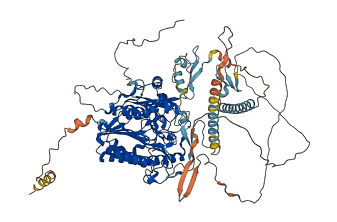
Descriptions
The autoinhibited protein was predicted that may have potential autoinhibitory elements via cis-regPred.
Autoinhibitory domains (AIDs)
Target domain |
|
Relief mechanism |
|
Assay |
cis-regPred |
Accessory elements
No accessory elements
Autoinhibited structure

Activated structure
1 structures for Q8K007
| Entry ID | Method | Resolution | Chain | Position | Source |
|---|---|---|---|---|---|
| AF-Q8K007-F1 | Predicted | AlphaFoldDB |
35 variants for Q8K007
| Variant ID(s) | Position | Change | Description | Diseaes Association | Provenance |
|---|---|---|---|---|---|
| rs3388458856 | 23 | S>P | No | EVA | |
| rs3388457916 | 29 | R>M | No | EVA | |
| rs3388457785 | 30 | F>L | No | EVA | |
| rs3388458424 | 36 | Q>R | No | EVA | |
| rs3388457877 | 42 | R>K | No | EVA | |
| rs3412825788 | 59 | S>* | No | EVA | |
| rs3388458314 | 65 | K>N | No | EVA | |
| rs3388458069 | 75 | A>T | No | EVA | |
| rs3388458663 | 79 | N>H | No | EVA | |
| rs3388457879 | 116 | S>L | No | EVA | |
| rs3388457748 | 128 | V>E | No | EVA | |
| rs3388457615 | 145 | N>I | No | EVA | |
| rs3388458248 | 146 | E>K | No | EVA | |
| rs3388457830 | 171 | Y>N | No | EVA | |
| rs3388458636 | 209 | M>K | No | EVA | |
| rs3388458442 | 236 | K>I | No | EVA | |
| rs3389634918 | 247 | P>H | No | EVA | |
| rs3388457904 | 254 | N>T | No | EVA | |
| rs3388458477 | 257 | K>E | No | EVA | |
| rs3388458695 | 305 | E>V | No | EVA | |
| rs3388458597 | 372 | A>D | No | EVA | |
| rs3388458053 | 405 | K>Q | No | EVA | |
| rs3388457851 | 437 | K>I | No | EVA | |
| rs3388457851 | 437 | K>R | No | EVA | |
| rs3388458298 | 459 | Q>* | No | EVA | |
| rs3388458622 | 500 | K>T | No | EVA | |
| rs3388457776 | 521 | Q>P | No | EVA | |
| rs229862359 | 525 | L>P | No | EVA | |
| rs3388457629 | 584 | I>F | No | EVA | |
| rs252269444 | 584 | I>S | No | EVA | |
| rs220120827 | 675 | G>S | No | EVA | |
| rs230399954 | 680 | S>R | No | EVA | |
| rs249346052 | 683 | N>D | No | EVA | |
| rs3388458488 | 732 | Q>* | No | EVA | |
| rs3388457732 | 744 | T>I | No | EVA |
No associated diseases with Q8K007
1 regional properties for Q8K007
| Type | Name | Position | InterPro Accession |
|---|---|---|---|
| binding_site | EF-Hand 1, calcium-binding site | 20 - 32 | IPR018247 |
Functions
| Description | ||
|---|---|---|
| EC Number | 3.1.6.1 | Sulfuric ester hydrolases |
| Subcellular Localization |
|
|
| PANTHER Family | ||
| PANTHER Subfamily | ||
| PANTHER Protein Class | ||
| PANTHER Pathway Category | No pathway information available | |
7 GO annotations of cellular component
| Name | Definition |
|---|---|
| cell surface | The external part of the cell wall and/or plasma membrane. |
| endoplasmic reticulum | The irregular network of unit membranes, visible only by electron microscopy, that occurs in the cytoplasm of many eukaryotic cells. The membranes form a complex meshwork of tubular channels, which are often expanded into slitlike cavities called cisternae. The ER takes two forms, rough (or granular), with ribosomes adhering to the outer surface, and smooth (with no ribosomes attached). |
| extracellular space | That part of a multicellular organism outside the cells proper, usually taken to be outside the plasma membranes, and occupied by fluid. |
| Golgi apparatus | A membrane-bound cytoplasmic organelle of the endomembrane system that further processes the core oligosaccharides (e.g. N-glycans) added to proteins in the endoplasmic reticulum and packages them into membrane-bound vesicles. The Golgi apparatus operates at the intersection of the secretory, lysosomal, and endocytic pathways. |
| Golgi stack | The set of thin, flattened membrane-bounded compartments, called cisternae, that form the central portion of the Golgi complex. The stack usually comprises cis, medial, and trans cisternae; the cis- and trans-Golgi networks are not considered part of the stack. |
| membrane raft | Any of the small (10-200 nm), heterogeneous, highly dynamic, sterol- and sphingolipid-enriched membrane domains that compartmentalize cellular processes. Small rafts can sometimes be stabilized to form larger platforms through protein-protein and protein-lipid interactions. |
| plasma membrane | The membrane surrounding a cell that separates the cell from its external environment. It consists of a phospholipid bilayer and associated proteins. |
4 GO annotations of molecular function
| Name | Definition |
|---|---|
| arylsulfatase activity | Catalysis of the reaction: a phenol sulfate + H2O = a phenol + sulfate. |
| calcium ion binding | Binding to a calcium ion (Ca2+). |
| glycosaminoglycan binding | Binding to a glycan (polysaccharide) containing a substantial proportion of aminomonosaccharide residues. |
| N-acetylglucosamine-6-sulfatase activity | Catalysis of the hydrolysis of the 6-sulfate group of the N-acetyl-D-glucosamine 6-sulfate units of heparan sulfate and keratan sulfate. |
27 GO annotations of biological process
| Name | Definition |
|---|---|
| apoptotic process | A programmed cell death process which begins when a cell receives an internal (e.g. DNA damage) or external signal (e.g. an extracellular death ligand), and proceeds through a series of biochemical events (signaling pathway phase) which trigger an execution phase. The execution phase is the last step of an apoptotic process, and is typically characterized by rounding-up of the cell, retraction of pseudopodes, reduction of cellular volume (pyknosis), chromatin condensation, nuclear fragmentation (karyorrhexis), plasma membrane blebbing and fragmentation of the cell into apoptotic bodies. When the execution phase is completed, the cell has died. |
| bone development | The process whose specific outcome is the progression of bone over time, from its formation to the mature structure. Bone is the hard skeletal connective tissue consisting of both mineral and cellular components. |
| cartilage condensation | The condensation of mesenchymal cells that have been committed to differentiate into chondrocytes. |
| cartilage development | The process whose specific outcome is the progression of a cartilage element over time, from its formation to the mature structure. Cartilage elements are skeletal elements that consist of connective tissue dominated by extracellular matrix containing collagen type II and large amounts of proteoglycan, particularly chondroitin sulfate. |
| cell adhesion | The attachment of a cell, either to another cell or to an underlying substrate such as the extracellular matrix, via cell adhesion molecules. |
| chondrocyte development | The process whose specific outcome is the progression of a chondrocyte over time, from its commitment to its mature state. Chondrocyte development does not include the steps involved in committing a chondroblast to a chondrocyte fate. |
| embryonic skeletal system development | The process, occurring during the embryonic phase, whose specific outcome is the progression of the skeleton over time, from its formation to the mature structure. |
| esophagus smooth muscle contraction | A process in which force is generated within smooth muscle tissue, resulting in a change in muscle geometry. This process occurs in the esophagus. Force generation involves a chemo-mechanical energy conversion step that is carried out by the actin/myosin complex activity, which generates force through ATP hydrolysis. The esophagus is the muscular membranous segment between the pharynx and the stomach in the upper gastrointestinal tract. |
| glial cell-derived neurotrophic factor receptor signaling pathway | The series of molecular signals initiated by a ligand binding to a glial cell-derived neurotrophic factor receptor. |
| glomerular basement membrane development | The process whose specific outcome is the progression of the glomerular basement membrane over time, from its formation to the mature structure. The glomerular basement membrane is the basal laminal portion of the glomerulus which performs the actual filtration. |
| glomerular filtration | The process in which plasma is filtered through the glomerular membrane which consists of capillary endothelial cells, the basement membrane, and epithelial cells. The glomerular filtrate is the same as plasma except it has no significant amount of protein. |
| heparan sulfate proteoglycan metabolic process | The chemical reactions and pathways involving any proteoglycan containing heparan sulfate, any member of a group of glycosaminoglycans that have repeat units consisting of alternating alpha-(1->4)-linked hexuronic acid and glucosamine residues, the former being a mixture of sulfated and nonsulfated D-glucuronic and L-iduronic acids, and the latter being either sulfated or acetylated on its amino group as well as sulfated on one of its hydroxyl groups. |
| innervation | The process in which a nerve invades a tissue and makes functional synaptic connection within the tissue. |
| kidney development | The process whose specific outcome is the progression of the kidney over time, from its formation to the mature structure. The kidney is an organ that filters the blood and/or excretes the end products of body metabolism in the form of urine. |
| limb joint morphogenesis | The process in which the anatomical structures of a limb joint are generated and organized. A limb joint is a flexible region that separates the rigid sections of a limb to allow movement in a controlled manner. |
| negative regulation of angiogenesis | Any process that stops, prevents, or reduces the frequency, rate or extent of angiogenesis. |
| negative regulation of cell migration | Any process that stops, prevents, or reduces the frequency, rate or extent of cell migration. |
| negative regulation of endothelial cell proliferation | Any process that stops, prevents, or reduces the rate or extent of endothelial cell proliferation. |
| negative regulation of fibroblast growth factor receptor signaling pathway | Any process that stops, prevents, or reduces the frequency, rate or extent of fibroblast growth factor receptor signaling pathway activity. |
| negative regulation of prostatic bud formation | Any process that decreases the rate, frequency, or extent of prostatic bud formation, the morphogenetic process in which a region of the fetal urogenital sinus epithelium is specified to become the prostate, resulting in prostate bud outgrowth. |
| positive regulation of BMP signaling pathway | Any process that activates or increases the frequency, rate or extent of BMP signaling pathway activity. |
| positive regulation of smooth muscle cell proliferation | Any process that activates or increases the rate or extent of smooth muscle cell proliferation. |
| positive regulation of vascular endothelial growth factor production | Any process that increases or activates the frequency, rate, or extent of production of vascular endothelial growth factor. |
| positive regulation of Wnt signaling pathway | Any process that activates or increases the frequency, rate or extent of Wnt signal transduction. |
| regulation of fibroblast growth factor receptor signaling pathway | Any process that modulates the frequency, rate or extent of fibroblast growth factor receptor signaling pathway activity. |
| sulfur compound metabolic process | The chemical reactions and pathways involving the nonmetallic element sulfur or compounds that contain sulfur, such as the amino acids methionine and cysteine or the tripeptide glutathione. |
| vascular endothelial growth factor receptor signaling pathway | The series of molecular signals initiated by a ligand binding to a vascular endothelial growth factor receptor (VEGFR) on the surface of the target cell, and ending with the regulation of a downstream cellular process, e.g. transcription. |
1 homologous proteins in AiPD
| UniProt AC | Gene Name | Protein Name | Species | Evidence Code |
|---|---|---|---|---|
| Q148F3 | ARSK | Arylsulfatase K | Bos taurus (Bovine) | PR |
| 10 | 20 | 30 | 40 | 50 | 60 |
| MKYSLWALLL | AVLGTQLLGS | LCSTVRSQRF | RGRIQQERKN | IRPNIILVLT | DDQDVELGSL |
| 70 | 80 | 90 | 100 | 110 | 120 |
| QVMNKTRKIM | EQGGATFTNA | FVTTPMCCPS | RSSMLTGKYV | HNHNVYTNNE | NCSSPSWQAM |
| 130 | 140 | 150 | 160 | 170 | 180 |
| HEPRTFAVYL | NNTGYRTAFF | GKYLNEYNGS | YIPPGWREWL | GLIKNSRFYN | YTVCRNGIKE |
| 190 | 200 | 210 | 220 | 230 | 240 |
| KHGFDYAKDY | FTDLITNESI | NYFKMSKRMY | PHRPIMMVIS | HAAPHGPEDS | APQFSKLYPN |
| 250 | 260 | 270 | 280 | 290 | 300 |
| ASQHITPSYN | YAPNMDKHWI | MQYTGPMLPI | HMEFTNVLQR | KRLQTLMSVD | DSVERLYNML |
| 310 | 320 | 330 | 340 | 350 | 360 |
| VESGELDNTY | IIYTADHGYH | IGQFGLVKGK | SMPYDFDIRV | PFFIRGPSIE | PGSIVPQIVL |
| 370 | 380 | 390 | 400 | 410 | 420 |
| NIDLAPTILD | IAGLDSPSDV | DGKSVLKLLD | LEKPGNRFRT | NKKAKIWRDT | FLVERGKFLR |
| 430 | 440 | 450 | 460 | 470 | 480 |
| KKEESGKNIQ | QSNHLPKYER | VKELCQQARY | QTACEQPGQN | WQCIEDTSGK | LRIHKCKGPS |
| 490 | 500 | 510 | 520 | 530 | 540 |
| DLLTVRQNAR | NLYSRGLHDK | DKECHCRDSG | YRSSRSQRKN | QRQFLRNKGT | PKYKPRFVHT |
| 550 | 560 | 570 | 580 | 590 | 600 |
| RQTRSLSVEF | EGEIYDINLE | EEELQVLPPR | SIAKRHDEGH | QGFIGHQAAA | GDIRNEMLAD |
| 610 | 620 | 630 | 640 | 650 | 660 |
| SNNAVGLPAT | VRVTHKCFIL | PNDTIHCERE | LYQSARAWKD | HKAYIDKEIE | VLQDKIKNLR |
| 670 | 680 | 690 | 700 | 710 | 720 |
| EVRGHLKKRK | PEECGCGDQS | YYNKEKGVKR | QEKLKSHLHP | FKEAAAQEVD | SKLQLFKEHR |
| 730 | 740 | 750 | 760 | 770 | 780 |
| RRKKERKEKK | RQRKGEECSL | PGLTCFTHDN | NHWQTAPFWN | LGSFCACTSS | NNNTYWCLRT |
| 790 | 800 | 810 | 820 | 830 | 840 |
| VNETHNFLFC | EFATGFLEYF | DMNTDPYQLT | NTVHTVERSI | LNQLHIQLME | LRSCQGYKQC |
| 850 | 860 | ||||
| NPRPKSLDIG | AKEGGNYDPH | RGQLWDGWEG |