Q8CIZ5
Gene name |
Dmbt1 |
Protein name |
Deleted in malignant brain tumors 1 protein |
Names |
Ebnerin, Hensin, Pancrin |
Species |
Rattus norvegicus (Rat) |
KEGG Pathway |
rno:170568 |
EC number |
|
Protein Class |
|
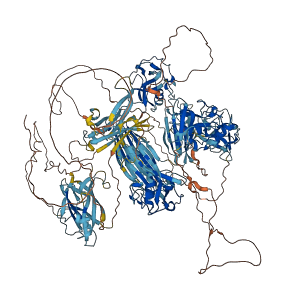
Descriptions
The autoinhibited protein was predicted that may have potential autoinhibitory elements via cis-regPred.
Autoinhibitory domains (AIDs)
Target domain |
|
Relief mechanism |
|
Assay |
cis-regPred |
Accessory elements
No accessory elements
Autoinhibited structure

Activated structure
1 structures for Q8CIZ5
| Entry ID | Method | Resolution | Chain | Position | Source |
|---|---|---|---|---|---|
| AF-Q8CIZ5-F1 | Predicted | AlphaFoldDB |
No variants for Q8CIZ5
| Variant ID(s) | Position | Change | Description | Diseaes Association | Provenance |
|---|---|---|---|---|---|
| No variants for Q8CIZ5 | |||||
No associated diseases with Q8CIZ5
1 regional properties for Q8CIZ5
| Type | Name | Position | InterPro Accession |
|---|---|---|---|
| domain | Heparinase II, N-terminal | 150 - 314 | IPR032518 |
Functions
9 GO annotations of cellular component
| Name | Definition |
|---|---|
| collagen-containing extracellular matrix | An extracellular matrix consisting mainly of proteins (especially collagen) and glycosaminoglycans (mostly as proteoglycans) that provides not only essential physical scaffolding for the cellular constituents but can also initiate crucial biochemical and biomechanical cues required for tissue morphogenesis, differentiation and homeostasis. The components are secreted by cells in the vicinity and form a sheet underlying or overlying cells such as endothelial and epithelial cells. |
| cytoplasm | The contents of a cell excluding the plasma membrane and nucleus, but including other subcellular structures. |
| extracellular matrix | A structure lying external to one or more cells, which provides structural support, biochemical or biomechanical cues for cells or tissues. |
| extracellular space | That part of a multicellular organism outside the cells proper, usually taken to be outside the plasma membranes, and occupied by fluid. |
| extrinsic component of membrane | The component of a membrane consisting of gene products and protein complexes that are loosely bound to one of its surfaces, but not integrated into the hydrophobic region. |
| integral component of membrane | The component of a membrane consisting of the gene products and protein complexes having at least some part of their peptide sequence embedded in the hydrophobic region of the membrane. |
| phagocytic vesicle membrane | The lipid bilayer surrounding a phagocytic vesicle. |
| transport vesicle membrane | The lipid bilayer surrounding a transport vesicle. |
| zymogen granule membrane | The lipid bilayer surrounding a zymogen granule. |
3 GO annotations of molecular function
| Name | Definition |
|---|---|
| extracellular matrix binding | Binding to a component of the extracellular matrix. |
| scavenger receptor activity | Combining with any modified low-density lipoprotein (LDL) or other polyanionic ligand and delivering the ligand into the cell via endocytosis. Ligands include acetylated and oxidized LDL, Gram-positive and Gram-negative bacteria, apoptotic cells, amyloid-beta fibrils, and advanced glycation end products (AGEs). |
| zymogen binding | Binding to a zymogen, an enzymatically inactive precursor of an enzyme that is often convertible to an active enzyme by proteolysis. |
15 GO annotations of biological process
| Name | Definition |
|---|---|
| blastocyst development | The process whose specific outcome is the progression of the blastocyst over time, from its formation to the mature structure. The mammalian blastocyst is a hollow ball of cells containing two cell types, the inner cell mass and the trophectoderm. |
| cell differentiation | The process in which relatively unspecialized cells, e.g. embryonic or regenerative cells, acquire specialized structural and/or functional features that characterize the cells, tissues, or organs of the mature organism or some other relatively stable phase of the organism's life history. Differentiation includes the processes involved in commitment of a cell to a specific fate and its subsequent development to the mature state. |
| columnar/cuboidal epithelial cell differentiation | The process in which a relatively unspecialized cell acquires specialized features of a columnar/cuboidal epithelial cell. A columnar/cuboidal epithelial cell is a cell usually found in a two dimensional sheet with a free surface. Columnar/cuboidal epithelial cells take on the shape of a column or cube. |
| defense response | Reactions, triggered in response to the presence of a foreign body or the occurrence of an injury, which result in restriction of damage to the organism attacked or prevention/recovery from the infection caused by the attack. |
| defense response to Gram-negative bacterium | Reactions triggered in response to the presence of a Gram-negative bacterium that act to protect the cell or organism. |
| defense response to Gram-positive bacterium | Reactions triggered in response to the presence of a Gram-positive bacterium that act to protect the cell or organism. |
| detection of bacterial lipoprotein | The series of events in which a bacterial lipoprotein stimulus is received by a cell and converted into a molecular signal. Bacterial lipoproteins are lipoproteins characterized by the presence of conserved sequence motifs called pathogen-associated molecular patterns (PAMPs). |
| inner cell mass cell proliferation | The proliferation of cells in the inner cell mass. |
| positive regulation of epithelial cell differentiation | Any process that activates or increases the frequency, rate or extent of epithelial cell differentiation. |
| protein transport | The directed movement of proteins into, out of or within a cell, or between cells, by means of some agent such as a transporter or pore. |
| response to bacterium | Any process that results in a change in state or activity of a cell or an organism (in terms of movement, secretion, enzyme production, gene expression, etc.) as a result of a stimulus from a bacterium. |
| response to estrogen | Any process that results in a change in state or activity of a cell or an organism (in terms of movement, secretion, enzyme production, gene expression, etc.) as a result of stimulus by an estrogen, C18 steroid hormones that can stimulate the development of female sexual characteristics. |
| response to organic substance | Any process that results in a change in state or activity of a cell or an organism (in terms of movement, secretion, enzyme production, gene expression, etc.) as a result of an organic substance stimulus. |
| response to wounding | Any process that results in a change in state or activity of a cell or an organism (in terms of movement, secretion, enzyme production, gene expression, etc.) as a result of a stimulus indicating damage to the organism. |
| tissue regeneration | The regrowth of lost or destroyed tissues. |
| 10 | 20 | 30 | 40 | 50 | 60 |
| MGISIVIFEI | CLLWGQILST | ASQSRSSTPD | WWNHGGTIND | VIYDTQETPE | VTTTQVPDST |
| 70 | 80 | 90 | 100 | 110 | 120 |
| SIGTDSGLAV | RLVNGGDRCR | GRVEILYQGS | WGTMCDDGTD | SGLAVRLVNG | GDRCRGRVEI |
| 130 | 140 | 150 | 160 | 170 | 180 |
| LYQGSWGTMC | DDSWDINDAN | VVCRQLGCGW | ALSAPGSAQF | GQGLGPIVLD | DVACRGHEAY |
| 190 | 200 | 210 | 220 | 230 | 240 |
| LWSCSHRGWL | SHNCGHQEDA | GVICSDSQTS | SPTPGWWNPG | GTNNDVIYDT | QETTETSQTS |
| 250 | 260 | 270 | 280 | 290 | 300 |
| SPTPDWWNHG | GTINDVIYDT | QETTEGTDSG | LAVRLVNGGD | RCRGRVEILY | QGSWGTVCDD |
| 310 | 320 | 330 | 340 | 350 | 360 |
| SWDINDANVV | CRQLGCGWAL | SAPGSAQFGQ | GSGSIVLDDV | ACRGHEAYLW | SCSHRGWLSH |
| 370 | 380 | 390 | 400 | 410 | 420 |
| NCGHQEDAGV | ICSYSQTSSP | TPDSQTSSPT | PGWWNPGGTN | NDVSYGPEQT | TDATDSGLAV |
| 430 | 440 | 450 | 460 | 470 | 480 |
| RLVNGGDRCQ | GRVEILYQGS | WGTVCDDSWD | TKDANVVCRQ | LVCGWALSAP | GSAHFGQGSG |
| 490 | 500 | 510 | 520 | 530 | 540 |
| SIVLDDVACT | GHEAYLWSCS | HRGWLSHNCG | HHEDAGVICS | DAQTQSTTWP | DMWPTTTPET |
| 550 | 560 | 570 | 580 | 590 | 600 |
| TTDWWTTKYS | SSVPTTQFPT | IADWWTTPSP | EYTCGGLLTL | PYGQFSSPYY | PGSYPNNARC |
| 610 | 620 | 630 | 640 | 650 | 660 |
| LWKIFVSSMN | RVTVVFTDVQ | LEGGCNYDYI | LVFDGPENNS | SLIARVCDGF | NGSFTSTQNF |
| 670 | 680 | 690 | 700 | 710 | 720 |
| MSVVFITDGS | VTRRGFQADY | YSTPISTSTT | SPTTFPIVTD | WWTTPSPEYT | CGGLLTLPYG |
| 730 | 740 | 750 | 760 | 770 | 780 |
| QFSSPYYPGS | YPNNARCLWK | IFVPSMNRVT | VVFTDVQLEG | GCNYDYILGF | DGPEYNSSLI |
| 790 | 800 | 810 | 820 | 830 | 840 |
| ARVCDGSNGS | FTSTQNFMSV | VFITDGSVTR | RGFQADYYST | PIRTSTTPPT | TFPIITGNDS |
| 850 | 860 | 870 | 880 | 890 | 900 |
| SLVLRLVNGT | NRCEGRVEIL | YRGSWVPCAD | DSWDINDANV | VCRQLGCGSA | LSAPGNAWFG |
| 910 | 920 | 930 | 940 | 950 | 960 |
| QGSGLIVLDD | VSCSGYESHL | WNCRHPGWLV | HNCRHVEDAG | VICSLPDPTP | SPGPVWTSPP |
| 970 | 980 | 990 | 1000 | 1010 | 1020 |
| FVNYTCGGFL | TGLSGQFSSP | YYPGSYPNNA | RCLWNIEVPN | NYRVTVVFRD | VQLEGGCNYD |
| 1030 | 1040 | 1050 | 1060 | 1070 | 1080 |
| YIEIFDGPHH | SSPLIARVCD | GAMGSFTSTS | NFMSVRFTTD | HSVTRRGFRA | DYYSDFDNNT |
| 1090 | 1100 | 1110 | 1120 | 1130 | 1140 |
| TNLLCLSNHM | RASVSRSYLQ | SMGYSSRDLV | IPGWNVSYQC | QPQITQREVI | FTIPYTGCGT |
| 1150 | 1160 | 1170 | 1180 | 1190 | 1200 |
| TKQADNETIN | YSNFLKAAVS | NGIIKRRKDL | HIHVSCKMLQ | NTWVNTMYIT | NNTVEIQEVQ |
| 1210 | 1220 | 1230 | 1240 | 1250 | 1260 |
| YGNFDVNISF | YTSSSFLYPV | TSSPYYVDLD | QNLYLQAEVL | HSDTSLALFV | DTCVASPHPN |
| 1270 | 1280 | 1290 | 1300 | 1310 | 1320 |
| DFSSLTYDLI | RSGCIRDETY | QSYSSPSPRI | TRFKFSSFHF | LNRFPSVYLQ | CKLVVCRAND |
| 1330 | 1340 | 1350 | 1360 | 1370 | 1380 |
| VSSRCYRGCV | VRSKRDVGSY | QEKVDVVLGP | IQLQSPSKEK | RSLDLAVADV | EKPASSQEVY |
| 1390 | 1400 | 1410 | |||
| PTAAIFGGVF | LALVVAVAAF | TLGRKTRTAR | GQPPSTKM |