Q8CI59
Gene name |
Steap3 (Tsap6) |
Protein name |
Metalloreductase STEAP3 |
Names |
Dudulin-2, Protein nm1054, Six-transmembrane epithelial antigen of prostate 3, Tumor suppressor-activated pathway protein 6 |
Species |
Mus musculus (Mouse) |
KEGG Pathway |
mmu:68428 |
EC number |
|
Protein Class |
|
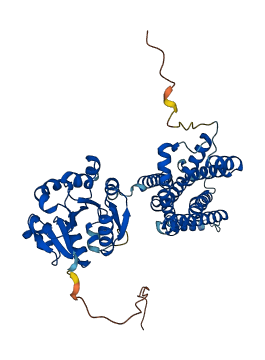
Descriptions
The autoinhibited protein was predicted that may have potential autoinhibitory elements via cis-regPred.
Autoinhibitory domains (AIDs)
Target domain |
|
Relief mechanism |
|
Assay |
cis-regPred |
Accessory elements
No accessory elements
Autoinhibited structure

Activated structure
1 structures for Q8CI59
| Entry ID | Method | Resolution | Chain | Position | Source |
|---|---|---|---|---|---|
| AF-Q8CI59-F1 | Predicted | AlphaFoldDB |
No variants for Q8CI59
| Variant ID(s) | Position | Change | Description | Diseaes Association | Provenance |
|---|---|---|---|---|---|
| No variants for Q8CI59 | |||||
No associated diseases with Q8CI59
6 GO annotations of cellular component
| Name | Definition |
|---|---|
| cytoplasm | The contents of a cell excluding the plasma membrane and nucleus, but including other subcellular structures. |
| endosome | A vacuole to which materials ingested by endocytosis are delivered. |
| endosome membrane | The lipid bilayer surrounding an endosome. |
| integral component of membrane | The component of a membrane consisting of the gene products and protein complexes having at least some part of their peptide sequence embedded in the hydrophobic region of the membrane. |
| multivesicular body | A type of endosome in which regions of the limiting endosomal membrane invaginate to form internal vesicles; membrane proteins that enter the internal vesicles are sequestered from the cytoplasm. |
| plasma membrane | The membrane surrounding a cell that separates the cell from its external environment. It consists of a phospholipid bilayer and associated proteins. |
5 GO annotations of molecular function
| Name | Definition |
|---|---|
| cupric reductase activity | Catalysis of the reaction: Cu+ + NAD+ + H+ = Cu2+ + NADH. |
| ferric-chelate reductase (NADPH) activity | Catalysis of the reaction: 2 Fe3+-siderophore + NADP(+) + H(+) -> 2 Fe2+-siderophore + NADPH. |
| ferric-chelate reductase activity | Catalysis of the reaction: 2 Fe3+-siderophore + electron donor -> 2 Fe3+-siderophore + electron acceptor. |
| identical protein binding | Binding to an identical protein or proteins. |
| metal ion binding | Binding to a metal ion. |
11 GO annotations of biological process
| Name | Definition |
|---|---|
| apoptotic process | A programmed cell death process which begins when a cell receives an internal (e.g. DNA damage) or external signal (e.g. an extracellular death ligand), and proceeds through a series of biochemical events (signaling pathway phase) which trigger an execution phase. The execution phase is the last step of an apoptotic process, and is typically characterized by rounding-up of the cell, retraction of pseudopodes, reduction of cellular volume (pyknosis), chromatin condensation, nuclear fragmentation (karyorrhexis), plasma membrane blebbing and fragmentation of the cell into apoptotic bodies. When the execution phase is completed, the cell has died. |
| cell cycle | The progression of biochemical and morphological phases and events that occur in a cell during successive cell replication or nuclear replication events. Canonically, the cell cycle comprises the replication and segregation of genetic material followed by the division of the cell, but in endocycles or syncytial cells nuclear replication or nuclear division may not be followed by cell division. |
| copper ion import | The directed movement of copper ions into a cell or organelle. |
| establishment of localization in cell | Any process, occuring in a cell, that localizes a substance or cellular component. This may occur via movement, tethering or selective degradation. |
| exosomal secretion | The process whereby a membrane-bounded vesicle is released into the extracellular region by fusion of the limiting endosomal membrane of a multivesicular body with the plasma membrane. |
| iron import into cell | The directed movement of iron ions from outside of a cell into the cytoplasmic compartment. This may occur via transport across the plasma membrane or via endocytosis. |
| iron ion import across cell outer membrane | The directed movement of iron ions from outside of a cell, across the cell outer membrane and into the periplasmic space. |
| iron ion transport | The directed movement of iron (Fe) ions into, out of or within a cell, or between cells, by means of some agent such as a transporter or pore. |
| positive regulation of apoptotic process | Any process that activates or increases the frequency, rate or extent of cell death by apoptotic process. |
| positive regulation of intrinsic apoptotic signaling pathway in response to DNA damage by p53 class mediator | Any process that activates or increases the frequency, rate or extent of intrinsic apoptotic signaling pathway in response to DNA damage by p53 class mediator. |
| protein secretion | The controlled release of proteins from a cell. |
| 10 | 20 | 30 | 40 | 50 | 60 |
| MSGEMDKPLI | SRRLVDSDGS | LAEVPKEAPK | VGILGSGDFA | RSLATRLVGS | GFSVVVGSRN |
| 70 | 80 | 90 | 100 | 110 | 120 |
| PKRTAGLFPS | LAQVTFQEEA | VSSPEVIFVA | VFREHYSSLC | SLADQLAGKI | LVDVSNPTEK |
| 130 | 140 | 150 | 160 | 170 | 180 |
| EHLQHRQSNA | EYLASLFPAC | TVVKAFNVIS | AWALQAGPRD | GNRQVLICSD | QPEAKRTISE |
| 190 | 200 | 210 | 220 | 230 | 240 |
| MARAMGFTPL | DMGSLASARE | VEAIPLRLLP | SWKVPTLLAL | GLFVCFYTYN | FIRDVLQPYI |
| 250 | 260 | 270 | 280 | 290 | 300 |
| RKDENKFYKM | PLSVVNTTLP | CVAYVLLSLV | YLPGVLAAAL | QLRRGTKYQR | FPDWLDHWLQ |
| 310 | 320 | 330 | 340 | 350 | 360 |
| HRKQIGLLSF | FFAMLHALYS | FCLPLRRSHR | YDLVNLAVKQ | VLANKSRLWV | EEEVWRMEIY |
| 370 | 380 | 390 | 400 | 410 | 420 |
| LSLGVLALGM | LSLLAVTSLP | SIANSLNWKE | FSFVQSTLGF | VALILSTMHT | LTYGWTRAFE |
| 430 | 440 | 450 | 460 | 470 | 480 |
| ENHYKFYLPP | TFTLTLLLPC | VIILAKGLFL | LPCLSRRLTK | IRRGWEKDGA | VKFMLPGDHT |
| QGEKTSHV |