Q8C5S7
Gene name |
Rec8 (Mei8, Rec8L1) |
Protein name |
Meiotic recombination protein REC8 homolog |
Names |
Cohesin Rec8p |
Species |
Mus musculus (Mouse) |
KEGG Pathway |
mmu:56739 |
EC number |
|
Protein Class |
|
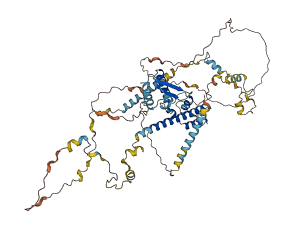
Descriptions
The autoinhibited protein was predicted that may have potential autoinhibitory elements via cis-regPred.
Autoinhibitory domains (AIDs)
Target domain |
|
Relief mechanism |
|
Assay |
cis-regPred |
Accessory elements
No accessory elements
Autoinhibited structure

Activated structure
1 structures for Q8C5S7
| Entry ID | Method | Resolution | Chain | Position | Source |
|---|---|---|---|---|---|
| AF-Q8C5S7-F1 | Predicted | AlphaFoldDB |
40 variants for Q8C5S7
| Variant ID(s) | Position | Change | Description | Diseaes Association | Provenance |
|---|---|---|---|---|---|
| rs3413077113 | 17 | T>I | No | EVA | |
| rs3389330473 | 60 | L>M | No | EVA | |
| rs3389302634 | 76 | G>D | No | EVA | |
| rs3389337344 | 77 | V>M | No | EVA | |
| rs3389254243 | 118 | L>M | No | EVA | |
| rs3389284897 | 128 | E>D | No | EVA | |
| rs3389254274 | 130 | L>P | No | EVA | |
| rs3389321223 | 131 | E>V | No | EVA | |
| rs3389254289 | 154 | P>T | No | EVA | |
| rs1133973972 | 163 | A>V | No | EVA | |
| rs3389330127 | 168 | T>S | No | EVA | |
| rs3389284943 | 177 | T>S | No | EVA | |
| rs3389254284 | 189 | T>I | No | EVA | |
| rs251836676 | 201 | A>S | No | EVA | |
| rs3389302646 | 210 | E>K | No | EVA | |
| rs3411290496 | 213 | Q>E | No | EVA | |
| rs3405125267 | 213 | Q>R | No | EVA | |
| rs3389302690 | 218 | I>V | No | EVA | |
| rs3389327522 | 220 | R>Q | No | EVA | |
| rs3389302675 | 231 | D>N | No | EVA | |
| rs3389327278 | 267 | A>G | No | EVA | |
| rs3389302649 | 269 | L>M | No | EVA | |
| rs3389302649 | 269 | L>V | No | EVA | |
| rs3389330543 | 271 | S>P | No | EVA | |
| rs235295699 | 283 | G>E | No | EVA | |
| rs3389337323 | 302 | G>C | No | EVA | |
| rs3389333389 | 327 | E>G | No | EVA | |
| rs49665056 | 343 | R>Q | No | EVA | |
| rs3405214258 | 344 | R>G | No | EVA | |
| rs3389337384 | 382 | M>I | No | EVA | |
| rs3389341623 | 416 | R>T | No | EVA | |
| rs3389330082 | 417 | M>I | No | EVA | |
| rs3389337369 | 420 | Q>L | No | EVA | |
| rs217053453 | 438 | E>D | No | EVA | |
| rs3405130170 | 448 | S>G | No | EVA | |
| rs3389341601 | 455 | E>G | No | EVA | |
| rs3389327484 | 500 | P>L | No | EVA | |
| rs3405125259 | 530 | V>E | No | EVA | |
| rs251276094 | 567 | T>A | No | EVA | |
| rs220393564 | 576 | Q>E | No | EVA |
No associated diseases with Q8C5S7
Functions
11 GO annotations of cellular component
| Name | Definition |
|---|---|
| cohesin complex | A protein complex that is required for sister chromatid cohesion in eukaryotes. The cohesin complex forms a molecular ring complex, and is composed of structural maintenance of chromosomes (SMC) and kleisin proteins. For example, in yeast, the complex is composed of the SMC proteins Smc1p and Smc3p, and the kleisin protein Scc1p. In vertebrates, the complex is composed of the SMC1 (SMC1A or SMC1B) and SMC3 heterodimer attached via their hinge domains to a kleisin (RAD21, REC8 or RAD21L) which links them, and one STAG protein (STAG1, STAG2 or STAG3). |
| condensed chromosome | A highly compacted molecule of DNA and associated proteins resulting in a cytologically distinct structure. |
| condensed chromosome, centromeric region | The region of a condensed chromosome that includes the centromere and associated proteins, including the kinetochore. In monocentric chromosomes, this region corresponds to a single area of the chromosome, whereas in holocentric chromosomes, it is evenly distributed along the chromosome. |
| condensed nuclear chromosome | A highly compacted molecule of DNA and associated proteins resulting in a cytologically distinct nuclear chromosome. |
| kinetochore | A multisubunit complex that is located at the centromeric region of DNA and provides an attachment point for the spindle microtubules. |
| lateral element | A proteinaceous core found between sister chromatids during meiotic prophase. |
| male germ cell nucleus | The nucleus of a male germ cell, a reproductive cell in males. |
| meiotic cohesin complex | A cohesin complex that mediates sister chromatid cohesion during meiosis; has a subunit composition distinct from that of the mitotic cohesin complex. |
| nucleoplasm | That part of the nuclear content other than the chromosomes or the nucleolus. |
| nucleus | A membrane-bounded organelle of eukaryotic cells in which chromosomes are housed and replicated. In most cells, the nucleus contains all of the cell's chromosomes except the organellar chromosomes, and is the site of RNA synthesis and processing. In some species, or in specialized cell types, RNA metabolism or DNA replication may be absent. |
| synaptonemal complex | A proteinaceous scaffold found between homologous chromosomes during meiosis. It consists of 2 lateral elements and a central element, all running parallel to each other. Transverse filaments connect the lateral elements to the central element. |
1 GO annotations of molecular function
| Name | Definition |
|---|---|
| chromatin binding | Binding to chromatin, the network of fibers of DNA, protein, and sometimes RNA, that make up the chromosomes of the eukaryotic nucleus during interphase. |
12 GO annotations of biological process
| Name | Definition |
|---|---|
| double-strand break repair | The repair of double-strand breaks in DNA via homologous and nonhomologous mechanisms to reform a continuous DNA helix. |
| double-strand break repair via homologous recombination | The error-free repair of a double-strand break in DNA in which the broken DNA molecule is repaired using homologous sequences. A strand in the broken DNA searches for a homologous region in an intact chromosome to serve as the template for DNA synthesis. The restoration of two intact DNA molecules results in the exchange, reciprocal or nonreciprocal, of genetic material between the intact DNA molecule and the broken DNA molecule. |
| fertilization | The union of gametes of opposite sexes during the process of sexual reproduction to form a zygote. It involves the fusion of the gametic nuclei (karyogamy) and cytoplasm (plasmogamy). |
| homologous chromosome pairing at meiosis | The meiotic cell cycle process where side by side pairing and physical juxtaposition of homologous chromosomes is created during meiotic prophase. Homologous chromosome pairing begins when the chromosome arms begin to pair from the clustered telomeres and ends when synaptonemal complex or linear element assembly is complete. |
| male meiosis I | A cell cycle process comprising the steps by which a cell progresses through male meiosis I, the first meiotic division in the male germline. |
| meiotic cell cycle | Progression through the phases of the meiotic cell cycle, in which canonically a cell replicates to produce four offspring with half the chromosomal content of the progenitor cell via two nuclear divisions. |
| meiotic sister chromatid cohesion | The cell cycle process in which sister chromatids of a replicated chromosome are joined along the entire length of the chromosome during meiosis. |
| oocyte maturation | A developmental process, independent of morphogenetic (shape) change, that is required for an oocyte to attain its fully functional state. Oocyte maturation commences after reinitiation of meiosis commonly starting with germinal vesicle breakdown, and continues up to the second meiotic arrest prior to fertilization. |
| seminiferous tubule development | The reproductive developmental process whose specific outcome is the progression of the seminiferous tubule over time, from its formation to the mature structure. Seminiferous tubules are ducts located in the testicles, and are the specific location of meiosis, and the subsequent creation of gametes, namely spermatozoa. |
| sister chromatid cohesion | The cell cycle process in which the sister chromatids of a replicated chromosome become tethered to each other. |
| spermatid development | The process whose specific outcome is the progression of a spermatid over time, from its formation to the mature structure. |
| synaptonemal complex assembly | The cell cycle process in which the synaptonemal complex is formed. This is a structure that holds paired chromosomes together during prophase I of meiosis and that promotes genetic recombination. |
| 10 | 20 | 30 | 40 | 50 | 60 |
| MFYYPNVLQR | HTGCFATIWL | AATRGSRLVK | REYLNVNVVK | TCEEILNYVL | VRVQPPVAGL |
| 70 | 80 | 90 | 100 | 110 | 120 |
| PRPRFSLYLS | AQLQIGVIRV | YFQQCQYLVE | DIQHILEHLH | RAQLRIRIDM | EEADLPSLLL |
| 130 | 140 | 150 | 160 | 170 | 180 |
| PNCLAMMETL | EDAPEPFFGK | MSVDPRLPSP | FDIPQIRHLL | EAATPEKTRK | ETLPEATPDP |
| 190 | 200 | 210 | 220 | 230 | 240 |
| RKPDRTLATV | QSPEVITLQE | AEPIRMLQIE | GEQDLPEISR | GDLELLIAEK | DDAILLEERQ |
| 250 | 260 | 270 | 280 | 290 | 300 |
| RGRLLRQRRA | SLPLDESREE | PRALEGAGLV | SALSPPAPAQ | VEGIQEALPG | QVFPPEVQKM |
| 310 | 320 | 330 | 340 | 350 | 360 |
| TGWEPGALLT | EVTPPQELRL | PAPPSTEKRL | PSLQRPLPRR | HRRRQLLFWD | KETQISREKF |
| 370 | 380 | 390 | 400 | 410 | 420 |
| EEQLQTGAHC | WEYPVAQPPK | RMLTSPAELF | RTPTLSGWLP | PELLGLWTHC | AQVPQRMLRQ |
| 430 | 440 | 450 | 460 | 470 | 480 |
| RPQLETEETV | EEERAADEEE | RRKTEALSEI | EVLREAQEPS | GPLMLSSELS | LEAAEDEKSR |
| 490 | 500 | 510 | 520 | 530 | 540 |
| TSLIPPEWWA | WSEEGQPEPP | ALPMLPELPE | VPMEMPPRPE | LSSEAVLRAV | ALKLQANKEL |
| 550 | 560 | 570 | 580 | 590 | |
| DFSSLVPPLS | PRKLASRVFY | LLLVLSTQKI | LLVEQQKPYG | PLLIRPGPKF | P |