Q8C180
Gene name |
Frs2 (Frs2a) |
Protein name |
Fibroblast growth factor receptor substrate 2 |
Names |
FGFR substrate 2, FGFR-signaling adaptor SNT, FRS2-alpha, Suc1-associated neurotrophic factor target 1, SNT-1 |
Species |
Mus musculus (Mouse) |
KEGG Pathway |
mmu:327826 |
EC number |
|
Protein Class |
|
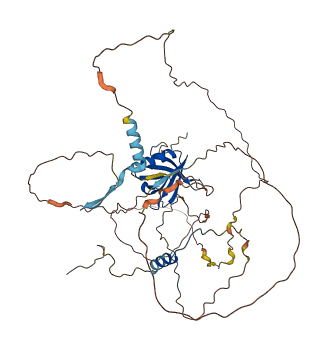
Descriptions
The autoinhibited protein was predicted that may have potential autoinhibitory elements via cis-regPred.
Autoinhibitory domains (AIDs)
Target domain |
|
Relief mechanism |
|
Assay |
cis-regPred |
Accessory elements
No accessory elements
Autoinhibited structure

Activated structure
1 structures for Q8C180
| Entry ID | Method | Resolution | Chain | Position | Source |
|---|---|---|---|---|---|
| AF-Q8C180-F1 | Predicted | AlphaFoldDB |
33 variants for Q8C180
| Variant ID(s) | Position | Change | Description | Diseaes Association | Provenance |
|---|---|---|---|---|---|
| rs3389127738 | 5 | C>S | No | EVA | |
| rs30916944 | 8 | P>S | No | EVA | |
| rs3389137104 | 10 | K>I | No | EVA | |
| rs3389132386 | 17 | H>L | No | EVA | |
| rs3389137096 | 27 | D>G | No | EVA | |
| rs3389127734 | 27 | D>N | No | EVA | |
| rs3389127509 | 29 | D>G | No | EVA | |
| rs3389139463 | 52 | R>Q | No | EVA | |
| rs3389130652 | 79 | R>M | No | EVA | |
| rs3389127898 | 106 | Q>H | No | EVA | |
| rs3389129334 | 108 | N>I | No | EVA | |
| rs3389127542 | 113 | V>M | No | EVA | |
| rs3389137158 | 126 | E>A | No | EVA | |
| rs3389101082 | 135 | T>S | No | EVA | |
| rs3389127497 | 242 | V>M | No | EVA | |
| rs3389130725 | 270 | Q>* | No | EVA | |
| rs3389104066 | 307 | E>D | No | EVA | |
| rs3389129353 | 331 | S>* | No | EVA | |
| rs3389124329 | 351 | N>I | No | EVA | |
| rs3389093579 | 357 | P>T | No | EVA | |
| rs3389139393 | 358 | V>L | No | EVA | |
| rs3389127929 | 360 | E>G | No | EVA | |
| rs3389104068 | 370 | D>Y | No | EVA | |
| rs226450407 | 371 | N>H | No | EVA | |
| rs3389127507 | 377 | P>S | No | EVA | |
| rs3389068215 | 406 | K>I | No | EVA | |
| rs3389130641 | 435 | N>I | No | EVA | |
| rs3389101004 | 459 | P>S | No | EVA | |
| rs3389093539 | 460 | L>F | No | EVA | |
| rs3401581397 | 464 | P>A | No | EVA | |
| rs3389127494 | 467 | R>H | No | EVA | |
| rs3389068148 | 497 | R>Q | No | EVA | |
| rs3389127670 | 506 | L>V | No | EVA |
No associated diseases with Q8C180
5 GO annotations of cellular component
| Name | Definition |
|---|---|
| adherens junction | A cell-cell junction composed of the epithelial cadherin-catenin complex. The epithelial cadherins, or E-cadherins, of each interacting cell extend through the plasma membrane into the extracellular space and bind to each other. The E-cadherins bind to catenins on the cytoplasmic side of the membrane, where the E-cadherin-catenin complex binds to cytoskeletal components and regulatory and signaling molecules. |
| cell-cell junction | A cell junction that forms a connection between two or more cells of an organism; excludes direct cytoplasmic intercellular bridges, such as ring canals in insects. |
| cytoplasm | The contents of a cell excluding the plasma membrane and nucleus, but including other subcellular structures. |
| cytosol | The part of the cytoplasm that does not contain organelles but which does contain other particulate matter, such as protein complexes. |
| plasma membrane | The membrane surrounding a cell that separates the cell from its external environment. It consists of a phospholipid bilayer and associated proteins. |
3 GO annotations of molecular function
| Name | Definition |
|---|---|
| fibroblast growth factor receptor binding | Binding to a fibroblast growth factor receptor (FGFR). |
| neurotrophin TRKA receptor binding | Binding to a neurotrophin TRKA receptor. |
| transmembrane receptor protein tyrosine kinase adaptor activity | The binding activity of a molecule that brings together a transmembrane receptor protein tyrosine kinase and one or more other molecules, permitting them to function in a coordinated way. |
19 GO annotations of biological process
| Name | Definition |
|---|---|
| anterior/posterior axis specification, embryo | The specification of the anterior/posterior axis of the embryo by the products of genes expressed maternally and genes expressed in the zygote. |
| cellular response to fibroblast growth factor stimulus | Any process that results in a change in state or activity of a cell (in terms of movement, secretion, enzyme production, gene expression, etc.) as a result of an fibroblast growth factor stimulus. |
| fibroblast growth factor receptor signaling pathway | The series of molecular signals generated as a consequence of a fibroblast growth factor receptor binding to one of its physiological ligands. |
| forebrain development | The process whose specific outcome is the progression of the forebrain over time, from its formation to the mature structure. The forebrain is the anterior of the three primary divisions of the developing chordate brain or the corresponding part of the adult brain (in vertebrates, includes especially the cerebral hemispheres, the thalamus, and the hypothalamus and especially in higher vertebrates is the main control center for sensory and associative information processing, visceral functions, and voluntary motor functions). |
| gastrulation with mouth forming second | A gastrulation process in which the initial invagination becomes the anus and the mouth forms second. |
| lens development in camera-type eye | The process whose specific outcome is the progression of the lens over time, from its formation to the mature structure. The lens is a transparent structure in the eye through which light is focused onto the retina. An example of this process is found in Mus musculus. |
| lens fiber cell development | The process whose specific outcome is the progression of a lens fiber cell over time, from its formation to the mature structure. Cell development does not include the steps involved in committing a cell to a lens fiber cell fate. A lens fiber cell is any of the elongated, tightly packed cells that make up the bulk of the mature lens in a camera-type eye. |
| lens placode formation involved in camera-type eye formation | Establishment and formation of the optic placode, paired ectodermal placodes that become invaginated to form the embryonic lens vesicles. |
| negative regulation of cardiac muscle cell differentiation | Any process that stops, prevents or reduces the frequency, rate or extent of cardiac muscle cell differentiation. |
| neuroblast proliferation | The expansion of a neuroblast population by cell division. A neuroblast is any cell that will divide and give rise to a neuron. |
| organ induction | The interaction of two or more cells or tissues that causes them to change their fates and specify the development of an organ. |
| positive regulation of MAPK cascade | Any process that activates or increases the frequency, rate or extent of signal transduction mediated by the MAPK cascade. |
| positive regulation of vascular associated smooth muscle cell proliferation | Any process that activates or increases the frequency, rate or extent of vascular smooth muscle cell proliferation. |
| prostate epithelial cord arborization involved in prostate glandular acinus morphogenesis | The branching morphogenesis process in which the prostate epithelial cords branch freely to create the structure of the prostate acini. |
| regulation of apoptotic process | Any process that modulates the occurrence or rate of cell death by apoptotic process. |
| regulation of epithelial cell proliferation | Any process that modulates the frequency, rate or extent of epithelial cell proliferation. |
| regulation of ERK1 and ERK2 cascade | Any process that modulates the frequency, rate or extent of signal transduction mediated by the ERK1 and ERK2 cascade. |
| transmembrane receptor protein tyrosine kinase signaling pathway | The series of molecular signals initiated by an extracellular ligand binding to a receptor on the surface of the target cell where the receptor possesses tyrosine kinase activity, and ending with the regulation of a downstream cellular process, e.g. transcription. |
| ventricular septum development | The progression of the ventricular septum over time from its formation to the mature structure. |
3 homologous proteins in AiPD
| UniProt AC | Gene Name | Protein Name | Species | Evidence Code |
|---|---|---|---|---|
| O43559 | FRS3 | Fibroblast growth factor receptor substrate 3 | Homo sapiens (Human) | PR |
| Q8WU20 | FRS2 | Fibroblast growth factor receptor substrate 2 | Homo sapiens (Human) | PR |
| Q91WJ0 | Frs3 | Fibroblast growth factor receptor substrate 3 | Mus musculus (Mouse) | PR |
| 10 | 20 | 30 | 40 | 50 | 60 |
| MGSCCSCPDK | DTVPDNHRNK | FKVINVDDDG | NELGSGVMEL | TDTELILYTR | KRDSVKWHYL |
| 70 | 80 | 90 | 100 | 110 | 120 |
| CLRRYGYDSN | LFSFESGRRC | QTGQGIFAFK | CARAEELFNM | LQEIMQNNSI | NVVEEPVVER |
| 130 | 140 | 150 | 160 | 170 | 180 |
| SSHQTELEVP | RTPRTPTTPG | LGAQNLPNGY | PRYPSFGDAS | SHPSSRHPSV | GSARLPSVGE |
| 190 | 200 | 210 | 220 | 230 | 240 |
| ESTHPLLVAE | EQVHTYVNTT | GVQEERKNRA | SVHVPPEARV | SNAESNTPKE | EPSNPEDRDP |
| 250 | 260 | 270 | 280 | 290 | 300 |
| QVLLKPEGVR | FVLGPTPVQK | QLMEKEKLEQ | LGKDPVSGSG | AGNTEWDTGY | DSDERRDVPP |
| 310 | 320 | 330 | 340 | 350 | 360 |
| VNKLVYENIN | GLSIPSASGV | RRGRLTSTST | SDTQNINNSA | QRRPALLNYE | NLPSLPPVWE |
| 370 | 380 | 390 | 400 | 410 | 420 |
| ARKLSRDEDD | NLGPKTPSLN | GYHNNLDPMH | NYVNTENVTV | PASAHKIDYS | KRRDCTPTVF |
| 430 | 440 | 450 | 460 | 470 | 480 |
| NFDIRRPSLE | HRQLNYIQVD | LEGGSDSDNP | QTPKTPTTPL | PQTPTRRTEL | YAVIDIERTA |
| 490 | 500 | ||||
| AMSNLQKALP | RDDGTSRKTR | HNSTDLPM |