Q8BTM8
Gene name |
Flna (Fln, Fln1) |
Protein name |
Filamin-A |
Names |
FLN-A, Actin-binding protein 280, ABP-280, Alpha-filamin, Endothelial actin-binding protein, Filamin-1, Non-muscle filamin |
Species |
Mus musculus (Mouse) |
KEGG Pathway |
|
EC number |
2.3.2.27: Aminoacyltransferases |
Protein Class |
UBIQUITIN LIGASE E3 ALPHA-RELATED (PTHR21497) |
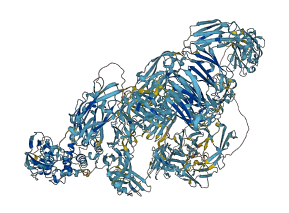
Descriptions
In Saccharomyces cerevisiae, RING domain-containing Ub ligase UBR1 recognizes and binds to proteins bearing specific N-terminal residues that are destabilizing according to the N-end rule, leading to their ubiquitination and subsequent degradation. Binding of dipeptides with destabilizing N-terminal residues to two substrate-binding sites of UBR1 causes dissociation of the C-terminal autoinhibitory domain of UBR1 from its N-terminal region that contains all three substrate-binding sites. This dissociation allows the interaction between UBR1 and CUP9, a transcriptional repressor of the peptide transporter PTR2, thereby accelerating the UBR1-dependent degradation of CUP9 and increasing the cell's capacity to import peptides. An aspect of autoinhibition characteristic of yeast UBR1 also is observed with mouse UBR1.
Autoinhibitory domains (AIDs)
Target domain |
2233-2325 (IgFLNa21 domain) |
Relief mechanism |
PTM, Others |
Assay |
|
Accessory elements
No accessory elements
Autoinhibited structure

Activated structure
1 structures for Q8BTM8
| Entry ID | Method | Resolution | Chain | Position | Source |
|---|---|---|---|---|---|
| AF-Q8BTM8-F1 | Predicted | AlphaFoldDB |
5 variants for Q8BTM8
| Variant ID(s) | Position | Change | Description | Diseaes Association | Provenance |
|---|---|---|---|---|---|
| rs223157556 | 12 | A>T | No | Ensembl | |
| rs213561359 | 921 | R>Q | No | Ensembl | |
| rs1133456813 | 990 | E>* | No | Ensembl | |
| rs217924152 | 1762 | N>T | No | Ensembl | |
| rs3166685 | 2253 | V>A | No | Ensembl |
No associated diseases with Q8BTM8
5 regional properties for Q8BTM8
| Type | Name | Position | InterPro Accession |
|---|---|---|---|
| domain | Cyclic nucleotide-binding domain | 478 - 602 | IPR000595 |
| domain | Ion transport domain | 166 - 405 | IPR005821 |
| conserved_site | Cyclic nucleotide-binding, conserved site | 505 - 521 | IPR018488-1 |
| conserved_site | Cyclic nucleotide-binding, conserved site | 543 - 566 | IPR018488-2 |
| domain | Cyclic nucleotide-gated channel, C-terminal leucine zipper domain | 594 - 663 | IPR032406 |
Functions
| Description | ||
|---|---|---|
| EC Number | 2.3.2.27 | Aminoacyltransferases |
| Subcellular Localization |
|
|
| PANTHER Family | PTHR21497 | UBIQUITIN LIGASE E3 ALPHA-RELATED |
| PANTHER Subfamily | PTHR21497:SF27 | E3 UBIQUITIN-PROTEIN LIGASE UBR1 |
| PANTHER Protein Class |
ubiquitin-protein ligase
protein modifying enzyme |
|
| PANTHER Pathway Category | No pathway information available | |
24 GO annotations of cellular component
| Name | Definition |
|---|---|
| actin cytoskeleton | The part of the cytoskeleton (the internal framework of a cell) composed of actin and associated proteins. Includes actin cytoskeleton-associated complexes. |
| actin filament | A filamentous structure formed of a two-stranded helical polymer of the protein actin and associated proteins. Actin filaments are a major component of the contractile apparatus of skeletal muscle and the microfilaments of the cytoskeleton of eukaryotic cells. The filaments, comprising polymerized globular actin molecules, appear as flexible structures with a diameter of 5-9 nm. They are organized into a variety of linear bundles, two-dimensional networks, and three dimensional gels. In the cytoskeleton they are most highly concentrated in the cortex of the cell just beneath the plasma membrane. |
| actin filament bundle | An assembly of actin filaments that are on the same axis but may be oriented with the same or opposite polarities and may be packed with different levels of tightness. |
| apical dendrite | A dendrite that emerges near the apical pole of a neuron. In bipolar neurons, apical dendrites are located on the opposite side of the soma from the axon. |
| axonal growth cone | The migrating motile tip of a growing nerve cell axon. |
| brush border | The dense covering of microvilli on the apical surface of an epithelial cell in tissues such as the intestine, kidney, and choroid plexus; the microvilli aid absorption by increasing the surface area of the cell. |
| cell cortex | The region of a cell that lies just beneath the plasma membrane and often, but not always, contains a network of actin filaments and associated proteins. |
| cell-cell junction | A cell junction that forms a connection between two or more cells of an organism; excludes direct cytoplasmic intercellular bridges, such as ring canals in insects. |
| cortical cytoskeleton | The portion of the cytoskeleton that lies just beneath the plasma membrane. |
| cytoplasm | The contents of a cell excluding the plasma membrane and nucleus, but including other subcellular structures. |
| cytosol | The part of the cytoplasm that does not contain organelles but which does contain other particulate matter, such as protein complexes. |
| dendritic shaft | Cylindric portion of the dendrite, directly stemming from the perikaryon, and carrying the dendritic spines. |
| glutamatergic synapse | A synapse that uses glutamate as a neurotransmitter. |
| growth cone | The migrating motile tip of a growing neuron projection, where actin accumulates, and the actin cytoskeleton is the most dynamic. |
| Myb complex | A multisubunit complex consisting of Myb and other proteins that regulates site specific DNA replication, gene amplification and transcriptional repression. |
| neuronal cell body | The portion of a neuron that includes the nucleus, but excludes cell projections such as axons and dendrites. |
| nucleolus | A small, dense body one or more of which are present in the nucleus of eukaryotic cells. It is rich in RNA and protein, is not bounded by a limiting membrane, and is not seen during mitosis. Its prime function is the transcription of the nucleolar DNA into 45S ribosomal-precursor RNA, the processing of this RNA into 5.8S, 18S, and 28S components of ribosomal RNA, and the association of these components with 5S RNA and proteins synthesized outside the nucleolus. This association results in the formation of ribonucleoprotein precursors; these pass into the cytoplasm and mature into the 40S and 60S subunits of the ribosome. |
| nucleus | A membrane-bounded organelle of eukaryotic cells in which chromosomes are housed and replicated. In most cells, the nucleus contains all of the cell's chromosomes except the organellar chromosomes, and is the site of RNA synthesis and processing. In some species, or in specialized cell types, RNA metabolism or DNA replication may be absent. |
| perikaryon | The portion of the cell soma (neuronal cell body) that excludes the nucleus. |
| perinuclear region of cytoplasm | Cytoplasm situated near, or occurring around, the nucleus. |
| plasma membrane | The membrane surrounding a cell that separates the cell from its external environment. It consists of a phospholipid bilayer and associated proteins. |
| postsynapse | The part of a synapse that is part of the post-synaptic cell. |
| trans-Golgi network | The network of interconnected tubular and cisternal structures located within the Golgi apparatus on the side distal to the endoplasmic reticulum, from which secretory vesicles emerge. The trans-Golgi network is important in the later stages of protein secretion where it is thought to play a key role in the sorting and targeting of secreted proteins to the correct destination. |
| Z disc | Platelike region of a muscle sarcomere to which the plus ends of actin filaments are attached. |
15 GO annotations of molecular function
| Name | Definition |
|---|---|
| actin binding | Binding to monomeric or multimeric forms of actin, including actin filaments. |
| actin filament binding | Binding to an actin filament, also known as F-actin, a helical filamentous polymer of globular G-actin subunits. |
| DNA-binding transcription factor binding | Binding to a DNA-binding transcription factor, a protein that interacts with a specific DNA sequence (sometimes referred to as a motif) within the regulatory region of a gene to modulate transcription. |
| Fc-gamma receptor I complex binding | Binding to one or more specific sites on the Fc-gamma receptor I complex. The complex functions primarily as an activating receptor for IgG. |
| G protein-coupled receptor binding | Binding to a G protein-coupled receptor. |
| GTPase binding | Binding to a GTPase, any enzyme that catalyzes the hydrolysis of GTP. |
| kinase binding | Binding to a kinase, any enzyme that catalyzes the transfer of a phosphate group. |
| mu-type opioid receptor binding | Binding to a mu-type opioid receptor. |
| potassium channel regulator activity | Binds to and modulates the activity of a potassium channel. |
| protein homodimerization activity | Binding to an identical protein to form a homodimer. |
| protein kinase C binding | Binding to protein kinase C. |
| protein-containing complex binding | Binding to a macromolecular complex. |
| SMAD binding | Binding to a SMAD signaling protein. |
| small GTPase binding | Binding to a small monomeric GTPase. |
| transmembrane transporter binding | Binding to a transmembrane transporter, a protein or protein complex that enables the transfer of a substance, usually a specific substance or a group of related substances, from one side of a membrane to the other. |
44 GO annotations of biological process
| Name | Definition |
|---|---|
| actin crosslink formation | The process in which two or more actin filaments are connected together by proteins that act as crosslinks between the filaments. The crosslinked filaments may be on the same or differing axes. |
| actin cytoskeleton organization | A process that is carried out at the cellular level which results in the assembly, arrangement of constituent parts, or disassembly of cytoskeletal structures comprising actin filaments and their associated proteins. |
| actin cytoskeleton reorganization | A process that is carried out at the cellular level which results in dynamic structural changes to the arrangement of constituent parts of cytoskeletal structures comprising actin filaments and their associated proteins. |
| adenylate cyclase-inhibiting dopamine receptor signaling pathway | An adenylate cyclase-inhibiting G protein-coupled receptor signaling pathway initiated by dopamine binding to its receptor, and ending with the regulation of a downstream cellular process. |
| angiogenesis | Blood vessel formation when new vessels emerge from the proliferation of pre-existing blood vessels. |
| blood vessel remodeling | The reorganization or renovation of existing blood vessels. |
| cell-cell junction organization | A process that is carried out at the cellular level which results in the assembly, arrangement of constituent parts, or disassembly of a cell-cell junction. A cell-cell junction is a specialized region of connection between two cells. |
| cilium assembly | The assembly of a cilium, a specialized eukaryotic organelle that consists of a filiform extrusion of the cell surface. Each cilium is bounded by an extrusion of the cytoplasmic membrane, and contains a regular longitudinal array of microtubules, anchored basally in a centriole. |
| cytoplasmic sequestering of protein | The selective interaction of a protein with specific molecules in the cytoplasm, thereby inhibiting its transport into other areas of the cell. |
| early endosome to late endosome transport | The directed movement of substances, in membrane-bounded vesicles, from the early sorting endosomes to the late sorting endosomes; transport occurs along microtubules and can be experimentally blocked with microtubule-depolymerizing drugs. |
| epithelial to mesenchymal transition | A transition where an epithelial cell loses apical/basolateral polarity, severs intercellular adhesive junctions, degrades basement membrane components and becomes a migratory mesenchymal cell. |
| establishment of protein localization | The directed movement of a protein to a specific location. |
| establishment of Sertoli cell barrier | Establishment of a structure near the basement membrane in adjacent Sertoli cells of the seminiferous epithelium for maintaining spermatogenesis. The structure consists of tight junctions, basal ectoplasmic specializations, and desmosome-like junctions. |
| formation of radial glial scaffolds | The formation of scaffolds from a radial glial cell. The scaffolds are used as a substrate for the radial migration of cells. |
| heart morphogenesis | The developmental process in which the heart is generated and organized. The heart is a hollow, muscular organ, which, by contracting rhythmically, keeps up the circulation of the blood. |
| mitotic spindle assembly | Mitotic bipolar spindle assembly begins with spindle microtubule nucleation from the separated spindle pole body, includes spindle elongation during prometaphase, and is complete when all kinetochores are stably attached the spindle, and the spindle assembly checkpoint is satisfied. |
| mRNA transcription by RNA polymerase II | The cellular synthesis of messenger RNA (mRNA) from a DNA template by RNA polymerase II, originating at an RNA polymerase II promoter. |
| negative regulation of apoptotic process | Any process that stops, prevents, or reduces the frequency, rate or extent of cell death by apoptotic process. |
| negative regulation of DNA-binding transcription factor activity | Any process that stops, prevents, or reduces the frequency, rate or extent of the activity of a transcription factor, any factor involved in the initiation or regulation of transcription. |
| negative regulation of neuron projection development | Any process that decreases the rate, frequency or extent of neuron projection development. Neuron projection development is the process whose specific outcome is the progression of a neuron projection over time, from its formation to the mature structure. A neuron projection is any process extending from a neural cell, such as axons or dendrites (collectively called neurites). |
| negative regulation of protein catabolic process | Any process that stops, prevents or reduces the frequency, rate or extent of protein catabolic process. |
| negative regulation of transcription by RNA polymerase I | Any process that stops, prevents, or reduces the frequency, rate or extent of transcription mediated by RNA polymerase I. |
| positive regulation of actin filament bundle assembly | Any process that activates or increases the frequency, rate or extent of the assembly of actin filament bundles. |
| positive regulation of axon regeneration | Any process that activates, maintains or increases the rate of axon regeneration. |
| positive regulation of I-kappaB kinase/NF-kappaB signaling | Any process that activates or increases the frequency, rate or extent of I-kappaB kinase/NF-kappaB signaling. |
| positive regulation of integrin-mediated signaling pathway | Any process that activates or increases the frequency, rate or extent of integrin-mediated signaling pathway. |
| positive regulation of neural precursor cell proliferation | Any process that activates or increases the frequency, rate or extent of neural precursor cell proliferation. |
| positive regulation of neuron migration | Any process that activates or increases the frequency, rate or extent of neuron migration. |
| positive regulation of potassium ion transmembrane transport | Any process that activates or increases the frequency, rate or extent of potassium ion transmembrane transport. |
| positive regulation of protein import into nucleus | Any process that activates or increases the frequency, rate or extent of movement of proteins from the cytoplasm into the nucleus. |
| positive regulation of substrate adhesion-dependent cell spreading | Any process that activates or increases the frequency, rate or extent of substrate adhesion-dependent cell spreading. |
| protein localization to bicellular tight junction | A process in which a protein is transported to, or maintained in, a location within a bicellular tight junction. |
| protein localization to cell surface | A process in which a protein is transported to, or maintained in, a location within the external part of the cell wall and/or plasma membrane. |
| protein localization to plasma membrane | A process in which a protein is transported to, or maintained in, a specific location in the plasma membrane. |
| protein stabilization | Any process involved in maintaining the structure and integrity of a protein and preventing it from degradation or aggregation. |
| receptor clustering | The receptor metabolic process that results in grouping of a set of receptors at a cellular location, often to amplify the sensitivity of a signaling response. |
| regulation of actin filament bundle assembly | Any process that modulates the frequency, rate or extent of the assembly of actin filament bundles. |
| regulation of cell migration | Any process that modulates the frequency, rate or extent of cell migration. |
| regulation of membrane repolarization during atrial cardiac muscle cell action potential | Any process that modulates the frequency, rate or extent of membrane repolarization during atrial cardiac muscle cell action potential. |
| regulation of membrane repolarization during cardiac muscle cell action potential | Any process that modulates the frequency, rate or extent of membrane repolarization during cardiac muscle cell action potential. |
| semaphorin-plexin signaling pathway | The series of molecular signals generated as a consequence of a semaphorin receptor (composed of a plexin and a neurophilin) binding to a semaphorin ligand. |
| synapse organization | A process that is carried out at the cellular level which results in the assembly, arrangement of constituent parts, or disassembly of a synapse, the junction between a neuron and a target (neuron, muscle, or secretory cell). |
| tubulin deacetylation | The removal of an acetyl group from tubulin. An acetyl group is CH3CO-, derived from acetic |
| wound healing, spreading of cells | The migration of a cell along or through a wound gap that contributes to the reestablishment of a continuous surface. |
| 10 | 20 | 30 | 40 | 50 | 60 |
| MADEEMDGAE | RMDVSPEPPL | APQRPASWWD | QQVDFYTAFL | HHLAQLVPEI | YFAEMDPDLE |
| 70 | 80 | 90 | 100 | 110 | 120 |
| KQEESVQMSI | LTPLEWYLFG | EDPDICLEKL | KHSGAFQLCG | KVFKSGETTY | SCRDCAIDPT |
| 130 | 140 | 150 | 160 | 170 | 180 |
| CVLCMDCFQS | SVHKNHRYKM | HTSTGGGFCD | CGDTEAWKTG | PFCVDHEPGR | AGTTKESLHC |
| 190 | 200 | 210 | 220 | 230 | 240 |
| PLNEEVIAQA | RRIFPSVIKY | IVEMTIWEEE | KELPPELQIR | EKNERYYCVL | FNDEHHSYDH |
| 250 | 260 | 270 | 280 | 290 | 300 |
| VIYSLQRALD | CELAEAQLHT | TAIDKEGRRA | VKAGVYATCQ | EAKEDIKSHS | ENVSQHPLHV |
| 310 | 320 | 330 | 340 | 350 | 360 |
| EVLHSVVMAH | QKFALRLGSW | MNKIMSYSSD | FRQIFCQACL | VEEPGSENPC | LISRLMLWDA |
| 370 | 380 | 390 | 400 | 410 | 420 |
| KLYKGARKIL | HELIFSSFFM | EMEYKKLFAM | EFVKYYKQLQ | KEYISDDHER | SISITALSVQ |
| 430 | 440 | 450 | 460 | 470 | 480 |
| MLTVPTLARH | LIEEQNVISV | ITETLLEVLP | EYLDRNNKFN | FQGYSQDKLG | RVYAVICDLK |
| 490 | 500 | 510 | 520 | 530 | 540 |
| YILISKPVIW | TERLRAQFLE | GFRSFLKILT | CMQGMEEIRR | QVGQHIEVDP | DWEAAIAIQM |
| 550 | 560 | 570 | 580 | 590 | 600 |
| QLKNILLMFQ | EWCACDEDLL | LVAYKECHKA | VMRCSTNFMS | STKTVVQLCG | HSLETKSYKV |
| 610 | 620 | 630 | 640 | 650 | 660 |
| SEDLVSIHLP | LSRTLAGLHV | RLSRLGAISR | LHEFVPFDGF | QVEVLVEYPL | RCLVLVAQVV |
| 670 | 680 | 690 | 700 | 710 | 720 |
| AEMWRRNGLS | LISQVFYYQD | VKCREEMYDK | DIIMLQIGAS | IMDPNKFLLL | VLQRYELTDA |
| 730 | 740 | 750 | 760 | 770 | 780 |
| FNKTISTKDQ | DLIKQYNTLI | EEMLQVLIYI | VGERYVPGVG | NVTREEVIMR | EITHLLCIEP |
| 790 | 800 | 810 | 820 | 830 | 840 |
| MPHSAIARNL | PENENNETGL | ENVINKVATF | KKPGVSGHGV | YELKDESLKD | FNMYFYHYSK |
| 850 | 860 | 870 | 880 | 890 | 900 |
| TQHSKAEHMQ | KKRRKQENKD | EALPPPPPPE | FCPAFSKVVN | LLSCDVMMYI | LRTIFERAVD |
| 910 | 920 | 930 | 940 | 950 | 960 |
| MESNLWTEGM | LQMAFHILAL | GLLEEKQQLQ | KAPEEEVAFD | FYHKASRLGS | SAMNAQNIQM |
| 970 | 980 | 990 | 1000 | 1010 | 1020 |
| LLEKLKGIPQ | LESQKDMITW | ILQMFDTVKR | LREKSCLVVA | TTSGLECVKS | EEITHDKEKA |
| 1030 | 1040 | 1050 | 1060 | 1070 | 1080 |
| ERKRKAEAAR | LHRQKIMAQM | SALQKNFIET | HKLMYDNTSE | VTGKEDSIME | EESTSAVSEA |
| 1090 | 1100 | 1110 | 1120 | 1130 | 1140 |
| SRIALGPKRG | PAVTEKEVLT | CILCQEEQEV | KLENNAMVLS | ACVQKSTALT | QHRGKPVDHL |
| 1150 | 1160 | 1170 | 1180 | 1190 | 1200 |
| GETLDPLFMD | PDLAHGTYTG | SCGHVMHAVC | WQKYFEAVQL | SSQQRIHVDL | FDLESGEYLC |
| 1210 | 1220 | 1230 | 1240 | 1250 | 1260 |
| PLCKSLCNTV | IPIIPLQPQK | INSENAEALA | QLLTLARWIQ | TVLARISGYN | IKHAKGEAPA |
| 1270 | 1280 | 1290 | 1300 | 1310 | 1320 |
| VPVLFNQGMG | DSTFEFHSIL | SFGVQSSVKY | SNSIKEMVIL | FATTIYRIGL | KVPPDELDPR |
| 1330 | 1340 | 1350 | 1360 | 1370 | 1380 |
| VPMMTWSTCA | FTIQAIENLL | GDEGKPLFGA | LQNRQHNGLK | ALMQFAVAQR | TTCPQVLIHK |
| 1390 | 1400 | 1410 | 1420 | 1430 | 1440 |
| HLARLLSVIL | PNLQSENTPG | LLSVDLFHVL | VGAVLAFPSL | YWDDTVDLQP | SPLSSSYNHL |
| 1450 | 1460 | 1470 | 1480 | 1490 | 1500 |
| YLFHLITMAH | MLQILLTTDT | DLSSGPPLAE | GEEDSEEARC | ASAFFVEVSQ | HTDGLAGCGA |
| 1510 | 1520 | 1530 | 1540 | 1550 | 1560 |
| PGWYLWLSLR | NGITPYLRCA | ALLFHYLLGV | APPEELFANS | AEGEFSALCS | YLSLPTNLFL |
| 1570 | 1580 | 1590 | 1600 | 1610 | 1620 |
| LFQEYWDTIR | PLLQRWCGDP | ALLKSLKQKS | AVVRYPRKRN | SLIELPEDYS | CLLNQASHFR |
| 1630 | 1640 | 1650 | 1660 | 1670 | 1680 |
| CPRSADDERK | HPVLCLFCGA | ILCSQNICCQ | EIVNGEEVGA | CVFHALHCGA | GVCIFLKIRE |
| 1690 | 1700 | 1710 | 1720 | 1730 | 1740 |
| CRVVLVEGKA | RGCAYPAPYL | DEYGETDPGL | KRGNPLHLSR | ERYRKLHLVW | QQHCIIEEIA |
| 1750 | |||||
| RSQETNQMLF | GFNWQLL |