Q8BS45
Gene name |
Ttc26 |
Protein name |
Intraflagellar transport protein 56 |
Names |
Protein hop-sterile, Tetratricopeptide repeat protein 26, TPR repeat protein 26 |
Species |
Mus musculus (Mouse) |
KEGG Pathway |
mmu:264134 |
EC number |
|
Protein Class |
|
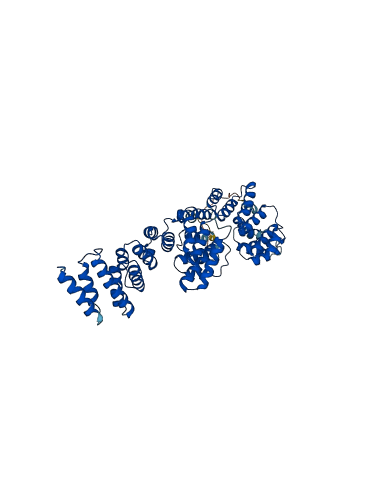
Descriptions
The autoinhibited protein was predicted that may have potential autoinhibitory elements via cis-regPred.
Autoinhibitory domains (AIDs)
Target domain |
|
Relief mechanism |
|
Assay |
cis-regPred |
Accessory elements
No accessory elements
Autoinhibited structure

Activated structure
1 structures for Q8BS45
| Entry ID | Method | Resolution | Chain | Position | Source |
|---|---|---|---|---|---|
| AF-Q8BS45-F1 | Predicted | AlphaFoldDB |
29 variants for Q8BS45
| Variant ID(s) | Position | Change | Description | Diseaes Association | Provenance |
|---|---|---|---|---|---|
| rs3388802275 | 34 | L>I | No | EVA | |
| rs3388817948 | 75 | R>I | No | EVA | |
| rs3388823155 | 104 | L>P | No | EVA | |
| rs3388812812 | 120 | S>I | No | EVA | |
| rs3388827191 | 120 | S>R | No | EVA | |
| rs223026699 | 121 | R>W | No | EVA | |
| rs3396719534 | 134 | F>Y | No | EVA | |
| rs3396626428 | 136 | D>G | No | EVA | |
| rs3396407813 | 136 | D>Y | No | EVA | |
| rs3388827244 | 176 | R>W | No | EVA | |
| rs3388827177 | 182 | R>T | No | EVA | |
| rs3388824141 | 196 | Y>N | No | EVA | |
| rs3388802290 | 215 | I>V | No | EVA | |
| rs3388824397 | 245 | L>V | No | EVA | |
| rs3388824107 | 274 | L>S | No | EVA | |
| rs3388802320 | 287 | A>P | No | EVA | |
| rs3388822124 | 333 | M>V | No | EVA | |
| rs3388830738 | 340 | K>N | No | EVA | |
| rs3388809838 | 363 | Q>L | No | EVA | |
| rs3388802321 | 404 | A>D | No | EVA | |
| rs3388812837 | 404 | A>S | No | EVA | |
| rs3388806558 | 409 | T>I | No | EVA | |
| rs3388821311 | 415 | V>A | No | EVA | |
| rs3388823165 | 468 | A>V | No | EVA | |
| rs3388827201 | 469 | N>I | No | EVA | |
| rs3388809791 | 479 | Y>F | No | EVA | |
| rs3388806543 | 479 | Y>N | No | EVA | |
| rs3388821357 | 536 | V>M | No | EVA | |
| rs3388812789 | 551 | R>G | No | EVA |
No associated diseases with Q8BS45
4 regional properties for Q8BS45
| Type | Name | Position | InterPro Accession |
|---|---|---|---|
| domain | Translation elongation factor EFTs/EF1B, dimerisation | 73 - 228 | IPR014039-1 |
| domain | Translation elongation factor EFTs/EF1B, dimerisation | 239 - 337 | IPR014039-2 |
| conserved_site | Translation elongation factor Ts, conserved site | 12 - 27 | IPR018101-1 |
| conserved_site | Translation elongation factor Ts, conserved site | 77 - 87 | IPR018101-2 |
6 GO annotations of cellular component
| Name | Definition |
|---|---|
| centrosome | A structure comprised of a core structure (in most organisms, a pair of centrioles) and peripheral material from which a microtubule-based structure, such as a spindle apparatus, is organized. Centrosomes occur close to the nucleus during interphase in many eukaryotic cells, though in animal cells it changes continually during the cell-division cycle. |
| ciliary basal body | A membrane-tethered, short cylindrical array of microtubules and associated proteins found at the base of a eukaryotic cilium (also called flagellum) that is similar in structure to a centriole and derives from it. The cilium basal body is the site of assembly and remodelling of the cilium and serves as a nucleation site for axoneme growth. As well as anchoring the cilium, it is thought to provide a selective gateway regulating the entry of ciliary proteins and vesicles by intraflagellar transport. |
| ciliary base | Area of the cilium (also called flagellum) where the basal body and the axoneme are anchored to the plasma membrane. The ciliary base encompasses the distal part of the basal body, transition fibers and transition zone and is structurally and functionally very distinct from the rest of the cilium. In this area proteins are sorted and filtered before entering the cilium, and many ciliary proteins localize specifically to this area. |
| cilium | A specialized eukaryotic organelle that consists of a filiform extrusion of the cell surface and of some cytoplasmic parts. Each cilium is largely bounded by an extrusion of the cytoplasmic (plasma) membrane, and contains a regular longitudinal array of microtubules, anchored to a basal body. |
| intraciliary transport particle B | The larger subcomplex of the intraciliary transport particle; characterized complexes have molecular weights around 550 kDa. |
| neuron projection | A prolongation or process extending from a nerve cell, e.g. an axon or dendrite. |
1 GO annotations of molecular function
| Name | Definition |
|---|---|
| intraciliary transport particle B binding | Binding to an intraciliary transport particle B (IFT B) complex. |
12 GO annotations of biological process
| Name | Definition |
|---|---|
| axoneme assembly | The assembly and organization of an axoneme, the bundle of microtubules and associated proteins that forms the core of cilia (also called flagella) in eukaryotic cells and is responsible for their movements. |
| cilium assembly | The assembly of a cilium, a specialized eukaryotic organelle that consists of a filiform extrusion of the cell surface. Each cilium is bounded by an extrusion of the cytoplasmic membrane, and contains a regular longitudinal array of microtubules, anchored basally in a centriole. |
| intraciliary anterograde transport | The directed movement of large protein complexes along microtubules from the cell body toward the tip of a cilium (also called flagellum), mediated by motor proteins. |
| intraciliary transport | The bidirectional movement of large protein complexes along microtubules within a cilium, mediated by motor proteins. |
| intraciliary transport involved in cilium assembly | The bidirectional movement of large protein complexes along microtubules within a cilium that contributes to cilium assembly. |
| manchette assembly | The aggregation, arrangement and bonding together of a set of components to form a manchette. |
| photoreceptor cell differentiation | The specialization of organization of a photoreceptor, a cell that responds to incident electromagnetic radiation, particularly visible light. An example of this process is found in Drosophila melanogaster. |
| photoreceptor cell morphogenesis | The process in which the structures of a photoreceptor cell are generated and organized. This process occurs while the initially relatively unspecialized cell is acquiring the specialized features of a photoreceptor cell, a sensory cell that reacts to the presence of light. An example of this is found in Drosophila melanogaster. |
| protein localization to cilium | A process in which a protein is transported to, or maintained in, a location within a cilium. |
| protein transport | The directed movement of proteins into, out of or within a cell, or between cells, by means of some agent such as a transporter or pore. |
| smoothened signaling pathway | The series of molecular signals generated as a consequence of activation of the transmembrane protein Smoothened. |
| spermatid development | The process whose specific outcome is the progression of a spermatid over time, from its formation to the mature structure. |
3 homologous proteins in AiPD
| UniProt AC | Gene Name | Protein Name | Species | Evidence Code |
|---|---|---|---|---|
| A0AVF1 | TTC26 | Intraflagellar transport protein 56 | Homo sapiens (Human) | PR |
| Q5U2N8 | Ttc26 | Intraflagellar transport protein 56 | Rattus norvegicus (Rat) | PR |
| A4III8 | ttc26 | Intraflagellar transport protein 56 | Xenopus tropicalis (Western clawed frog) (Silurana tropicalis) | PR |
| 10 | 20 | 30 | 40 | 50 | 60 |
| MMLSRAKPAV | GGESPHTDKR | KKKGRKIPKL | EDLLSQRDFT | GAITLLEFKR | HVGEQEDDTN |
| 70 | 80 | 90 | 100 | 110 | 120 |
| LWIGYCAFHL | GDYKRALEEY | ENATKEENCN | PEVWVNLACT | YFFLGMYKQA | EAAGFKAPKS |
| 130 | 140 | 150 | 160 | 170 | 180 |
| RLQNRLLFHL | AHKFNDEKKL | MNFHQNLQDI | KEDQLSLASI | HYMRSHYQEA | IDIYKRILLD |
| 190 | 200 | 210 | 220 | 230 | 240 |
| NREYLALNVY | VALCYYKLDY | YDVSQEVLAV | YLQQIPDSTI | ALNLKACNHF | RLYNGKAAEA |
| 250 | 260 | 270 | 280 | 290 | 300 |
| ELKSLMDNAS | SPFEFAKELI | RHNLVVFRGG | EGALQVLPPL | VDVIPEARLN | LVIYYLRQDD |
| 310 | 320 | 330 | 340 | 350 | 360 |
| VQEAYNLIKD | LEPTTPQEYI | LKGVVNAALG | QEMGSRDHMK | IAQQFFQLVG | GSASECDTIP |
| 370 | 380 | 390 | 400 | 410 | 420 |
| GRQCMASCFF | LLKQFDDVLI | YLNSFKSYFY | NDDIFNFNYA | QAKAATGNTS | EGEEVFLLIQ |
| 430 | 440 | 450 | 460 | 470 | 480 |
| SEKLKNDYIY | LSWLARCYIM | NKKPRLAWEL | YLKMETSGES | FSLLQLIAND | CYKMGQFYYS |
| 490 | 500 | 510 | 520 | 530 | 540 |
| AKAFDVLERL | DPNPEYWEGK | RGACVGIFQM | ILAGREPKET | LREVLHLLRS | TGNTQVEYII |
| 550 | |||||
| RIMKKWAKEN | RVPI |