Q8BR65
Gene name |
Suds3 (Sds3) |
Protein name |
Sin3 histone deacetylase corepressor complex component SDS3 |
Names |
Suppressor of defective silencing 3 protein homolog |
Species |
Mus musculus (Mouse) |
KEGG Pathway |
mmu:71954 |
EC number |
|
Protein Class |
|
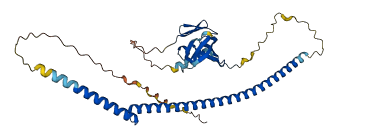
Descriptions
The autoinhibited protein was predicted that may have potential autoinhibitory elements via cis-regPred.
Autoinhibitory domains (AIDs)
Target domain |
|
Relief mechanism |
|
Assay |
cis-regPred |
Accessory elements
No accessory elements
Autoinhibited structure

Activated structure
4 structures for Q8BR65
| Entry ID | Method | Resolution | Chain | Position | Source |
|---|---|---|---|---|---|
| 2N2H | NMR | - | A | 205-228 | PDB |
| 4ZQA | X-ray | 165 A | A | 90-172 | PDB |
| 7SXI | NMR | - | A | 250-326 | PDB |
| AF-Q8BR65-F1 | Predicted | AlphaFoldDB |
13 variants for Q8BR65
| Variant ID(s) | Position | Change | Description | Diseaes Association | Provenance |
|---|---|---|---|---|---|
| rs3388756735 | 87 | L>I | No | EVA | |
| rs3388784508 | 120 | E>D | No | EVA | |
| rs3388781773 | 132 | K>T | No | EVA | |
| rs3388781771 | 141 | D>E | No | EVA | |
| rs3388785328 | 144 | V>* | No | EVA | |
| rs3388773419 | 160 | M>I | No | EVA | |
| rs3388785314 | 183 | R>I | No | EVA | |
| rs3388756728 | 216 | I>F | No | EVA | |
| rs3388784984 | 234 | S>F | No | EVA | |
| rs3388770960 | 263 | Y>* | No | EVA | |
| rs3388776035 | 275 | I>T | No | EVA | |
| rs13463081 | 307 | K>R | No | EVA | |
| rs215971603 | 317 | R>C | No | EVA |
No associated diseases with Q8BR65
No regional properties for Q8BR65
| Type | Name | Position | InterPro Accession |
|---|---|---|---|
| No domain, repeats, and functional sites for Q8BR65 | |||
5 GO annotations of cellular component
| Name | Definition |
|---|---|
| cytosol | The part of the cytoplasm that does not contain organelles but which does contain other particulate matter, such as protein complexes. |
| nuclear body | Extra-nucleolar nuclear domains usually visualized by confocal microscopy and fluorescent antibodies to specific proteins. |
| nucleus | A membrane-bounded organelle of eukaryotic cells in which chromosomes are housed and replicated. In most cells, the nucleus contains all of the cell's chromosomes except the organellar chromosomes, and is the site of RNA synthesis and processing. In some species, or in specialized cell types, RNA metabolism or DNA replication may be absent. |
| Sin3 complex | A multiprotein complex that functions broadly in eukaryotic organisms as a transcriptional repressor of protein-coding genes, through the gene-specific deacetylation of histones. Amongst its subunits, the Sin3 complex contains Sin3-like proteins, and a number of core proteins that are shared with the NuRD complex (including histone deacetylases and histone binding proteins). The Sin3 complex does not directly bind DNA itself, but is targeted to specific genes through protein-protein interactions with DNA-binding proteins. |
| Sin3-type complex | Any of a number of evolutionarily conserved histone deacetylase complexes (HDACs) containing a core consisting of a paired amphipathic helix motif protein (e.g. Sin3p in S. cerevisiae, Pst1 in S. pombe or Sin3A in mammals) at least one class I histone deacetylase (e.g. Rpd3p in S. cerevisiae, Clr6 in S. pombe, or HDAC1 and HDAC2 in mammals), and at least one WD40 repeat protein (e.g. Ume1p in S. cerevisiae, Prw1 in S. pombe, or RbAp46 and RbAp48 in mammals). These complexes also contain a variable number of other proteins that direct histone binding, DNA binding, or add other functionality to the complex. |
4 GO annotations of molecular function
| Name | Definition |
|---|---|
| enzyme binding | Binding to an enzyme, a protein with catalytic activity. |
| histone deacetylase activity | Catalysis of the reaction: histone N6-acetyl-L-lysine + H2O = histone L-lysine + acetate. This reaction represents the removal of an acetyl group from a histone, a class of proteins complexed to DNA in chromatin and chromosomes. |
| histone deacetylase binding | Binding to histone deacetylase. |
| identical protein binding | Binding to an identical protein or proteins. |
11 GO annotations of biological process
| Name | Definition |
|---|---|
| apoptotic process | A programmed cell death process which begins when a cell receives an internal (e.g. DNA damage) or external signal (e.g. an extracellular death ligand), and proceeds through a series of biochemical events (signaling pathway phase) which trigger an execution phase. The execution phase is the last step of an apoptotic process, and is typically characterized by rounding-up of the cell, retraction of pseudopodes, reduction of cellular volume (pyknosis), chromatin condensation, nuclear fragmentation (karyorrhexis), plasma membrane blebbing and fragmentation of the cell into apoptotic bodies. When the execution phase is completed, the cell has died. |
| blastocyst hatching | The hatching of the cellular blastocyst from the zona pellucida. |
| chromatin organization | The assembly or remodeling of chromatin composed of DNA complexed with histones, other associated proteins, and sometimes RNA. |
| histone deacetylation | The modification of histones by removal of acetyl groups. |
| negative regulation of cell migration | Any process that stops, prevents, or reduces the frequency, rate or extent of cell migration. |
| negative regulation of DNA-templated transcription | Any process that stops, prevents, or reduces the frequency, rate or extent of cellular DNA-templated transcription. |
| negative regulation of stem cell population maintenance | Any process that stops, prevents or reduces the frequency, rate or extent of stem cell population maintenance. |
| negative regulation of transcription by RNA polymerase II | Any process that stops, prevents, or reduces the frequency, rate or extent of transcription mediated by RNA polymerase II. |
| negative regulation of transforming growth factor beta receptor signaling pathway | Any process that stops, prevents, or reduces the frequency, rate or extent of any TGF-beta receptor signaling pathway. |
| positive regulation of apoptotic process | Any process that activates or increases the frequency, rate or extent of cell death by apoptotic process. |
| positive regulation of stem cell population maintenance | Any process that activates or increases the frequency, rate or extent of stem cell population maintenance. |
1 homologous proteins in AiPD
| UniProt AC | Gene Name | Protein Name | Species | Evidence Code |
|---|---|---|---|---|
| Q9H7L9 | SUDS3 | Sin3 histone deacetylase corepressor complex component SDS3 | Homo sapiens (Human) | PR |
| 10 | 20 | 30 | 40 | 50 | 60 |
| MSAAGLLAPA | PAPAAAPAAP | EYYPEDEEEL | ESAEDDERSC | RGRESDEDTE | DASETDLAKH |
| 70 | 80 | 90 | 100 | 110 | 120 |
| DEEDYVEMKE | QMYQDKLASL | KRQLQQLQEG | TLQEYQKRMK | KLDQQYRERI | RNAELFLQLE |
| 130 | 140 | 150 | 160 | 170 | 180 |
| TEQVERNYIK | EKKAAVKEFE | DKKVELKENL | IAELEEKKKM | IENEKLTMEL | TGDSMEVKPI |
| 190 | 200 | 210 | 220 | 230 | 240 |
| MTRKLRRRPN | DPVPIPDKRR | KPAPAQLNYL | LTDEQIMEDL | RTLNKLKSPK | RPASPSSPEH |
| 250 | 260 | 270 | 280 | 290 | 300 |
| LPATPAESPA | QRFEARIEDG | KLYYDKRWYH | KSQAIYLESK | DNQKLSCVIS | SVGANEIWVR |
| 310 | 320 | ||||
| KTSDSTKMRI | YVGQLQRGLF | VIRRRSAA |