Q8BHC0
Gene name |
Lyve1 (Crsbp1, Xlkd1) |
Protein name |
Lymphatic vessel endothelial hyaluronic acid receptor 1 |
Names |
LYVE-1, Cell surface retention sequence-binding protein 1, CRSBP-1, Extracellular link domain-containing protein 1 |
Species |
Mus musculus (Mouse) |
KEGG Pathway |
mmu:114332 |
EC number |
|
Protein Class |
|
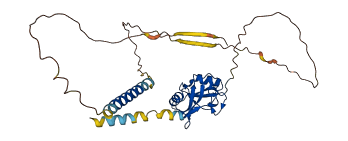
Descriptions
The autoinhibited protein was predicted that may have potential autoinhibitory elements via cis-regPred.
Autoinhibitory domains (AIDs)
Target domain |
|
Relief mechanism |
|
Assay |
cis-regPred |
Accessory elements
No accessory elements
Autoinhibited structure

Activated structure
1 structures for Q8BHC0
| Entry ID | Method | Resolution | Chain | Position | Source |
|---|---|---|---|---|---|
| AF-Q8BHC0-F1 | Predicted | AlphaFoldDB |
16 variants for Q8BHC0
| Variant ID(s) | Position | Change | Description | Diseaes Association | Provenance |
|---|---|---|---|---|---|
| rs3388940727 | 5 | T>N | No | EVA | |
| rs3388931713 | 16 | T>S | No | EVA | |
| rs3398460296 | 20 | P>L | No | EVA | |
| rs3388940757 | 39 | G>D | No | EVA | |
| rs3388931673 | 96 | I>T | No | EVA | |
| rs3388931664 | 143 | V>D | No | EVA | |
| rs255422980 | 158 | E>Q | No | EVA | |
| rs3388936681 | 167 | L>F | No | EVA | |
| rs3388937864 | 174 | T>P | No | EVA | |
| rs3388897415 | 202 | Y>F | No | EVA | |
| rs3397618797 | 237 | L>Q | No | EVA | |
| rs248351910 | 278 | V>A | No | EVA | |
| rs244522889 | 296 | T>P | No | EVA | |
| rs221977199 | 297 | I>V | No | EVA | |
| rs219864941 | 313 | C>Y | No | EVA | |
| rs3388936631 | 316 | A>T | No | EVA |
No associated diseases with Q8BHC0
1 regional properties for Q8BHC0
| Type | Name | Position | InterPro Accession |
|---|---|---|---|
| domain | Link domain | 37 - 129 | IPR000538 |
Functions
3 GO annotations of cellular component
| Name | Definition |
|---|---|
| cell periphery | The part of a cell encompassing the cell cortex, the plasma membrane, and any external encapsulating structures. |
| integral component of membrane | The component of a membrane consisting of the gene products and protein complexes having at least some part of their peptide sequence embedded in the hydrophobic region of the membrane. |
| plasma membrane | The membrane surrounding a cell that separates the cell from its external environment. It consists of a phospholipid bilayer and associated proteins. |
3 GO annotations of molecular function
| Name | Definition |
|---|---|
| cargo receptor activity | Binding specifically to a substance (cargo) to deliver it to a transport vesicle. Cargo receptors span a membrane (either the plasma membrane or a vesicle membrane), binding simultaneously to cargo molecules and coat adaptors, to efficiently recruit soluble proteins to nascent vesicles. |
| hyaluronic acid binding | Binding to hyaluronic acid, a polymer composed of repeating dimeric units of glucuronic acid and N-acetyl glucosamine. |
| transmembrane signaling receptor activity | Combining with an extracellular or intracellular signal and transmitting the signal from one side of the membrane to the other to initiate a change in cell activity or state as part of signal transduction. |
5 GO annotations of biological process
| Name | Definition |
|---|---|
| cell adhesion | The attachment of a cell, either to another cell or to an underlying substrate such as the extracellular matrix, via cell adhesion molecules. |
| glycosaminoglycan catabolic process | The chemical reactions and pathways resulting in the breakdown of glycosaminoglycans, any one of a group of polysaccharides that contain amino sugars. |
| hyaluronan catabolic process | The chemical reactions and pathways resulting in the breakdown of hyaluronan, the naturally occurring anionic form of hyaluronic acid, any member of a group of glycosaminoglycans, the repeat units of which consist of beta-1,4 linked D-glucuronyl-beta-(1,3)-N-acetyl-D-glucosamine. |
| positive regulation of cellular extravasation | Any process that activates or increases the frequency, rate, or extent of cellular extravasation. |
| receptor-mediated endocytosis | An endocytosis process in which cell surface receptors ensure specificity of transport. A specific receptor on the cell surface binds tightly to the extracellular macromolecule (the ligand) that it recognizes; the plasma-membrane region containing the receptor-ligand complex then undergoes endocytosis, forming a transport vesicle containing the receptor-ligand complex and excluding most other plasma-membrane proteins. Receptor-mediated endocytosis generally occurs via clathrin-coated pits and vesicles. |
4 homologous proteins in AiPD
| UniProt AC | Gene Name | Protein Name | Species | Evidence Code |
|---|---|---|---|---|
| Q6UC88 | LYVE1 | Lymphatic vessel endothelial hyaluronic acid receptor 1 | Bos taurus (Bovine) | PR |
| Q9Y5Y7 | LYVE1 | Lymphatic vessel endothelial hyaluronic acid receptor 1 | Homo sapiens (Human) | PR |
| P98066 | TNFAIP6 | Tumor necrosis factor-inducible gene 6 protein | Homo sapiens (Human) | PR |
| O08859 | Tnfaip6 | Tumor necrosis factor-inducible gene 6 protein | Mus musculus (Mouse) | PR |
| 10 | 20 | 30 | 40 | 50 | 60 |
| MLQHTSLVLL | LASIWTTRHP | VQGADLVQDL | SISTCRIMGV | ALVGRNKNPQ | MNFTEANEAC |
| 70 | 80 | 90 | 100 | 110 | 120 |
| KMLGLTLASR | DQVESAQKSG | FETCSYGWVG | EQFSVIPRIF | SNPRCGKNGK | GVLIWNAPSS |
| 130 | 140 | 150 | 160 | 170 | 180 |
| QKFKAYCHNS | SDTWVNSCIP | EIVTTFYPVL | DTQTPATEFS | VSSSAYLASS | PDSTTPVSAT |
| 190 | 200 | 210 | 220 | 230 | 240 |
| TRAPPLTSMA | RKTKKICITE | VYTEPITMAT | ETEAFVASGA | AFKNEAAGFG | GVPTALLVLA |
| 250 | 260 | 270 | 280 | 290 | 300 |
| LLFFGAAAVL | AVCYVKRYVK | AFPFTTKNQQ | KEMIETKVVK | EEKADDVNAN | EESKKTIKNP |
| 310 | |||||
| EEAKSPPKTT | VRCLEAEV |