Q7TNF0
Gene name |
Doc2a |
Protein name |
Double C2-like domain-containing protein alpha |
Names |
Doc2-alpha |
Species |
Mus musculus (Mouse) |
KEGG Pathway |
mmu:13446 |
EC number |
|
Protein Class |
|
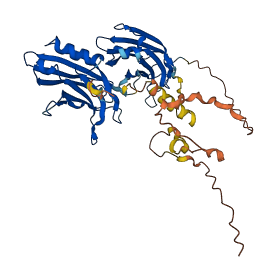
Descriptions
The autoinhibited protein was predicted that may have potential autoinhibitory elements via cis-regPred.
Autoinhibitory domains (AIDs)
Target domain |
|
Relief mechanism |
|
Assay |
cis-regPred |
Accessory elements
No accessory elements
Autoinhibited structure

Activated structure
1 structures for Q7TNF0
| Entry ID | Method | Resolution | Chain | Position | Source |
|---|---|---|---|---|---|
| AF-Q7TNF0-F1 | Predicted | AlphaFoldDB |
16 variants for Q7TNF0
| Variant ID(s) | Position | Change | Description | Diseaes Association | Provenance |
|---|---|---|---|---|---|
| rs241537166 | 79 | D>Y | No | EVA | |
| rs216422226 | 106 | Q>R | No | EVA | |
| rs3388946829 | 152 | T>I | No | EVA | |
| rs3388944359 | 164 | E>K | No | EVA | |
| rs3412659359 | 167 | Y>D | No | EVA | |
| rs3388946802 | 168 | S>C | No | EVA | |
| rs3398110381 | 227 | P>A | No | EVA | |
| rs3388941154 | 228 | S>F | No | EVA | |
| rs3398123246 | 233 | A>E | No | EVA | |
| rs3398110393 | 237 | I>* | No | EVA | |
| rs3398110395 | 247 | A>P | No | EVA | |
| rs3388950198 | 294 | P>T | No | EVA | |
| rs3388941207 | 297 | K>E | No | EVA | |
| rs3388953114 | 301 | R>K | No | EVA | |
| rs3388950220 | 315 | K>M | No | EVA | |
| rs3388920839 | 331 | I>V | No | EVA |
No associated diseases with Q7TNF0
8 GO annotations of cellular component
| Name | Definition |
|---|---|
| anchoring junction | A cell junction that mechanically attaches a cell (and its cytoskeleton) to neighboring cells or to the extracellular matrix. |
| cell junction | A cellular component that forms a specialized region of connection between two or more cells, or between a cell and the extracellular matrix, or between two membrane-bound components of a cell, such as flagella. |
| extrinsic component of synaptic vesicle membrane | The component of the synaptic vesicle membrane consisting of gene products and protein complexes that are loosely bound to one of its surfaces, but not integrated into the hydrophobic region. |
| lysosome | A small lytic vacuole that has cell cycle-independent morphology found in most animal cells and that contains a variety of hydrolases, most of which have their maximal activities in the pH range 5-6. The contained enzymes display latency if properly isolated. About 40 different lysosomal hydrolases are known and lysosomes have a great variety of morphologies and functions. |
| neuron projection | A prolongation or process extending from a nerve cell, e.g. an axon or dendrite. |
| nucleolus | A small, dense body one or more of which are present in the nucleus of eukaryotic cells. It is rich in RNA and protein, is not bounded by a limiting membrane, and is not seen during mitosis. Its prime function is the transcription of the nucleolar DNA into 45S ribosomal-precursor RNA, the processing of this RNA into 5.8S, 18S, and 28S components of ribosomal RNA, and the association of these components with 5S RNA and proteins synthesized outside the nucleolus. This association results in the formation of ribonucleoprotein precursors; these pass into the cytoplasm and mature into the 40S and 60S subunits of the ribosome. |
| nucleoplasm | That part of the nuclear content other than the chromosomes or the nucleolus. |
| synapse | The junction between an axon of one neuron and a dendrite of another neuron, a muscle fiber or a glial cell. As the axon approaches the synapse it enlarges into a specialized structure, the presynaptic terminal bouton, which contains mitochondria and synaptic vesicles. At the tip of the terminal bouton is the presynaptic membrane; facing it, and separated from it by a minute cleft (the synaptic cleft) is a specialized area of membrane on the receiving cell, known as the postsynaptic membrane. In response to the arrival of nerve impulses, the presynaptic terminal bouton secretes molecules of neurotransmitters into the synaptic cleft. These diffuse across the cleft and transmit the signal to the postsynaptic membrane. |
2 GO annotations of molecular function
| Name | Definition |
|---|---|
| calcium ion binding | Binding to a calcium ion (Ca2+). |
| calcium-dependent phospholipid binding | Binding to a phospholipid, a class of lipids containing phosphoric acid as a mono- or diester, in the presence of calcium. |
4 GO annotations of biological process
| Name | Definition |
|---|---|
| exocytosis | A process of secretion by a cell that results in the release of intracellular molecules (e.g. hormones, matrix proteins) contained within a membrane-bounded vesicle. Exocytosis can occur either by full fusion, when the vesicle collapses into the plasma membrane, or by a kiss-and-run mechanism that involves the formation of a transient contact, a pore, between a granule (for exemple of chromaffin cells) and the plasma membrane. The latter process most of the time leads to only partial secretion of the granule content. Exocytosis begins with steps that prepare vesicles for fusion with the membrane (tethering and docking) and ends when molecules are secreted from the cell. |
| regulation of calcium ion-dependent exocytosis | Any process that modulates the frequency, rate or extent of calcium ion-dependent exocytosis. |
| spontaneous neurotransmitter secretion | Neurotransmitter secretion that occurs in the absence of the action of a secretagogue or a presynaptic action potential. |
| synaptic vesicle exocytosis | Fusion of intracellular membrane-bounded vesicles with the pre-synaptic membrane of the neuronal cell resulting in release of neurotransmitter into the synaptic cleft. |
5 homologous proteins in AiPD
| UniProt AC | Gene Name | Protein Name | Species | Evidence Code |
|---|---|---|---|---|
| Q06846 | RPH3A | Rabphilin-3A | Bos taurus (Bovine) | PR |
| Q9Y2J0 | RPH3A | Rabphilin-3A | Homo sapiens (Human) | PR |
| Q14183 | DOC2A | Double C2-like domain-containing protein alpha | Homo sapiens (Human) | PR |
| P47708 | Rph3a | Rabphilin-3A | Mus musculus (Mouse) | PR |
| P47709 | Rph3a | Rabphilin-3A | Rattus norvegicus (Rat) | PR |
| 10 | 20 | 30 | 40 | 50 | 60 |
| MRGRRGDRMT | INIQEHMAIN | VCPGPIRPIR | QISDYFPRRG | PGPEGGGGGG | GTGCGEAPAH |
| 70 | 80 | 90 | 100 | 110 | 120 |
| LAPLALAPPA | ALLGATTPDD | GAEVDSYDSD | DTTALGTLEF | DLLYDQASCM | LHCRILRAKG |
| 130 | 140 | 150 | 160 | 170 | 180 |
| LKPMDFNGLA | DPYVKLHLLP | GACKANKLKT | KTQRNTLNPV | WNEELTYSGI | TDDDITHKVL |
| 190 | 200 | 210 | 220 | 230 | 240 |
| RISVCDEDKL | SHNEFIGEIR | VPLRRLKPSQ | KKHFNICLER | QVPLPSPSSM | SAALRGISCY |
| 250 | 260 | 270 | 280 | 290 | 300 |
| LKELEQAEQG | PGLLEERGRI | LLSLSYSSRR | HGLLVGIVRC | AHLAAMDVNG | YSDPYVKTYL |
| 310 | 320 | 330 | 340 | 350 | 360 |
| RPDVDKKSKH | KTCVKKKTLN | PEFNEEFFYE | IELSTLATKT | LEVTVWDYDI | GKSNDFIGGV |
| 370 | 380 | 390 | 400 | ||
| SLGPGARGEA | QKHWNDCLHQ | PDTALERWHT | LTSELPPAAG | AYPLA |