P47708
Gene name |
Rph3a |
Protein name |
Rabphilin-3A |
Names |
Exophilin-1 |
Species |
Mus musculus (Mouse) |
KEGG Pathway |
mmu:19894 |
EC number |
|
Protein Class |
|
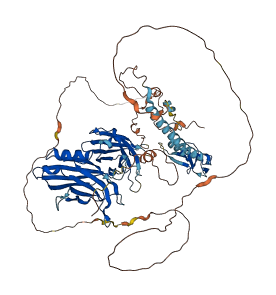
Descriptions
The autoinhibited protein was predicted that may have potential autoinhibitory elements via cis-regPred.
Autoinhibitory domains (AIDs)
Target domain |
|
Relief mechanism |
|
Assay |
cis-regPred |
Accessory elements
No accessory elements
Autoinhibited structure

Activated structure
2 structures for P47708
| Entry ID | Method | Resolution | Chain | Position | Source |
|---|---|---|---|---|---|
| 2K3H | NMR | - | A | 368-507 | PDB |
| AF-P47708-F1 | Predicted | AlphaFoldDB |
41 variants for P47708
| Variant ID(s) | Position | Change | Description | Diseaes Association | Provenance |
|---|---|---|---|---|---|
| rs3388792032 | 15 | G>V | No | EVA | |
| rs3396034487 | 34 | G>A* | No | EVA | |
| rs3388768991 | 74 | R>C | No | EVA | |
| rs3388785518 | 85 | N>K | No | EVA | |
| rs3388794292 | 86 | V>L | No | EVA | |
| rs3396161725 | 114 | C>W | No | EVA | |
| rs3395436845 | 115 | K>M | No | EVA | |
| rs3396167912 | 115 | K>S* | No | EVA | |
| rs3396161683 | 116 | K>M | No | EVA | |
| rs3388788835 | 151 | G>* | No | EVA | |
| rs3388794286 | 173 | K>E | No | EVA | |
| rs3395968837 | 175 | Q>L | No | EVA | |
| rs3388794276 | 180 | E>D | No | EVA | |
| rs3388788448 | 182 | A>V | No | EVA | |
| rs3388758165 | 202 | D>* | No | EVA | |
| rs3388773683 | 202 | D>E | No | EVA | |
| rs3388758165 | 203 | M>* | No | EVA | |
| rs3388781094 | 204 | E>G | No | EVA | |
| rs3388768973 | 207 | R>G | No | EVA | |
| rs3388791952 | 236 | A>T | No | EVA | |
| rs238976198 | 237 | R>Q | No | EVA | |
| rs3388758209 | 241 | A>T | No | EVA | |
| rs239523245 | 256 | T>A | No | EVA | |
| rs1133967822 | 277 | P>L | No | EVA | |
| rs3388788417 | 284 | S>N | No | EVA | |
| rs213441577 | 362 | A>T | No | EVA | |
| rs3396167859 | 420 | K>* | No | EVA | |
| rs3396161731 | 420 | K>N | No | EVA | |
| rs3395436962 | 425 | P>A | No | EVA | |
| rs3395886482 | 426 | G>A | No | EVA | |
| rs3395749181 | 426 | G>R | No | EVA | |
| rs3395968150 | 427 | A>G | No | EVA | |
| rs3388773691 | 453 | H>L | No | EVA | |
| rs3388788278 | 470 | C>S | No | EVA | |
| rs3388794317 | 471 | D>G* | No | EVA | |
| rs3388787030 | 501 | I>V | No | EVA | |
| rs3388788811 | 562 | V>L | No | EVA | |
| rs3388788232 | 572 | Y>* | No | EVA | |
| rs3388783115 | 614 | H>Y | No | EVA | |
| rs3412028339 | 643 | L>Q | No | EVA | |
| rs3388788272 | 647 | A>T | No | EVA |
No associated diseases with P47708
5 regional properties for P47708
| Type | Name | Position | InterPro Accession |
|---|---|---|---|
| domain | DNA-directed DNA polymerase X | 185 - 574 | IPR002054 |
| domain | DNA polymerase beta-like, N-terminal domain | 188 - 254 | IPR010996 |
| binding_site | DNA polymerase family X, binding site | 356 - 375 | IPR019843 |
| domain | DNA polymerase beta, palm domain | 327 - 406 | IPR028207 |
| domain | DNA polymerase beta, thumb domain | 516 - 574 | IPR029398 |
Functions
15 GO annotations of cellular component
| Name | Definition |
|---|---|
| anchoring junction | A cell junction that mechanically attaches a cell (and its cytoskeleton) to neighboring cells or to the extracellular matrix. |
| cholinergic synapse | A synapse that uses acetylcholine as a neurotransmitter. |
| cytosol | The part of the cytoplasm that does not contain organelles but which does contain other particulate matter, such as protein complexes. |
| dendritic spine | A small, membranous protrusion from a dendrite that forms a postsynaptic compartment, typically receiving input from a single presynapse. They function as partially isolated biochemical and an electrical compartments. Spine morphology is variable:they can be thin, stubby, mushroom, or branched, with a continuum of intermediate morphologies. They typically terminate in a bulb shape, linked to the dendritic shaft by a restriction. Spine remodeling is though to be involved in synaptic plasticity. |
| extrinsic component of membrane | The component of a membrane consisting of gene products and protein complexes that are loosely bound to one of its surfaces, but not integrated into the hydrophobic region. |
| extrinsic component of synaptic vesicle membrane | The component of the synaptic vesicle membrane consisting of gene products and protein complexes that are loosely bound to one of its surfaces, but not integrated into the hydrophobic region. |
| Golgi apparatus | A membrane-bound cytoplasmic organelle of the endomembrane system that further processes the core oligosaccharides (e.g. N-glycans) added to proteins in the endoplasmic reticulum and packages them into membrane-bound vesicles. The Golgi apparatus operates at the intersection of the secretory, lysosomal, and endocytic pathways. |
| neuromuscular junction | The junction between the axon of a motor neuron and a muscle fiber. In response to the arrival of action potentials, the presynaptic button releases molecules of neurotransmitters into the synaptic cleft. These diffuse across the cleft and transmit the signal to the postsynaptic membrane of the muscle fiber, leading to a change in post-synaptic potential. |
| neuron projection | A prolongation or process extending from a nerve cell, e.g. an axon or dendrite. |
| postsynaptic membrane | A specialized area of membrane facing the presynaptic membrane on the tip of the nerve ending and separated from it by a minute cleft (the synaptic cleft). Neurotransmitters cross the synaptic cleft and transmit the signal to the postsynaptic membrane. |
| protein-containing complex | A stable assembly of two or more macromolecules, i.e. proteins, nucleic acids, carbohydrates or lipids, in which at least one component is a protein and the constituent parts function together. |
| secretory granule | A small subcellular vesicle, surrounded by a membrane, that is formed from the Golgi apparatus and contains a highly concentrated protein destined for secretion. Secretory granules move towards the periphery of the cell and upon stimulation, their membranes fuse with the cell membrane, and their protein load is exteriorized. Processing of the contained protein may take place in secretory granules. |
| synapse | The junction between an axon of one neuron and a dendrite of another neuron, a muscle fiber or a glial cell. As the axon approaches the synapse it enlarges into a specialized structure, the presynaptic terminal bouton, which contains mitochondria and synaptic vesicles. At the tip of the terminal bouton is the presynaptic membrane; facing it, and separated from it by a minute cleft (the synaptic cleft) is a specialized area of membrane on the receiving cell, known as the postsynaptic membrane. In response to the arrival of nerve impulses, the presynaptic terminal bouton secretes molecules of neurotransmitters into the synaptic cleft. These diffuse across the cleft and transmit the signal to the postsynaptic membrane. |
| synaptic vesicle | A secretory organelle, typically 50 nm in diameter, of presynaptic nerve terminals; accumulates in high concentrations of neurotransmitters and secretes these into the synaptic cleft by fusion with the 'active zone' of the presynaptic plasma membrane. |
| synaptic vesicle membrane | The lipid bilayer surrounding a synaptic vesicle. |
9 GO annotations of molecular function
| Name | Definition |
|---|---|
| calcium ion binding | Binding to a calcium ion (Ca2+). |
| calcium-dependent phospholipid binding | Binding to a phospholipid, a class of lipids containing phosphoric acid as a mono- or diester, in the presence of calcium. |
| inositol 1,4,5 trisphosphate binding | Binding to inositol 1,4,5 trisphosphate. |
| phosphate ion binding | Binding to a phosphate ion. |
| phosphatidylinositol-4,5-bisphosphate binding | Binding to phosphatidylinositol-4,5-bisphosphate, a derivative of phosphatidylinositol in which the inositol ring is phosphorylated at the 4' and 5' positions. |
| protein-containing complex binding | Binding to a macromolecular complex. |
| selenium binding | Binding to a selenium (Se) ion. |
| small GTPase binding | Binding to a small monomeric GTPase. |
| zinc ion binding | Binding to a zinc ion (Zn). |
6 GO annotations of biological process
| Name | Definition |
|---|---|
| dendritic spine organization | A process that is carried out at the cellular level which results in the assembly, arrangement of constituent parts, or disassembly of a dendritic spine. A dendritic spine is a specialized protrusion from a neuronal dendrite and is involved in synaptic transmission. |
| exocytosis | A process of secretion by a cell that results in the release of intracellular molecules (e.g. hormones, matrix proteins) contained within a membrane-bounded vesicle. Exocytosis can occur either by full fusion, when the vesicle collapses into the plasma membrane, or by a kiss-and-run mechanism that involves the formation of a transient contact, a pore, between a granule (for exemple of chromaffin cells) and the plasma membrane. The latter process most of the time leads to only partial secretion of the granule content. Exocytosis begins with steps that prepare vesicles for fusion with the membrane (tethering and docking) and ends when molecules are secreted from the cell. |
| intracellular protein transport | The directed movement of proteins in a cell, including the movement of proteins between specific compartments or structures within a cell, such as organelles of a eukaryotic cell. |
| regulation of calcium ion-dependent exocytosis | Any process that modulates the frequency, rate or extent of calcium ion-dependent exocytosis. |
| regulation of NMDA receptor activity | Any process that modulates the frequency, rate or extent of N-methyl-D-aspartate selective glutamate receptor activity. |
| spontaneous neurotransmitter secretion | Neurotransmitter secretion that occurs in the absence of the action of a secretagogue or a presynaptic action potential. |
5 homologous proteins in AiPD
| UniProt AC | Gene Name | Protein Name | Species | Evidence Code |
|---|---|---|---|---|
| Q06846 | RPH3A | Rabphilin-3A | Bos taurus (Bovine) | PR |
| Q14183 | DOC2A | Double C2-like domain-containing protein alpha | Homo sapiens (Human) | PR |
| Q9Y2J0 | RPH3A | Rabphilin-3A | Homo sapiens (Human) | PR |
| Q7TNF0 | Doc2a | Double C2-like domain-containing protein alpha | Mus musculus (Mouse) | PR |
| P47709 | Rph3a | Rabphilin-3A | Rattus norvegicus (Rat) | PR |
| 10 | 20 | 30 | 40 | 50 | 60 |
| MTDTVVNRWM | YPGDGPLQSN | DKEQLQAGWS | VHPGAQTDRQ | RKQEELTDEE | KEIINRVIAR |
| 70 | 80 | 90 | 100 | 110 | 120 |
| AEKMEAMEQE | RIGRLVDRLE | TMRKNVAGDG | VNRCILCGEQ | LGMLGSACVV | CEDCKKNVCT |
| 130 | 140 | 150 | 160 | 170 | 180 |
| KCGVETSNNR | PHPVWLCKIC | LEQREVWKRS | GAWFFKGFPK | QVLPQPMPIK | KTKPQQPAGE |
| 190 | 200 | 210 | 220 | 230 | 240 |
| PATQEQPTPE | SRHPARAPAR | GDMEDRRPPG | QKPGPDLTSA | PGRGSHGPPT | RRASEARMST |
| 250 | 260 | 270 | 280 | 290 | 300 |
| AARDSEGWDH | AHGGGTGDTS | RSPAGLRRAN | SVQAARPAPA | PVPSPAPPQP | VQPGPPGGSR |
| 310 | 320 | 330 | 340 | 350 | 360 |
| ATPGPGRFPE | QSTEAPPSDP | GYPGAVAPAR | EERTGPAGGF | QAAPHTAAPY | SQAAPARQPP |
| 370 | 380 | 390 | 400 | 410 | 420 |
| PAEEEEEEAN | SYDSDEATTL | GALEFSLLYD | QDNSNLQCTI | IRAKGLKPMD | SNGLADPYVK |
| 430 | 440 | 450 | 460 | 470 | 480 |
| LHLLPGASKS | NKLRTKTLRN | TRNPVWNETL | QYHGITEEDM | QRKTLRISVC | DEDKFGHNEF |
| 490 | 500 | 510 | 520 | 530 | 540 |
| IGETRFSLKK | LKANQRKNFN | ICLERVIPMK | RAGTTGSARG | MALYEEEQVE | RIGDIEERGK |
| 550 | 560 | 570 | 580 | 590 | 600 |
| ILVSLMYSTQ | QGGLIVGIIR | CVHLAAMDAN | GYSDPFVKLW | LKPDMGKKAK | HKTQIKKKTL |
| 610 | 620 | 630 | 640 | 650 | 660 |
| NPEFNEEFFY | DIKHSDLAKK | SLDISVWDYD | IGKSNDYIGG | CQLGISAKGE | RLKHWYECLK |
| 670 | 680 | ||||
| NKDKKIERWH | QLQNENHVSS | D |