Q6X7S9
Gene name |
Eid2 |
Protein name |
EP300-interacting inhibitor of differentiation 2 |
Names |
EID-2, CREBBP/EP300 inhibitor 2, EID-1-like inhibitor of differentiation 2 |
Species |
Mus musculus (Mouse) |
KEGG Pathway |
mmu:386655 |
EC number |
|
Protein Class |
|
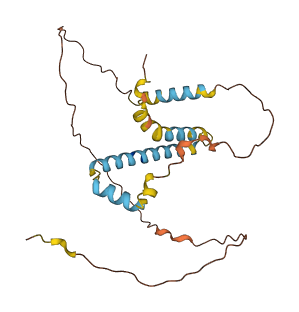
Descriptions
The autoinhibited protein was predicted that may have potential autoinhibitory elements via cis-regPred.
Autoinhibitory domains (AIDs)
Target domain |
|
Relief mechanism |
|
Assay |
cis-regPred |
Accessory elements
No accessory elements
Autoinhibited structure

Activated structure
1 structures for Q6X7S9
| Entry ID | Method | Resolution | Chain | Position | Source |
|---|---|---|---|---|---|
| AF-Q6X7S9-F1 | Predicted | AlphaFoldDB |
2 variants for Q6X7S9
| Variant ID(s) | Position | Change | Description | Diseaes Association | Provenance |
|---|---|---|---|---|---|
| rs233783226 | 38 | A>S | No | EVA | |
| rs582362890 | 86 | P>A | No | EVA |
No associated diseases with Q6X7S9
No regional properties for Q6X7S9
| Type | Name | Position | InterPro Accession |
|---|---|---|---|
| No domain, repeats, and functional sites for Q6X7S9 | |||
2 GO annotations of cellular component
| Name | Definition |
|---|---|
| nucleoplasm | That part of the nuclear content other than the chromosomes or the nucleolus. |
| nucleus | A membrane-bounded organelle of eukaryotic cells in which chromosomes are housed and replicated. In most cells, the nucleus contains all of the cell's chromosomes except the organellar chromosomes, and is the site of RNA synthesis and processing. In some species, or in specialized cell types, RNA metabolism or DNA replication may be absent. |
2 GO annotations of molecular function
| Name | Definition |
|---|---|
| SMAD binding | Binding to a SMAD signaling protein. |
| transcription corepressor activity | A transcription coregulator activity that represses or decreases the transcription of specific gene sets via binding to a DNA-bound DNA-binding transcription factor, either on its own or as part of a complex. Corepressors often act by altering chromatin structure and modifications. For example, one class of transcription corepressors modifies chromatin structure through covalent modification of histones. A second class remodels the conformation of chromatin in an ATP-dependent fashion. A third class modulates interactions of DNA-bound DNA-binding transcription factors with other transcription coregulators. |
9 GO annotations of biological process
| Name | Definition |
|---|---|
| cell differentiation | The process in which relatively unspecialized cells, e.g. embryonic or regenerative cells, acquire specialized structural and/or functional features that characterize the cells, tissues, or organs of the mature organism or some other relatively stable phase of the organism's life history. Differentiation includes the processes involved in commitment of a cell to a specific fate and its subsequent development to the mature state. |
| muscle organ development | The process whose specific outcome is the progression of the muscle over time, from its formation to the mature structure. The muscle is an organ consisting of a tissue made up of various elongated cells that are specialized to contract and thus to produce movement and mechanical work. |
| negative regulation of DNA-templated transcription | Any process that stops, prevents, or reduces the frequency, rate or extent of cellular DNA-templated transcription. |
| negative regulation of transcription by RNA polymerase II | Any process that stops, prevents, or reduces the frequency, rate or extent of transcription mediated by RNA polymerase II. |
| negative regulation of transforming growth factor beta receptor signaling pathway | Any process that stops, prevents, or reduces the frequency, rate or extent of any TGF-beta receptor signaling pathway. |
| regulation of cell population proliferation | Any process that modulates the frequency, rate or extent of cell proliferation. |
| regulation of transforming growth factor beta receptor signaling pathway | Any process that modulates the frequency, rate or extent of activity of any TGF-beta receptor signaling pathway. |
| SMAD protein complex assembly | The aggregation, arrangement and bonding together of a set of components to form a protein complex that contains SMAD proteins. |
| transforming growth factor beta receptor complex assembly | The aggregation, arrangement and bonding together of a ligand-bound type II transforming growth factor beta (TGF-beta) receptor dimer with a type I TGF-beta receptor dimer, following ligand binding, to form a heterotetrameric TGF-beta receptor complex. |
| 10 | 20 | 30 | 40 | 50 | 60 |
| MSQLPAVSSA | PQTGAASRDR | RLPQAEVGGG | RRALPGPARP | GETRGRPMAA | AREGPAAPAA |
| 70 | 80 | 90 | 100 | 110 | 120 |
| AARGGRVAAA | REGRAAAARG | GPGAAPRGGA | AAREGPAAAA | ASREARMAEV | ARLLGDPLEE |
| 130 | 140 | 150 | 160 | 170 | 180 |
| EAPEGRPRSR | AGGLAAMPYM | RFRHPLSVLG | INYQQFLRHY | LENYPIAPGR | IQELEERRRR |
| 190 | 200 | 210 | 220 | 230 | |
| FVEACRAREA | AFDIEYLRNP | QRVDFDILTF | TIALTASEVI | NPLIEELGCD | KFIHRE |