Q6P205
Gene name |
Xlr3b |
Protein name |
X-linked lymphocyte-regulated protein 3B |
Names |
|
Species |
Mus musculus (Mouse) |
KEGG Pathway |
mmu:574437 |
EC number |
|
Protein Class |
|
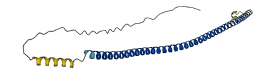
Descriptions
The autoinhibited protein was predicted that may have potential autoinhibitory elements via cis-regPred.
Autoinhibitory domains (AIDs)
Target domain |
|
Relief mechanism |
|
Assay |
cis-regPred |
Accessory elements
No accessory elements
Autoinhibited structure

Activated structure
1 structures for Q6P205
| Entry ID | Method | Resolution | Chain | Position | Source |
|---|---|---|---|---|---|
| AF-Q6P205-F1 | Predicted | AlphaFoldDB |
8 variants for Q6P205
| Variant ID(s) | Position | Change | Description | Diseaes Association | Provenance |
|---|---|---|---|---|---|
| rs3389541954 | 28 | Q>R | No | EVA | |
| rs3389558997 | 35 | A>E | No | EVA | |
| rs3389471582 | 36 | A>T | No | EVA | |
| rs3389471577 | 94 | A>T | No | EVA | |
| rs3389557013 | 136 | K>Q | No | EVA | |
| rs3409854729 | 138 | H>Q | No | EVA | |
| rs3389561421 | 218 | Q>H | No | EVA | |
| rs3389541959 | 220 | L>H | No | EVA |
No associated diseases with Q6P205
1 regional properties for Q6P205
| Type | Name | Position | InterPro Accession |
|---|---|---|---|
| domain | XLR/SYCP3/FAM9 domain | 75 - 202 | IPR006888 |
1 GO annotations of cellular component
| Name | Definition |
|---|---|
| synaptonemal complex | A proteinaceous scaffold found between homologous chromosomes during meiosis. It consists of 2 lateral elements and a central element, all running parallel to each other. Transverse filaments connect the lateral elements to the central element. |
No GO annotations of molecular function
| Name | Definition |
|---|---|
| No GO annotations for molecular function |
4 GO annotations of biological process
| Name | Definition |
|---|---|
| meiotic cell cycle | Progression through the phases of the meiotic cell cycle, in which canonically a cell replicates to produce four offspring with half the chromosomal content of the progenitor cell via two nuclear divisions. |
| positive regulation of dendritic spine morphogenesis | Any process that increases the rate, frequency, or extent of dendritic spine morphogenesis, the process in which the anatomical structures of a dendritic spine are generated and organized. A dendritic spine is a protrusion from a dendrite and a specialized subcellular compartment involved in synaptic transmission. |
| positive regulation of synapse assembly | Any process that activates, maintains or increases the frequency, rate or extent of synapse assembly, the aggregation, arrangement and bonding together of a set of components to form a synapse. |
| spermatid development | The process whose specific outcome is the progression of a spermatid over time, from its formation to the mature structure. |
| 10 | 20 | 30 | 40 | 50 | 60 |
| MSSRKRKATD | TAGRHSRMDP | NLSSDDSQNP | GAVAAANREV | LDAGREDIIS | SGTERQQARK |
| 70 | 80 | 90 | 100 | 110 | 120 |
| EKQDLVQEFE | EPPNKVLQEN | RERFSRIMTS | SFSAMEVKIK | DVLKTHCEER | QKLCQDYSLQ |
| 130 | 140 | 150 | 160 | 170 | 180 |
| FTNLNRKLTS | DAYKLKKHAE | TLSNMFMEQQ | KFIHESLTLQ | KNRMKEFKSL | CEKYLEKLEV |
| 190 | 200 | 210 | 220 | ||
| LRDSRGNSIA | EELRRLIATL | EIKLLMLHNQ | QKTAAPPQSL | LDVLFS |