Q6NZ21
Gene name |
rnft1 (zgc:77306) |
Protein name |
E3 ubiquitin-protein ligase RNFT1 |
Names |
RING finger and transmembrane domain-containing protein 1 |
Species |
Danio rerio (Zebrafish) (Brachydanio rerio) |
KEGG Pathway |
dre:406509 |
EC number |
|
Protein Class |
|
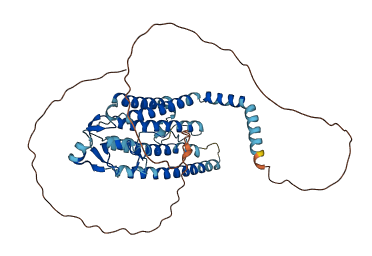
Descriptions
The autoinhibited protein was predicted that may have potential autoinhibitory elements via cis-regPred.
Autoinhibitory domains (AIDs)
Target domain |
|
Relief mechanism |
|
Assay |
cis-regPred |
Accessory elements
No accessory elements
Autoinhibited structure

Activated structure
1 structures for Q6NZ21
| Entry ID | Method | Resolution | Chain | Position | Source |
|---|---|---|---|---|---|
| AF-Q6NZ21-F1 | Predicted | AlphaFoldDB |
No variants for Q6NZ21
| Variant ID(s) | Position | Change | Description | Diseaes Association | Provenance |
|---|---|---|---|---|---|
| No variants for Q6NZ21 | |||||
No associated diseases with Q6NZ21
3 regional properties for Q6NZ21
| Type | Name | Position | InterPro Accession |
|---|---|---|---|
| conserved_site | Clathrin adaptor, mu subunit, conserved site | 157 - 177 | IPR018240-1 |
| conserved_site | Clathrin adaptor, mu subunit, conserved site | 253 - 267 | IPR018240-2 |
| domain | Mu homology domain | 157 - 421 | IPR028565 |
3 GO annotations of cellular component
| Name | Definition |
|---|---|
| endoplasmic reticulum | The irregular network of unit membranes, visible only by electron microscopy, that occurs in the cytoplasm of many eukaryotic cells. The membranes form a complex meshwork of tubular channels, which are often expanded into slitlike cavities called cisternae. The ER takes two forms, rough (or granular), with ribosomes adhering to the outer surface, and smooth (with no ribosomes attached). |
| endoplasmic reticulum membrane | The lipid bilayer surrounding the endoplasmic reticulum. |
| integral component of membrane | The component of a membrane consisting of the gene products and protein complexes having at least some part of their peptide sequence embedded in the hydrophobic region of the membrane. |
2 GO annotations of molecular function
| Name | Definition |
|---|---|
| metal ion binding | Binding to a metal ion. |
| ubiquitin protein ligase activity | Catalysis of the transfer of ubiquitin to a substrate protein via the reaction X-ubiquitin + S -> X + S-ubiquitin, where X is either an E2 or E3 enzyme, the X-ubiquitin linkage is a thioester bond, and the S-ubiquitin linkage is an amide bond: an isopeptide bond between the C-terminal glycine of ubiquitin and the epsilon-amino group of lysine residues in the substrate or, in the linear extension of ubiquitin chains, a peptide bond the between the C-terminal glycine and N-terminal methionine of ubiquitin residues. |
1 GO annotations of biological process
| Name | Definition |
|---|---|
| positive regulation of ERAD pathway | Any process that activates or increases the frequency, rate or extent of ERAD pathway. |
| 10 | 20 | 30 | 40 | 50 | 60 |
| MKLRAQFDRG | TYSESKGSFK | LRDSLDPMQP | EPSSREGNGL | SLTLQPELLA | RMPGAGSSSG |
| 70 | 80 | 90 | 100 | 110 | 120 |
| TETGEDVRVP | MGSSSGSTNG | RGATSRRMRT | ASHSHSHTHG | HGHSHEHESD | SGESDLESGE |
| 130 | 140 | 150 | 160 | 170 | 180 |
| SSSSISELRY | LLRWLKKSLP | FIVILCAKLV | IQHALGLAVA | VGLFTTFMYV | NKSIQTQVFL |
| 190 | 200 | 210 | 220 | 230 | 240 |
| HDRRTNLHCA | WLLLFLTSSS | LLVFYTFHTQ | SLYRCLFFAN | ATIDYHNFWE | VLWSVGVTNF |
| 250 | 260 | 270 | 280 | 290 | 300 |
| ILKFIFMGFK | CLILLVPCPL | MTYRRRGQWY | MLIEEVGQLY | QVIAPVPLWF | RYLVSYDEMD |
| 310 | 320 | 330 | 340 | 350 | 360 |
| TSVGLTLGIL | LALLYLIMKL | LALYGLSGSL | QKTLRTFFSP | EVNGAPASPA | QIREAGDICP |
| 370 | 380 | 390 | 400 | 410 | |
| ICQADFKQPR | VLVCQHIFCE | ECIAQWLNQE | RTCPLCRTVI | TDKVHKWKDG | ATSAHLQIY |