Q6NWG4
Gene name |
prmt6 |
Protein name |
Protein arginine N-methyltransferase 6 |
Names |
Histone-arginine N-methyltransferase PRMT6 |
Species |
Danio rerio (Zebrafish) (Brachydanio rerio) |
KEGG Pathway |
|
EC number |
2.1.1.319: Methyltransferases |
Protein Class |
|
Descriptions
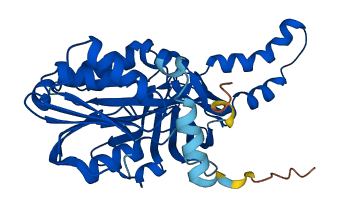
The autoinhibited protein was predicted that may have potential autoinhibitory elements via cis-regPred.
Autoinhibitory domains (AIDs)
Target domain |
|
Relief mechanism |
|
Assay |
cis-regPred |
Accessory elements
No accessory elements
Autoinhibited structure

Activated structure
1 structures for Q6NWG4
| Entry ID | Method | Resolution | Chain | Position | Source |
|---|---|---|---|---|---|
| AF-Q6NWG4-F1 | Predicted | AlphaFoldDB |
No variants for Q6NWG4
| Variant ID(s) | Position | Change | Description | Diseaes Association | Provenance |
|---|---|---|---|---|---|
| No variants for Q6NWG4 | |||||
No associated diseases with Q6NWG4
No regional properties for Q6NWG4
| Type | Name | Position | InterPro Accession |
|---|---|---|---|
| No domain, repeats, and functional sites for Q6NWG4 | |||
Functions
| Description | ||
|---|---|---|
| EC Number | 2.1.1.319 | Methyltransferases |
| Subcellular Localization |
|
|
| PANTHER Family | ||
| PANTHER Subfamily | ||
| PANTHER Protein Class | ||
| PANTHER Pathway Category | No pathway information available | |
2 GO annotations of cellular component
| Name | Definition |
|---|---|
| chromatin | The ordered and organized complex of DNA, protein, and sometimes RNA, that forms the chromosome. |
| nucleus | A membrane-bounded organelle of eukaryotic cells in which chromosomes are housed and replicated. In most cells, the nucleus contains all of the cell's chromosomes except the organellar chromosomes, and is the site of RNA synthesis and processing. In some species, or in specialized cell types, RNA metabolism or DNA replication may be absent. |
9 GO annotations of molecular function
| Name | Definition |
|---|---|
| histone binding | Binding to a histone, any of a group of water-soluble proteins found in association with the DNA of eukaryotic or archaeal chromosomes. They are involved in the condensation and coiling of chromosomes during cell division and have also been implicated in gene regulation and DNA replication. They may be chemically modified (methylated, acetlyated and others) to regulate gene transcription. |
| histone methyltransferase activity | Catalysis of the reaction: S-adenosyl-L-methionine + histone = S-adenosyl-L-homocysteine + methyl-histone. Histone methylation generally occurs on either an arginine or lysine residue. |
| histone methyltransferase activity (H2A-R3 specific) | Catalysis of the reaction: S-adenosyl-L-methionine + (histone H2A)-arginine (position 3) = S-adenosyl-L-homocysteine + (histone H2A)-N-methyl-arginine (position 3). This reaction is the addition of a methyl group to arginine at position 3 of histone H2A. |
| histone methyltransferase activity (H3-R2 specific) | Catalysis of the reaction: S-adenosyl-L-methionine + (histone H3)-arginine (position 2) = S-adenosyl-L-homocysteine + (histone H3)-N-methyl-arginine (position 2). This reaction is the addition of a methyl group to arginine at position 2 of histone H3. |
| histone methyltransferase activity (H4-R3 specific) | Catalysis of the reaction: S-adenosyl-L-methionine + (histone H4)-arginine (position 3) = S-adenosyl-L-homocysteine + (histone H4)-N-methyl-arginine (position 3). This reaction is the addition of a methyl group to arginine at position 3 of histone H4. |
| histone-arginine N-methyltransferase activity | Catalysis of the reaction: S-adenosyl-L-methionine + (histone)-arginine = S-adenosyl-L-homocysteine + (histone)-N-methyl-arginine. |
| protein-arginine omega-N asymmetric methyltransferase activity | Catalysis of the addition of a second methyl group to methylated peptidyl-arginine. Methylation is on the same terminal nitrogen (omega nitrogen) residue that was previously methylated, resulting in asymmetrical peptidyl-N(omega),N(omega)-dimethylated arginine residues. |
| protein-arginine omega-N monomethyltransferase activity | Catalysis of the addition of a methyl group to either of the unmethylated terminal nitrogen atoms (also called omega nitrogen) in peptidyl-arginine to form an omega-N-G-monomethylated arginine residue. The reaction is S-adenosyl-L-methionine |
| S-adenosylmethionine-dependent methyltransferase activity | +Catalysis of the transfer of a methyl group from S-adenosyl-L-methionine to a substrate. |
8 GO annotations of biological process
| Name | Definition |
|---|---|
| chromatin organization | The assembly or remodeling of chromatin composed of DNA complexed with histones, other associated proteins, and sometimes RNA. |
| DNA repair | The process of restoring DNA after damage. Genomes are subject to damage by chemical and physical agents in the environment (e.g. UV and ionizing radiations, chemical mutagens, fungal and bacterial toxins, etc.) and by free radicals or alkylating agents endogenously generated in metabolism. DNA is also damaged because of errors during its replication. A variety of different DNA repair pathways have been reported that include direct reversal, base excision repair, nucleotide excision repair, photoreactivation, bypass, double-strand break repair pathway, and mismatch repair pathway. |
| histone H3-R2 methylation | The modification of histone H3 by addition of a methyl group to arginine at position 2 of the histone. |
| negative regulation of DNA-templated transcription | Any process that stops, prevents, or reduces the frequency, rate or extent of cellular DNA-templated transcription. |
| negative regulation of gene expression | Any process that decreases the frequency, rate or extent of gene expression. Gene expression is the process in which a gene's coding sequence is converted into a mature gene product (protein or RNA). |
| negative regulation of histone H3-K4 methylation | Any process that stops, prevents, or reduces the frequency, rate or extent of the covalent addition of a methyl group to the lysine at position 4 of histone H3. |
| peptidyl-arginine methylation, to asymmetrical-dimethyl arginine | The process of methylation of peptidyl-arginine to form peptidyl-N(omega),N(omega)-dimethyl-L-arginine. |
| peptidyl-arginine N-methylation | The addition of a methyl group onto a nitrogen atom of an arginine residue in a protein. |
4 homologous proteins in AiPD
| UniProt AC | Gene Name | Protein Name | Species | Evidence Code |
|---|---|---|---|---|
| Q9JIF0 | Prmt1 | Protein arginine N-methyltransferase 1 | Mus musculus (Mouse) | PR |
| Q63009 | Prmt1 | Protein arginine N-methyltransferase 1 | Rattus norvegicus (Rat) | PR |
| Q7XKC0 | PRMT6.1 | Probable protein arginine N-methyltransferase 6.1 | Oryza sativa subsp japonica (Rice) | PR |
| A2AV36 | prmt7 | Protein arginine N-methyltransferase 7 | Danio rerio (Zebrafish) (Brachydanio rerio) | PR |
| 10 | 20 | 30 | 40 | 50 | 60 |
| MSQHATKKRK | LDRSTEDYMY | FDSYSDVTIH | EEMIADTVRT | NTYRMGIFKN | SKSIEGKVVL |
| 70 | 80 | 90 | 100 | 110 | 120 |
| DVGAGTGVLS | LFCAQAGARK | VYAVEASSIA | DQAVKIVKLN | QMEDRIEVIK | STLETIELAE |
| 130 | 140 | 150 | 160 | 170 | 180 |
| KVDVIVSEWM | GYALLHESML | NSVIFARDKW | LKPGGLILPS | RADLYIAPIN | DVVVEGRLDF |
| 190 | 200 | 210 | 220 | 230 | 240 |
| WSTVKGQYGV | DMSCMTDFAR | KCIMNKDITV | NPVTVEDVLS | HPCKFAELDL | NTVTLEQLRD |
| 250 | 260 | 270 | 280 | 290 | 300 |
| VNGSFSCVCF | GSSSIHAFCV | WFTVTFPAEE | KALVLSTSPF | KAETHWKQAV | LYLDDAVDVM |
| 310 | 320 | 330 | 340 | ||
| QDTKVEGEIS | LYPSEENSRH | ICIRVDYVIG | EQKKHSKSFS | IPDQYLEVK |