Q63009
Gene name |
Prmt1 (Hrmt1l2) |
Protein name |
Protein arginine N-methyltransferase 1 |
Names |
Histone-arginine N-methyltransferase PRMT1 |
Species |
Rattus norvegicus (Rat) |
KEGG Pathway |
rno:60421 |
EC number |
2.1.1.319: Methyltransferases |
Protein Class |
|
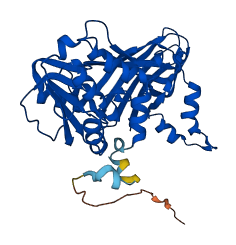
Descriptions
The autoinhibited protein was predicted that may have potential autoinhibitory elements via cis-regPred.
Autoinhibitory domains (AIDs)
Target domain |
|
Relief mechanism |
|
Assay |
cis-regPred |
Accessory elements
No accessory elements
Autoinhibited structure

Activated structure
5 structures for Q63009
| Entry ID | Method | Resolution | Chain | Position | Source |
|---|---|---|---|---|---|
| 1OR8 | X-ray | 235 A | A | 14-353 | PDB |
| 1ORH | X-ray | 264 A | A | 1-353 | PDB |
| 1ORI | X-ray | 250 A | A | 11-353 | PDB |
| 3Q7E | X-ray | 220 A | A | 14-353 | PDB |
| AF-Q63009-F1 | Predicted | AlphaFoldDB |
No variants for Q63009
| Variant ID(s) | Position | Change | Description | Diseaes Association | Provenance |
|---|---|---|---|---|---|
| No variants for Q63009 | |||||
No associated diseases with Q63009
1 regional properties for Q63009
| Type | Name | Position | InterPro Accession |
|---|---|---|---|
| domain | Methyltransferase domain 25 | 74 - 171 | IPR041698 |
Functions
| Description | ||
|---|---|---|
| EC Number | 2.1.1.319 | Methyltransferases |
| Subcellular Localization |
|
|
| PANTHER Family | ||
| PANTHER Subfamily | ||
| PANTHER Protein Class | ||
| PANTHER Pathway Category | No pathway information available | |
7 GO annotations of cellular component
| Name | Definition |
|---|---|
| cytoplasm | The contents of a cell excluding the plasma membrane and nucleus, but including other subcellular structures. |
| cytosol | The part of the cytoplasm that does not contain organelles but which does contain other particulate matter, such as protein complexes. |
| membrane | A lipid bilayer along with all the proteins and protein complexes embedded in it an attached to it. |
| methylosome | A large (20 S) protein complex that possesses protein arginine methyltransferase activity and modifies specific arginines to dimethylarginines in the arginine- and glycine-rich domains of several spliceosomal Sm proteins, thereby targeting these proteins to the survival of motor neurons (SMN) complex for assembly into small nuclear ribonucleoprotein (snRNP) core particles. Proteins found in the methylosome include the methyltransferase JBP1 (PRMT5), pICln (CLNS1A), MEP50 (WDR77), and unmethylated forms of SM proteins that have RG domains. |
| nucleoplasm | That part of the nuclear content other than the chromosomes or the nucleolus. |
| nucleus | A membrane-bounded organelle of eukaryotic cells in which chromosomes are housed and replicated. In most cells, the nucleus contains all of the cell's chromosomes except the organellar chromosomes, and is the site of RNA synthesis and processing. In some species, or in specialized cell types, RNA metabolism or DNA replication may be absent. |
| protein-containing complex | A stable assembly of two or more macromolecules, i.e. proteins, nucleic acids, carbohydrates or lipids, in which at least one component is a protein and the constituent parts function together. |
15 GO annotations of molecular function
| Name | Definition |
|---|---|
| enzyme binding | Binding to an enzyme, a protein with catalytic activity. |
| histone methyltransferase activity | Catalysis of the reaction: S-adenosyl-L-methionine + histone = S-adenosyl-L-homocysteine + methyl-histone. Histone methylation generally occurs on either an arginine or lysine residue. |
| histone methyltransferase activity (H4-R3 specific) | Catalysis of the reaction: S-adenosyl-L-methionine + (histone H4)-arginine (position 3) = S-adenosyl-L-homocysteine + (histone H4)-N-methyl-arginine (position 3). This reaction is the addition of a methyl group to arginine at position 3 of histone H4. |
| histone-arginine N-methyltransferase activity | Catalysis of the reaction: S-adenosyl-L-methionine + (histone)-arginine = S-adenosyl-L-homocysteine + (histone)-N-methyl-arginine. |
| identical protein binding | Binding to an identical protein or proteins. |
| methyl-CpG binding | Binding to a methylated cytosine/guanine dinucleotide. |
| mitogen-activated protein kinase p38 binding | Binding to mitogen-activated protein kinase p38, an enzyme that catalyzes the transfer of phosphate from ATP to hydroxyl side chains on proteins in response to mitogen activation. |
| N-methyltransferase activity | Catalysis of the transfer of a methyl group to the nitrogen atom of an acceptor molecule. |
| protein methyltransferase activity | Catalysis of the transfer of a methyl group (CH3-) to a protein. |
| protein-arginine N-methyltransferase activity | Catalysis of the reaction: S-adenosyl-L-methionine + (protein)-arginine = S-adenosyl-L-homocysteine + (protein)-N-methyl-arginine. |
| protein-arginine omega-N asymmetric methyltransferase activity | Catalysis of the addition of a second methyl group to methylated peptidyl-arginine. Methylation is on the same terminal nitrogen (omega nitrogen) residue that was previously methylated, resulting in asymmetrical peptidyl-N(omega),N(omega)-dimethylated arginine residues. |
| protein-arginine omega-N monomethyltransferase activity | Catalysis of the addition of a methyl group to either of the unmethylated terminal nitrogen atoms (also called omega nitrogen) in peptidyl-arginine to form an omega-N-G-monomethylated arginine residue. The reaction is S-adenosyl-L-methionine |
| S-adenosyl-L-methionine binding | +Binding to S-adenosyl-L-methionine. |
| S-adenosylmethionine-dependent methyltransferase activity | Catalysis of the transfer of a methyl group from S-adenosyl-L-methionine to a substrate. |
| snoRNP binding | Binding to a small nucleolar ribonucleoprotein particle. |
19 GO annotations of biological process
| Name | Definition |
|---|---|
| cardiac muscle tissue development | The process whose specific outcome is the progression of cardiac muscle over time, from its formation to the mature structure. |
| histone H4-R3 methylation | The modification of histone H4 by addition of a methyl group to arginine at position 3 of the histone. |
| histone methylation | The modification of histones by addition of methyl groups. |
| in utero embryonic development | The process whose specific outcome is the progression of the embryo in the uterus over time, from formation of the zygote in the oviduct, to birth. An example of this process is found in Mus musculus. |
| liver regeneration | The regrowth of lost or destroyed liver. |
| negative regulation of JNK cascade | Any process that stops, prevents, or reduces the frequency, rate or extent of signal transduction mediated by the JNK cascade. |
| negative regulation of megakaryocyte differentiation | Any process that stops, prevents, or reduces the frequency, rate or extent of megakaryocyte differentiation. |
| neuron projection development | The process whose specific outcome is the progression of a neuron projection over time, from its formation to the mature structure. A neuron projection is any process extending from a neural cell, such as axons or dendrites (collectively called neurites). |
| peptidyl-arginine methylation | The addition of a methyl group to an arginine residue in a protein. |
| peptidyl-arginine methylation, to asymmetrical-dimethyl arginine | The process of methylation of peptidyl-arginine to form peptidyl-N(omega),N(omega)-dimethyl-L-arginine. |
| peptidyl-arginine omega-N-methylation | The addition of a methyl group onto a terminal nitrogen (omega nitrogen) atom of an arginine residue in a protein. |
| positive regulation of cell population proliferation | Any process that activates or increases the rate or extent of cell proliferation. |
| positive regulation of erythrocyte differentiation | Any process that activates or increases the frequency, rate or extent of erythrocyte differentiation. |
| positive regulation of hemoglobin biosynthetic process | Any process that activates or increases the frequency, rate or extent of the chemical reactions and pathways resulting in the formation of hemoglobin, an oxygen carrying, conjugated protein containing four heme groups and globin. |
| positive regulation of p38MAPK cascade | Any process that activates or increases the frequency, rate or extent of p38MAPK cascade. |
| protein homooligomerization | The process of creating protein oligomers, compounds composed of a small number, usually between three and ten, of identical component monomers. Oligomers may be formed by the polymerization of a number of monomers or the depolymerization of a large protein polymer. |
| protein methylation | The addition of a methyl group to a protein amino acid. A methyl group is derived from methane by the removal of a hydrogen atom. |
| regulation of megakaryocyte differentiation | Any process that modulates the frequency, rate or extent of megakaryocyte differentiation. |
| RNA splicing | The process of removing sections of the primary RNA transcript to remove sequences not present in the mature form of the RNA and joining the remaining sections to form the mature form of the RNA. |
4 homologous proteins in AiPD
| UniProt AC | Gene Name | Protein Name | Species | Evidence Code |
|---|---|---|---|---|
| Q9JIF0 | Prmt1 | Protein arginine N-methyltransferase 1 | Mus musculus (Mouse) | PR |
| Q5U4E8 | Prmt7 | Protein arginine N-methyltransferase 7 | Rattus norvegicus (Rat) | PR |
| Q7XKC0 | PRMT6.1 | Probable protein arginine N-methyltransferase 6.1 | Oryza sativa subsp japonica (Rice) | PR |
| Q6NWG4 | prmt6 | Protein arginine N-methyltransferase 6 | Danio rerio (Zebrafish) (Brachydanio rerio) | PR |
| 10 | 20 | 30 | 40 | 50 | 60 |
| MAAAEAANCI | MEVSCGQAES | SEKPNAEDMT | SKDYYFDSYA | HFGIHEEMLK | DEVRTLTYRN |
| 70 | 80 | 90 | 100 | 110 | 120 |
| SMFHNRHLFK | DKVVLDVGSG | TGILCMFAAK | AGARKVIGIE | CSSISDYAVK | IVKANKLDHV |
| 130 | 140 | 150 | 160 | 170 | 180 |
| VTIIKGKVEE | VELPVEKVDI | IISEWMGYCL | FYESMLNTVL | HARDKWLAPD | GLIFPDRATL |
| 190 | 200 | 210 | 220 | 230 | 240 |
| YVTAIEDRQY | KDYKIHWWEN | VYGFDMSCIK | DVAIKEPLVD | VVDPKQLVTN | ACLIKEVDIY |
| 250 | 260 | 270 | 280 | 290 | 300 |
| TVKVEDLTFT | SPFCLQVKRN | DYVHALVAYF | NIEFTRCHKR | TGFSTSPESP | YTHWKQTVFY |
| 310 | 320 | 330 | 340 | 350 | |
| MEDYLTVKTG | EEIFGTIGMR | PNAKNNRDLD | FTIDLDFKGQ | LCELSCSTDY | RMR |