Q6AY06
Gene name |
Izumo1 |
Protein name |
Izumo sperm-egg fusion protein 1 |
Names |
Oocyte binding/fusion factor, OBF, Sperm-specific protein izumo |
Species |
Rattus norvegicus (Rat) |
KEGG Pathway |
rno:499152 |
EC number |
|
Protein Class |
|
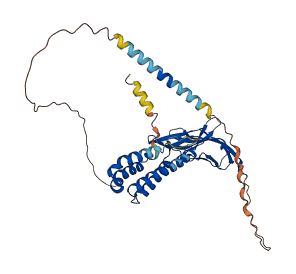
Descriptions
The autoinhibited protein was predicted that may have potential autoinhibitory elements via cis-regPred.
Autoinhibitory domains (AIDs)
Target domain |
|
Relief mechanism |
|
Assay |
cis-regPred |
Accessory elements
No accessory elements
Autoinhibited structure

Activated structure
1 structures for Q6AY06
| Entry ID | Method | Resolution | Chain | Position | Source |
|---|---|---|---|---|---|
| AF-Q6AY06-F1 | Predicted | AlphaFoldDB |
No variants for Q6AY06
| Variant ID(s) | Position | Change | Description | Diseaes Association | Provenance |
|---|---|---|---|---|---|
| No variants for Q6AY06 | |||||
No associated diseases with Q6AY06
1 regional properties for Q6AY06
| Type | Name | Position | InterPro Accession |
|---|---|---|---|
| domain | Izumo protein, immunoglobulin domain | 168 - 254 | IPR032699 |
Functions
6 GO annotations of cellular component
| Name | Definition |
|---|---|
| acrosomal membrane | The membrane that surrounds the acrosomal lumen. The acrosome is a special type of lysosome in the head of a spermatozoon that contains acid hydrolases and is concerned with the breakdown of the outer membrane of the ovum during fertilization. |
| acrosomal vesicle | A structure in the head of a spermatozoon that contains acid hydrolases, and is concerned with the breakdown of the outer membrane of the ovum during fertilization. It lies just beneath the plasma membrane and is derived from the lysosome. |
| cell-cell junction | A cell junction that forms a connection between two or more cells of an organism; excludes direct cytoplasmic intercellular bridges, such as ring canals in insects. |
| integral component of membrane | The component of a membrane consisting of the gene products and protein complexes having at least some part of their peptide sequence embedded in the hydrophobic region of the membrane. |
| plasma membrane | The membrane surrounding a cell that separates the cell from its external environment. It consists of a phospholipid bilayer and associated proteins. |
| protein-containing complex | A stable assembly of two or more macromolecules, i.e. proteins, nucleic acids, carbohydrates or lipids, in which at least one component is a protein and the constituent parts function together. |
4 GO annotations of molecular function
| Name | Definition |
|---|---|
| GTPase binding | Binding to a GTPase, any enzyme that catalyzes the hydrolysis of GTP. |
| protein binding involved in heterotypic cell-cell adhesion | Binding to a protein or protein complex contributing to the adhesion of two different types of cells. |
| protein homodimerization activity | Binding to an identical protein to form a homodimer. |
| signaling receptor binding | Binding to one or more specific sites on a receptor molecule, a macromolecule that undergoes combination with a hormone, neurotransmitter, drug or intracellular messenger to initiate a change in cell function. |
13 GO annotations of biological process
| Name | Definition |
|---|---|
| angiogenesis | Blood vessel formation when new vessels emerge from the proliferation of pre-existing blood vessels. |
| branching morphogenesis of an epithelial tube | The process in which the anatomical structures of branches in an epithelial tube are generated and organized. A tube is a long hollow cylinder. |
| fusion of sperm to egg plasma membrane involved in single fertilization | The binding and fusion of a sperm, with the plasma membrane of the oocyte as part of the process of single fertilization. In sperm with flagella, binding occurs at the posterior (post-acrosomal) region of the sperm head. |
| heterotypic cell-cell adhesion | The attachment of a cell to a cell of a different type via adhesion molecules. |
| negative regulation of autophagy | Any process that stops, prevents, or reduces the frequency, rate or extent of autophagy. Autophagy is the process in which cells digest parts of their own cytoplasm. |
| negative regulation of membrane permeability | Any process that stops, prevents or reduces the frequency, rate or extent of the passage or uptake of molecules by a membrane. |
| negative regulation of Rho protein signal transduction | Any process that stops, prevents, or reduces the frequency, rate or extent of Rho protein signal transduction. |
| negative regulation of Rho-dependent protein serine/threonine kinase activity | Any process that stops, prevents or reduces the frequency, rate or extent of Rho-dependent protein serine/threonine kinase activity. |
| positive regulation of integrin activation | Any process that activates or increases the frequency, rate, or extent of integrin activation. |
| regulation of GTPase activity | Any process that modulates the rate of GTP hydrolysis by a GTPase. |
| single fertilization | The union of male and female gametes to form a zygote. |
| sperm-egg recognition | The initial contact step made between the sperm plasma membrane and outer layer of the egg during fertilization. |
| vasculogenesis | The differentiation of endothelial cells from progenitor cells during blood vessel development, and the de novo formation of blood vessels and tubes. |
| 10 | 20 | 30 | 40 | 50 | 60 |
| MGLHFTLLLA | ALANCLCPAR | LCIICDPFVV | AAIKTLEQNY | LPTHLAPEHH | EDVMKRVEQE |
| 70 | 80 | 90 | 100 | 110 | 120 |
| VRNFADLPLN | QNTFLGVVDE | DTLEQASWSF | LKDLKRITDS | DVKGELFVKE | LFWMLRLQKD |
| 130 | 140 | 150 | 160 | 170 | 180 |
| IFATLVARFQ | KEVYCPNQCG | TMSQTLIWCN | KCEKQMHFCR | KSMDCGERQI | EVHRLEDMVL |
| 190 | 200 | 210 | 220 | 230 | 240 |
| DCQLSWHHAS | EGLTDYSFYR | VWGNSSETLM | SKGKEPYLTK | TMVGPEDAGN | YRCELDTVNA |
| 250 | 260 | 270 | 280 | 290 | 300 |
| GPATIIYYHV | TVLPPRSVEE | KPPPNIVTQE | EEETPVQVIV | PTLEPEPEPE | PIPTVTHRPE |
| 310 | 320 | 330 | 340 | 350 | 360 |
| KKLKSRLLIL | LILGFVVLVA | SVIASVLHFR | KTRVKSKNSN | VENKTSAAEF | KSEAESPQKM |
| 370 | 380 | ||||
| GSRKLSQAEF | HTDSSDKVEE | ADN |