Q68G58
Gene name |
Apex2 (Ape2) |
Protein name |
DNA-(apurinic or apyrimidinic site) endonuclease 2 |
Names |
APEX nuclease 2, Apurinic-apyrimidinic endonuclease 2, AP endonuclease 2 |
Species |
Mus musculus (Mouse) |
KEGG Pathway |
mmu:77622 |
EC number |
3.1.11.2: Exodeoxyribonucleases producing 5'-phosphomonoesters |
Protein Class |
|
Descriptions
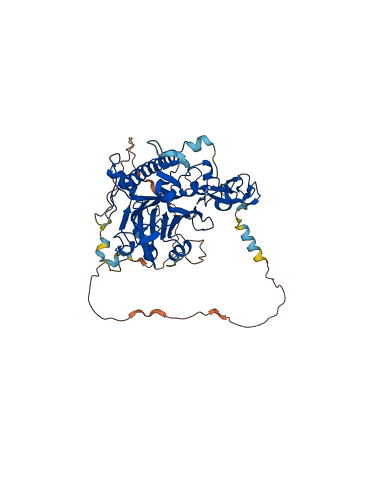
The autoinhibited protein was predicted that may have potential autoinhibitory elements via cis-regPred.
Autoinhibitory domains (AIDs)
Target domain |
|
Relief mechanism |
|
Assay |
cis-regPred |
Accessory elements
No accessory elements
Autoinhibited structure

Activated structure
1 structures for Q68G58
| Entry ID | Method | Resolution | Chain | Position | Source |
|---|---|---|---|---|---|
| AF-Q68G58-F1 | Predicted | AlphaFoldDB |
No variants for Q68G58
| Variant ID(s) | Position | Change | Description | Diseaes Association | Provenance |
|---|---|---|---|---|---|
| No variants for Q68G58 | |||||
No associated diseases with Q68G58
Functions
| Description | ||
|---|---|---|
| EC Number | 3.1.11.2 | Exodeoxyribonucleases producing 5'-phosphomonoesters |
| Subcellular Localization |
|
|
| PANTHER Family | ||
| PANTHER Subfamily | ||
| PANTHER Protein Class | ||
| PANTHER Pathway Category | No pathway information available | |
6 GO annotations of cellular component
| Name | Definition |
|---|---|
| fibrillar center | A structure found most metazoan nucleoli, but not usually found in lower eukaryotes; surrounded by the dense fibrillar component; the zone of transcription from multiple copies of the pre-rRNA genes is in the border region between these two structures. |
| intracellular membrane-bounded organelle | Organized structure of distinctive morphology and function, bounded by a single or double lipid bilayer membrane and occurring within the cell. Includes the nucleus, mitochondria, plastids, vacuoles, and vesicles. Excludes the plasma membrane. |
| mitochondrial inner membrane | The inner, i.e. lumen-facing, lipid bilayer of the mitochondrial envelope. It is highly folded to form cristae. |
| mitochondrion | A semiautonomous, self replicating organelle that occurs in varying numbers, shapes, and sizes in the cytoplasm of virtually all eukaryotic cells. It is notably the site of tissue respiration. |
| nucleoplasm | That part of the nuclear content other than the chromosomes or the nucleolus. |
| nucleus | A membrane-bounded organelle of eukaryotic cells in which chromosomes are housed and replicated. In most cells, the nucleus contains all of the cell's chromosomes except the organellar chromosomes, and is the site of RNA synthesis and processing. In some species, or in specialized cell types, RNA metabolism or DNA replication may be absent. |
6 GO annotations of molecular function
| Name | Definition |
|---|---|
| DNA binding | Any molecular function by which a gene product interacts selectively and non-covalently with DNA (deoxyribonucleic acid). |
| DNA-(apurinic or apyrimidinic site) endonuclease activity | Catalysis of the cleavage of the C-O-P bond in the AP site created when DNA glycosylase removes a damaged base, involved in the DNA base excision repair pathway (BER). |
| double-stranded DNA 3'-5' exodeoxyribonuclease activity | Catalysis of the sequential cleavage of mononucleotides from a free 3' terminus of a double-stranded DNA molecule. |
| endonuclease activity | Catalysis of the hydrolysis of ester linkages within nucleic acids by creating internal breaks. |
| phosphoric diester hydrolase activity | Catalysis of the hydrolysis of a phosphodiester to give a phosphomonoester and a free hydroxyl group. |
| zinc ion binding | Binding to a zinc ion (Zn). |
3 GO annotations of biological process
| Name | Definition |
|---|---|
| base-excision repair | In base excision repair, an altered base is removed by a DNA glycosylase enzyme, followed by excision of the resulting sugar phosphate. The small gap left in the DNA helix is filled in by the sequential action of DNA polymerase and DNA ligase. |
| cell cycle | The progression of biochemical and morphological phases and events that occur in a cell during successive cell replication or nuclear replication events. Canonically, the cell cycle comprises the replication and segregation of genetic material followed by the division of the cell, but in endocycles or syncytial cells nuclear replication or nuclear division may not be followed by cell division. |
| DNA recombination | Any process in which a new genotype is formed by reassortment of genes resulting in gene combinations different from those that were present in the parents. In eukaryotes genetic recombination can occur by chromosome assortment, intrachromosomal recombination, or nonreciprocal interchromosomal recombination. Interchromosomal recombination occurs by crossing over. In bacteria it may occur by genetic transformation, conjugation, transduction, or F-duction. |
| 10 | 20 | 30 | 40 | 50 | 60 |
| MLRVVSWNIN | GIRSPLQGLA | CQEPSSCPTA | LRRVLDELDA | DIVCLQETKV | TRDVLTEPLA |
| 70 | 80 | 90 | 100 | 110 | 120 |
| IVEGYNSYFS | FSRSRSGYSG | VATFCKDSAT | PVAAEEGLSG | VFATLNGDIG | CYGNMDEFTQ |
| 130 | 140 | 150 | 160 | 170 | 180 |
| EELRVLDSEG | RALLTQHKIR | TLEGKEKTLT | LINVYCPHAD | PGKPERLTFK | MRFYRLLQMR |
| 190 | 200 | 210 | 220 | 230 | 240 |
| AEALLAAGSH | VIILGDLNTA | HRPIDHCDAS | SLECFEEDPG | RKWMDGLLSN | PGDEAGPHIG |
| 250 | 260 | 270 | 280 | 290 | 300 |
| LFMDSYRYLH | PKQQRAFTCW | SVVSGARHLN | YGSRLDYVLG | DRALVIDTFQ | ASFLLPEVMG |
| 310 | 320 | 330 | 340 | 350 | 360 |
| SDHCPVGAVL | NVSCVPAKQC | PALCTRFLPE | FAGTQLKILR | FLVPLEQEPV | REQQVLQPSH |
| 370 | 380 | 390 | 400 | 410 | 420 |
| QIQAQRQPRK | ACMHSTRLRK | SQGGPKRKQK | NLMSYFQPSS | SLSQTSGVEL | PTLPLVGPLT |
| 430 | 440 | 450 | 460 | 470 | 480 |
| TPKTAEEVAT | ATVLEEKNKV | PESKDEKGER | TAFWKSMLSG | PSPMPLCGGH | REPCVMRTVK |
| 490 | 500 | 510 | |||
| KTGPNFGRQF | YMCARPRGPP | SDPSSRCNFF | LWSRPS |