Q68FX0
Gene name |
Idh3B |
Protein name |
Isocitrate dehydrogenase [NAD] subunit beta, mitochondrial |
Names |
Isocitric dehydrogenase subunit beta, NAD(+)-specific ICDH subunit beta |
Species |
Rattus norvegicus (Rat) |
KEGG Pathway |
rno:94173 |
EC number |
|
Protein Class |
|
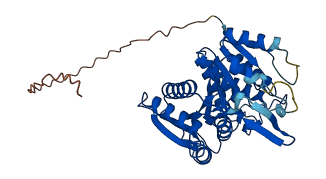
Descriptions
The autoinhibited protein was predicted that may have potential autoinhibitory elements via cis-regPred.
Autoinhibitory domains (AIDs)
Target domain |
|
Relief mechanism |
|
Assay |
cis-regPred |
Accessory elements
No accessory elements
Autoinhibited structure

Activated structure
1 structures for Q68FX0
| Entry ID | Method | Resolution | Chain | Position | Source |
|---|---|---|---|---|---|
| AF-Q68FX0-F1 | Predicted | AlphaFoldDB |
No variants for Q68FX0
| Variant ID(s) | Position | Change | Description | Diseaes Association | Provenance |
|---|---|---|---|---|---|
| No variants for Q68FX0 | |||||
No associated diseases with Q68FX0
2 GO annotations of cellular component
| Name | Definition |
|---|---|
| mitochondrial isocitrate dehydrogenase complex (NAD+) | Mitochondrial complex that possesses isocitrate dehydrogenase (NAD+) activity. |
| mitochondrion | A semiautonomous, self replicating organelle that occurs in varying numbers, shapes, and sizes in the cytoplasm of virtually all eukaryotic cells. It is notably the site of tissue respiration. |
3 GO annotations of molecular function
| Name | Definition |
|---|---|
| isocitrate dehydrogenase (NAD+) activity | Catalysis of the reaction: isocitrate + NAD+ = 2-oxoglutarate + CO2 + NADH. |
| magnesium ion binding | Binding to a magnesium (Mg) ion. |
| NAD binding | Binding to nicotinamide adenine dinucleotide, a coenzyme involved in many redox and biosynthetic reactions; binding may be to either the oxidized form, NAD+, or the reduced form, NADH. |
4 GO annotations of biological process
| Name | Definition |
|---|---|
| 2-oxoglutarate metabolic process | The chemical reactions and pathways involving oxoglutarate, the dianion of 2-oxoglutaric acid. It is a key constituent of the TCA cycle and a key intermediate in amino-acid metabolism. |
| isocitrate metabolic process | The chemical reactions and pathways involving isocitrate, the anion of isocitric acid, 1-hydroxy-1,2,3-propanetricarboxylic acid. Isocitrate is an important intermediate in the TCA cycle and the glycoxylate cycle. |
| NADH metabolic process | The chemical reactions and pathways involving reduced nicotinamide adenine dinucleotide (NADH), a coenzyme present in most living cells and derived from the B vitamin nicotinic acid. |
| tricarboxylic acid cycle | A nearly universal metabolic pathway in which the acetyl group of acetyl coenzyme A is effectively oxidized to two CO2 and four pairs of electrons are transferred to coenzymes. The acetyl group combines with oxaloacetate to form citrate, which undergoes successive transformations to isocitrate, 2-oxoglutarate, succinyl-CoA, succinate, fumarate, malate, and oxaloacetate again, thus completing the cycle. In eukaryotes the tricarboxylic acid is confined to the mitochondria. See also glyoxylate cycle. |
| 10 | 20 | 30 | 40 | 50 | 60 |
| MAALSNVRWL | TRAVLGARNS | GAWRGLRTAA | SAQAASQSQA | QDVRVEGAFP | VTMLPGDGVG |
| 70 | 80 | 90 | 100 | 110 | 120 |
| PELMHAVKEV | FKAAAVPVEF | KEHHLSEVQN | MASEEKLEQV | LSSMKENKVA | IIGKIYTPME |
| 130 | 140 | 150 | 160 | 170 | 180 |
| YKGELASYDM | QLRRKLDLFA | NVVHVKSLPG | YKTRHNNLDL | VIIREQTEGE | YSSLEHESAR |
| 190 | 200 | 210 | 220 | 230 | 240 |
| GVIECLKIVT | RTKSQRIAKF | AFDYATKKGR | SKVTAVHKAN | IMKLGDGLFL | QCCEEVAELY |
| 250 | 260 | 270 | 280 | 290 | 300 |
| PKIKFETMII | DNCCMQLVQN | PYQFDVLVMP | NLYGNIIDNL | AAGLVGGAGV | VPGESYSAEY |
| 310 | 320 | 330 | 340 | 350 | 360 |
| AVFETGARHP | FAQAVGRNIA | NPTAMLLSAS | NMLRHLNLEY | HSSMIADAVK | KVIKVGKVRT |
| 370 | 380 | ||||
| RDMGGYSTTT | DFIKSVIGHL | HPHGG |