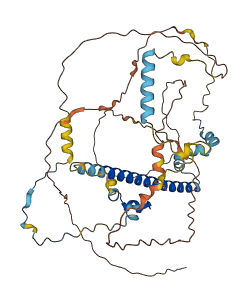
Descriptions
The autoinhibited protein was predicted that may have potential autoinhibitory elements via cis-regPred.
Autoinhibitory domains (AIDs)
Target domain |
|
Relief mechanism |
|
Assay |
cis-regPred |
Accessory elements
No accessory elements
Autoinhibited structure

Activated structure
1 structures for Q68FQ8
| Entry ID | Method | Resolution | Chain | Position | Source |
|---|---|---|---|---|---|
| AF-Q68FQ8-F1 | Predicted | AlphaFoldDB |
No variants for Q68FQ8
| Variant ID(s) | Position | Change | Description | Diseaes Association | Provenance |
|---|---|---|---|---|---|
| No variants for Q68FQ8 | |||||
No associated diseases with Q68FQ8
No regional properties for Q68FQ8
| Type | Name | Position | InterPro Accession |
|---|---|---|---|
| No domain, repeats, and functional sites for Q68FQ8 | |||
2 GO annotations of cellular component
| Name | Definition |
|---|---|
| cilium | A specialized eukaryotic organelle that consists of a filiform extrusion of the cell surface and of some cytoplasmic parts. Each cilium is largely bounded by an extrusion of the cytoplasmic (plasma) membrane, and contains a regular longitudinal array of microtubules, anchored to a basal body. |
| cytoplasm | The contents of a cell excluding the plasma membrane and nucleus, but including other subcellular structures. |
3 GO annotations of molecular function
| Name | Definition |
|---|---|
| alpha-tubulin binding | Binding to the microtubule constituent protein alpha-tubulin. |
| beta-tubulin binding | Binding to the microtubule constituent protein beta-tubulin. |
| tubulin binding | Binding to monomeric or multimeric forms of tubulin, including microtubules. |
4 GO annotations of biological process
| Name | Definition |
|---|---|
| cell differentiation | The process in which relatively unspecialized cells, e.g. embryonic or regenerative cells, acquire specialized structural and/or functional features that characterize the cells, tissues, or organs of the mature organism or some other relatively stable phase of the organism's life history. Differentiation includes the processes involved in commitment of a cell to a specific fate and its subsequent development to the mature state. |
| defense response to tumor cell | Reactions triggered in response to the presence of a tumor cell that act to protect the cell or organism. |
| negative regulation of cell population proliferation | Any process that stops, prevents or reduces the rate or extent of cell proliferation. |
| spermatogenesis | The developmental process by which male germ line stem cells self renew or give rise to successive cell types resulting in the development of a spermatozoa. |
| 10 | 20 | 30 | 40 | 50 | 60 |
| MEPESKKELQ | SPASSFVMSS | ETMWESTPRQ | PESTSLSWSP | RKSLRSLTVF | TDYCQFGYPT |
| 70 | 80 | 90 | 100 | 110 | 120 |
| RSLRAGFQEL | PPLPEPQTLR | LRPASLRTQD | ISHLLARVFR | NLYTAQVIGD | DLSDSLIKAR |
| 130 | 140 | 150 | 160 | 170 | 180 |
| GSEDARHEEF | LDQLQQARAI | YKKRLDDVAM | LEKHITQARA | RDIAETEHAT | KQGRLHVVEA |
| 190 | 200 | 210 | 220 | 230 | 240 |
| PVKLPPVKTV | FRWCIDNELM | QKHHLISTED | YYNDPLPFCP | APKRSPTPMY | SKMTFSCEKR |
| 250 | 260 | 270 | 280 | 290 | 300 |
| FTHKSDLERK | AEEHCRKLVE | FDDLEYTTDS | LRSVSKTKGK | TKVTIKKAST | PANKKWMEHL |
| 310 | 320 | 330 | 340 | 350 | 360 |
| QVPQRALDRR | LLARMQNRNH | YLKNPRFFPP | NTPHGGKSLI | VPSRKPERRG | SLSAKPEWRC |
| 370 | 380 | 390 | 400 | 410 | 420 |
| VCSSRRIPGN | VSFRVNLDLV | YGGPQTLASQ | GSVPEESGVL | GSTSGMAFDP | QGPRVRLFSA |
| 430 | 440 | 450 | 460 | ||
| VRSRGVDPWE | PVWASSGHPK | WGGAGAGAYS | HVTLAWYVDY | LFLLL |