Q66HD0
Gene name |
Hsp90b1 |
Protein name |
Endoplasmin |
Names |
94 kDa glucose-regulated protein, GRP-94, Heat shock protein 90 kDa beta member 1 |
Species |
Rattus norvegicus (Rat) |
KEGG Pathway |
rno:362862 |
EC number |
|
Protein Class |
|
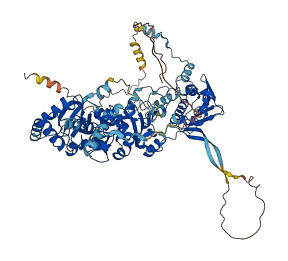
Descriptions
The autoinhibited protein was predicted that may have potential autoinhibitory elements via cis-regPred.
Autoinhibitory domains (AIDs)
Target domain |
|
Relief mechanism |
|
Assay |
cis-regPred |
Accessory elements
No accessory elements
Autoinhibited structure

Activated structure
1 structures for Q66HD0
| Entry ID | Method | Resolution | Chain | Position | Source |
|---|---|---|---|---|---|
| AF-Q66HD0-F1 | Predicted | AlphaFoldDB |
No variants for Q66HD0
| Variant ID(s) | Position | Change | Description | Diseaes Association | Provenance |
|---|---|---|---|---|---|
| No variants for Q66HD0 | |||||
No associated diseases with Q66HD0
13 GO annotations of cellular component
| Name | Definition |
|---|---|
| cytosol | The part of the cytoplasm that does not contain organelles but which does contain other particulate matter, such as protein complexes. |
| endoplasmic reticulum | The irregular network of unit membranes, visible only by electron microscopy, that occurs in the cytoplasm of many eukaryotic cells. The membranes form a complex meshwork of tubular channels, which are often expanded into slitlike cavities called cisternae. The ER takes two forms, rough (or granular), with ribosomes adhering to the outer surface, and smooth (with no ribosomes attached). |
| endoplasmic reticulum chaperone complex | A protein complex that is located in the endoplasmic reticulum and is composed of chaperone proteins, including BiP, GRP94; CaBP1, protein disulfide isomerase (PDI), ERdj3, cyclophilin B, ERp72, GRP170, UDP-glucosyltransferase, and SDF2-L1. |
| endoplasmic reticulum lumen | The volume enclosed by the membranes of the endoplasmic reticulum. |
| endoplasmic reticulum membrane | The lipid bilayer surrounding the endoplasmic reticulum. |
| melanosome | A tissue-specific, membrane-bounded cytoplasmic organelle within which melanin pigments are synthesized and stored. Melanosomes are synthesized in melanocyte cells. |
| midbody | A thin cytoplasmic bridge formed between daughter cells at the end of cytokinesis. The midbody forms where the contractile ring constricts, and may persist for some time before finally breaking to complete cytokinesis. |
| perinuclear region of cytoplasm | Cytoplasm situated near, or occurring around, the nucleus. |
| plasma membrane | The membrane surrounding a cell that separates the cell from its external environment. It consists of a phospholipid bilayer and associated proteins. |
| protein-containing complex | A stable assembly of two or more macromolecules, i.e. proteins, nucleic acids, carbohydrates or lipids, in which at least one component is a protein and the constituent parts function together. |
| sarcoplasmic reticulum lumen | The volume enclosed by the membranes of the sarcoplasmic reticulum. |
| smooth endoplasmic reticulum | The smooth endoplasmic reticulum (smooth ER or SER) has no ribosomes attached to it. The smooth ER is the recipient of the proteins synthesized in the rough ER. Those proteins to be exported are passed to the Golgi complex, the resident proteins are returned to the rough ER and the lysosomal proteins after phosphorylation of their mannose residues are passed to the lysosomes. Glycosylation of the glycoproteins also continues. The smooth ER is the site of synthesis of lipids, including the phospholipids. The membranes of the smooth ER also contain enzymes that catalyze a series of reactions to detoxify both lipid-soluble drugs and harmful products of metabolism. Large quantities of certain compounds such as phenobarbital cause an increase in the amount of the smooth ER. |
| sperm plasma membrane | A plasma membrane that is part of a sperm cell. |
7 GO annotations of molecular function
| Name | Definition |
|---|---|
| ATP binding | Binding to ATP, adenosine 5'-triphosphate, a universally important coenzyme and enzyme regulator. |
| ATP hydrolysis activity | Catalysis of the reaction: ATP + H2O = ADP + H+ phosphate. ATP hydrolysis is used in some reactions as an energy source, for example to catalyze a reaction or drive transport against a concentration gradient. |
| ATP-dependent protein folding chaperone | Binding to a protein or a protein-containing complex to assist the protein folding process, driven by ATP hydrolysis. |
| low-density lipoprotein particle receptor binding | Binding to a low-density lipoprotein receptor. |
| protein phosphatase binding | Binding to a protein phosphatase. |
| RNA binding | Binding to an RNA molecule or a portion thereof. |
| unfolded protein binding | Binding to an unfolded protein. |
9 GO annotations of biological process
| Name | Definition |
|---|---|
| actin rod assembly | The assembly of actin rods, a cellular structure consisting of parallel, hexagonally arranged actin tubules. |
| cellular response to ATP | Any process that results in a change in state or activity of a cell (in terms of movement, secretion, enzyme production, gene expression, etc.) as a result of an ATP (adenosine 5'-triphosphate) stimulus. |
| cellular response to manganese ion | Any process that results in a change in state or activity of a cell (in terms of movement, secretion, enzyme production, gene expression, etc.) as a result of a manganese ion stimulus. |
| negative regulation of apoptotic process | Any process that stops, prevents, or reduces the frequency, rate or extent of cell death by apoptotic process. |
| protein folding | The process of assisting in the covalent and noncovalent assembly of single chain polypeptides or multisubunit complexes into the correct tertiary structure. |
| regulation of phosphoprotein phosphatase activity | Any process that modulates the frequency, rate or extent of phosphoprotein phosphatase activity, the catalysis of the hydrolysis of phosphate from a phosphoprotein. |
| response to hypoxia | Any process that results in a change in state or activity of a cell or an organism (in terms of movement, secretion, enzyme production, gene expression, etc.) as a result of a stimulus indicating lowered oxygen tension. Hypoxia, defined as a decline in O2 levels below normoxic levels of 20.8 - 20.95%, results in metabolic adaptation at both the cellular and organismal level. |
| retrograde protein transport, ER to cytosol | The directed movement of unfolded or misfolded proteins from the endoplasmic reticulum to the cytosol through the translocon. |
| ubiquitin-dependent ERAD pathway | The series of steps necessary to target endoplasmic reticulum (ER)-resident proteins for degradation by the cytoplasmic proteasome. Begins with recognition of the ER-resident protein, includes retrotranslocation (dislocation) of the protein from the ER to the cytosol, protein ubiquitination necessary for correct substrate transfer, transport of the protein to the proteasome, and ends with degradation of the protein by the cytoplasmic proteasome. |
| 10 | 20 | 30 | 40 | 50 | 60 |
| MRVLWVLGLC | CVLLTFGFVR | ADDEVDVDGT | VEEDLGKSRE | GSRTDDEVVQ | REEEAIQLDG |
| 70 | 80 | 90 | 100 | 110 | 120 |
| LNASQIRELR | EKSEKFAFQA | EVNRMMKLII | NSLYKNKEIF | LRELISNASD | ALDKIRLISL |
| 130 | 140 | 150 | 160 | 170 | 180 |
| TDENALAGNE | ELTVKIKCDR | EKNLLHVTDT | GVGMTREELV | KNLGTIAKSG | TSEFLNKMTE |
| 190 | 200 | 210 | 220 | 230 | 240 |
| AQEDGQSTSE | LIGQFGVGFY | SAFLVADKVI | VTSKHNNDTQ | HIWESDSNEF | SVIADPRGNT |
| 250 | 260 | 270 | 280 | 290 | 300 |
| LGRGTTITLV | LKEEASDYLE | LDTIKNLVRK | YSQFINFPIY | VWSSKTETVE | EPLEEDETAQ |
| 310 | 320 | 330 | 340 | 350 | 360 |
| EEKEEADDEA | AVEEEEEEKK | PKTKKVEKTV | WDWELMNDIK | PIWQRPSKEV | EEDEYKAFYK |
| 370 | 380 | 390 | 400 | 410 | 420 |
| SFSKESDDPM | AYIHFTAEGE | VTFKSILFVP | TSAPRGLFDE | YGSKKSDYIK | LYVRRVFITD |
| 430 | 440 | 450 | 460 | 470 | 480 |
| DFHDMMPKYL | NFVKGVVDSD | DLPLNVSRET | LQQHKLLKVI | RKKLVRKTLD | MIKKIADEKY |
| 490 | 500 | 510 | 520 | 530 | 540 |
| NDTFWKEFGT | NIKLGVIEDH | SNRTRLAKLL | RFQSSHHSTD | ITSLDQYVER | MKEKQDKIYF |
| 550 | 560 | 570 | 580 | 590 | 600 |
| MAGSSRKEAE | SSPFVERLLK | KGYEVIYLTE | PVDEYCIQAL | PEFDGKRFQN | VAKEGVKFDE |
| 610 | 620 | 630 | 640 | 650 | 660 |
| SEKSKESREA | TEKEFEPLLN | WMKDKALKDK | IEKAVVSQRL | TESPCALVAS | QYGWSGNMER |
| 670 | 680 | 690 | 700 | 710 | 720 |
| IMKAQAYQTG | KDISTNYYAS | QKKTFEINPR | HPLIRDMLRR | VKEDEDDKTV | MDLAVVLFET |
| 730 | 740 | 750 | 760 | 770 | 780 |
| ATLRSGYLLP | DTKAYGDRIE | RMLRLSLNID | PEAQVEEEPE | EEPEDTTEDT | TDDSEQDEEE |
| 790 | 800 | ||||
| TDAGAEEEEE | EQETEKEPTE | KDEL |