Q66H28
Gene name |
Pacc1 |
Protein name |
Proton-activated chloride channel |
Names |
PAC, Transmembrane protein 206 |
Species |
Rattus norvegicus (Rat) |
KEGG Pathway |
rno:305070 |
EC number |
|
Protein Class |
|
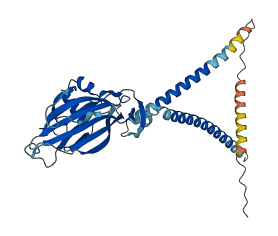
Descriptions
The autoinhibited protein was predicted that may have potential autoinhibitory elements via cis-regPred.
Autoinhibitory domains (AIDs)
Target domain |
|
Relief mechanism |
|
Assay |
cis-regPred |
Accessory elements
No accessory elements
Autoinhibited structure

Activated structure
1 structures for Q66H28
| Entry ID | Method | Resolution | Chain | Position | Source |
|---|---|---|---|---|---|
| AF-Q66H28-F1 | Predicted | AlphaFoldDB |
1 variants for Q66H28
| Variant ID(s) | Position | Change | Description | Diseaes Association | Provenance |
|---|---|---|---|---|---|
| rs3322554494 | 139 | A>T | No | EVA |
No associated diseases with Q66H28
No regional properties for Q66H28
| Type | Name | Position | InterPro Accession |
|---|---|---|---|
| No domain, repeats, and functional sites for Q66H28 | |||
2 GO annotations of cellular component
| Name | Definition |
|---|---|
| chloride channel complex | An ion channel complex through which chloride ions pass. |
| integral component of plasma membrane | The component of the plasma membrane consisting of the gene products and protein complexes having at least some part of their peptide sequence embedded in the hydrophobic region of the membrane. |
1 GO annotations of molecular function
| Name | Definition |
|---|---|
| pH-gated chloride channel activity | A gated channel activity that enables the transmembrane transfer of a chloride ion by a channel that opens in response to a change in pH. |
4 GO annotations of biological process
| Name | Definition |
|---|---|
| anion transmembrane transport | The process in which an anion is transported across a membrane. |
| chloride transmembrane transport | The process in which chloride is transported across a membrane. |
| chloride transport | The directed movement of chloride into, out of or within a cell, or between cells, by means of some agent such as a transporter or pore. |
| inorganic anion transport | The directed movement of inorganic anions into, out of or within a cell, or between cells, by means of some agent such as a transporter or pore. Inorganic anions are atoms or small molecules with a negative charge which do not contain carbon in covalent linkage. |
4 homologous proteins in AiPD
| UniProt AC | Gene Name | Protein Name | Species | Evidence Code |
|---|---|---|---|---|
| Q2KHV2 | PACC1 | Proton-activated chloride channel | Bos taurus (Bovine) | PR |
| Q9H813 | PACC1 | Proton-activated chloride channel | Homo sapiens (Human) | PR |
| Q9D771 | Pacc1 | Proton-activated chloride channel | Mus musculus (Mouse) | PR |
| Q0V9Z3 | pacc1 | Proton-activated chloride channel | Xenopus tropicalis (Western clawed frog) (Silurana tropicalis) | PR |
| 10 | 20 | 30 | 40 | 50 | 60 |
| MIRQDLSTSY | QELSEELEQV | VENSEQADER | DKELVQVQGP | GVVPGVDNES | ASSSIRFSKA |
| 70 | 80 | 90 | 100 | 110 | 120 |
| CLKNVFSVLL | ILIYLLLMAV | AVFLVYQTIT | DFREKLKHPV | MSVSYKEVDR | YDAPGIALYP |
| 130 | 140 | 150 | 160 | 170 | 180 |
| GQAQLLSCKH | HYEVIPPLAS | PGQPGDRNCT | TQRINYTHPF | SNHTMQSALI | VQGPQEVKKR |
| 190 | 200 | 210 | 220 | 230 | 240 |
| ELVFLQFRLN | QSDEDFSAID | YLLFSSFREF | MQSPDKAGFM | QACESAYSSW | KFSGGFRTWV |
| 250 | 260 | 270 | 280 | 290 | 300 |
| KMSLVKTKEE | DGREAVEFRQ | ETSVVNYIDQ | RPAAEKSTQL | FFVVFEWKDP | FIQKVQDIIT |
| 310 | 320 | 330 | 340 | ||
| ANPWNTIALL | CGAFLALFKA | AEFAKLSVKW | MIKIRKRYLK | RRGQATNHIS |