Q64267
Gene name |
Xpa (Xpac) |
Protein name |
DNA repair protein complementing XP-A cells homolog |
Names |
Xeroderma pigmentosum group A-complementing protein homolog |
Species |
Mus musculus (Mouse) |
KEGG Pathway |
mmu:22590 |
EC number |
|
Protein Class |
|
Descriptions
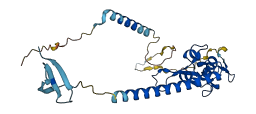
The autoinhibited protein was predicted that may have potential autoinhibitory elements via cis-regPred.
Autoinhibitory domains (AIDs)
Target domain |
|
Relief mechanism |
|
Assay |
cis-regPred |
Accessory elements
No accessory elements
Autoinhibited structure

Activated structure
1 structures for Q64267
| Entry ID | Method | Resolution | Chain | Position | Source |
|---|---|---|---|---|---|
| AF-Q64267-F1 | Predicted | AlphaFoldDB |
23 variants for Q64267
| Variant ID(s) | Position | Change | Description | Diseaes Association | Provenance |
|---|---|---|---|---|---|
| rs244587104 | 14 | V>A | No | EVA | |
| rs228267709 | 17 | D>E | No | EVA | |
| rs3394229976 | 72 | K>* | No | EVA | |
| rs3393693946 | 72 | K>I | No | EVA | |
| rs3394245304 | 72 | K>N | No | EVA | |
| rs3388679885 | 105 | E>* | No | EVA | |
| rs3388679887 | 105 | E>D | No | EVA | |
| rs3412087317 | 106 | E>G | No | EVA | |
| rs3388687364 | 112 | M>K | No | EVA | |
| rs3388675956 | 116 | L>V | No | EVA | |
| rs3388677817 | 152 | C>Y | No | EVA | |
| rs27840608 | 160 | A>V | No | EVA | |
| rs3388670430 | 165 | V>M | No | EVA | |
| rs3388675918 | 173 | Q>P | No | EVA | |
| rs3388686801 | 196 | Q>E | No | EVA | |
| rs3388677809 | 196 | Q>L | No | EVA | |
| rs3388683123 | 198 | A>G | No | EVA | |
| rs3388686778 | 200 | E>G | No | EVA | |
| rs3388680846 | 222 | V>I | No | EVA | |
| rs3388680846 | 222 | V>L | No | EVA | |
| rs3394255081 | 235 | K>R | No | EVA | |
| rs13477681 | 244 | K>E | No | EVA | |
| rs3388679878 | 264 | G>S | No | EVA |
No associated diseases with Q64267
6 GO annotations of cellular component
| Name | Definition |
|---|---|
| cytoplasm | The contents of a cell excluding the plasma membrane and nucleus, but including other subcellular structures. |
| DNA replication factor A complex | A conserved heterotrimeric complex that binds nonspecifically to single-stranded DNA and is required for multiple processes in eukaryotic DNA metabolism, including DNA replication, DNA repair, and recombination. In all eukaryotic organisms examined the complex is composed of subunits of approximately 70, 30, and 14 kDa. |
| intercellular bridge | A direct connection between the cytoplasm of two cells that is formed following the completion of cleavage furrow ingression during cell division. They are usually present only briefly prior to completion of cytokinesis. However, in some cases, such as the bridges between germ cells during their development, they become stabilised. |
| nucleoplasm | That part of the nuclear content other than the chromosomes or the nucleolus. |
| nucleotide-excision repair factor 1 complex | One of several protein complexes involved in nucleotide-excision repair; possesses DNA damage recognition and endodeoxynuclease activities. In S. cerevisiae, it is composed of Rad1p, Rad10p, and Rad14p; in human the subunits are ERCC4/XPF, ERCC1 and XPA, respectively. |
| nucleus | A membrane-bounded organelle of eukaryotic cells in which chromosomes are housed and replicated. In most cells, the nucleus contains all of the cell's chromosomes except the organellar chromosomes, and is the site of RNA synthesis and processing. In some species, or in specialized cell types, RNA metabolism or DNA replication may be absent. |
5 GO annotations of molecular function
| Name | Definition |
|---|---|
| damaged DNA binding | Binding to damaged DNA. |
| metal ion binding | Binding to a metal ion. |
| protein domain specific binding | Binding to a specific domain of a protein. |
| protein homodimerization activity | Binding to an identical protein to form a homodimer. |
| sequence-specific double-stranded DNA binding | Binding to double-stranded DNA of a specific nucleotide composition, e.g. GC-rich DNA binding, or with a specific sequence motif or type of DNA, e.g. promotor binding or rDNA binding. |
16 GO annotations of biological process
| Name | Definition |
|---|---|
| base-excision repair | In base excision repair, an altered base is removed by a DNA glycosylase enzyme, followed by excision of the resulting sugar phosphate. The small gap left in the DNA helix is filled in by the sequential action of DNA polymerase and DNA ligase. |
| DNA repair | The process of restoring DNA after damage. Genomes are subject to damage by chemical and physical agents in the environment (e.g. UV and ionizing radiations, chemical mutagens, fungal and bacterial toxins, etc.) and by free radicals or alkylating agents endogenously generated in metabolism. DNA is also damaged because of errors during its replication. A variety of different DNA repair pathways have been reported that include direct reversal, base excision repair, nucleotide excision repair, photoreactivation, bypass, double-strand break repair pathway, and mismatch repair pathway. |
| intrinsic apoptotic signaling pathway in response to DNA damage | The series of molecular signals in which an intracellular signal is conveyed to trigger the apoptotic death of a cell. The pathway is induced by the detection of DNA damage, and ends when the execution phase of apoptosis is triggered. |
| multicellular organism growth | The increase in size or mass of an entire multicellular organism, as opposed to cell growth. |
| nucleotide-excision repair | A DNA repair process in which a small region of the strand surrounding the damage is removed from the DNA helix as an oligonucleotide. The small gap left in the DNA helix is filled in by the sequential action of DNA polymerase and DNA ligase. Nucleotide excision repair recognizes a wide range of substrates, including damage caused by UV irradiation (pyrimidine dimers and 6-4 photoproducts) and chemicals (intrastrand cross-links and bulky adducts). |
| nucleotide-excision repair involved in interstrand cross-link repair | Any nucleotide-excision repair that is involved in interstrand cross-link repair. |
| nucleotide-excision repair, DNA damage recognition | The identification of lesions in DNA, such as pyrimidine-dimers, intrastrand cross-links, and bulky adducts. The wide range of substrate specificity suggests the repair complex recognizes distortions in the DNA helix. |
| nucleotide-excision repair, DNA incision | A process that results in the endonucleolytic cleavage of the damaged strand of DNA. The incision occurs at the junction of single-stranded DNA and double-stranded DNA that is formed when the DNA duplex is unwound. |
| positive regulation of transcription initiation by RNA polymerase II | Any process that increases the rate, frequency or extent of a process involved in starting transcription from an RNA polymerase II promoter. |
| protein localization to nucleus | A process in which a protein transports or maintains the localization of another protein to the nucleus. |
| regulation of autophagy | Any process that modulates the frequency, rate or extent of autophagy. Autophagy is the process in which cells digest parts of their own cytoplasm. |
| response to oxidative stress | Any process that results in a change in state or activity of a cell or an organism (in terms of movement, secretion, enzyme production, gene expression, etc.) as a result of oxidative stress, a state often resulting from exposure to high levels of reactive oxygen species, e.g. superoxide anions, hydrogen peroxide (H2O2), and hydroxyl radicals. |
| response to toxic substance | Any process that results in a change in state or activity of a cell or an organism (in terms of movement, secretion, enzyme production, gene expression, etc.) as a result of a toxic stimulus. |
| response to UV | Any process that results in a change in state or activity of a cell or an organism (in terms of movement, secretion, enzyme production, gene expression, etc.) as a result of an ultraviolet radiation (UV light) stimulus. Ultraviolet radiation is electromagnetic radiation with a wavelength in the range of 10 to 380 nanometers. |
| UV protection | Any process in which an organism or cell protects itself from ultraviolet radiation (UV), which may also result in resistance to repeated exposure to UV. |
| UV-damage excision repair | A DNA repair process that is initiated by an endonuclease that introduces a single-strand incision immediately 5' of a UV-induced damage site. UV-damage excision repair acts on both cyclobutane pyrimidine dimers (CPDs) and pyrimidine-pyrimidone 6-4 photoproducts (6-4PPs). |
| 10 | 20 | 30 | 40 | 50 | 60 |
| MATAEEKQTS | PEPVAADEPA | QLPAAVRASV | ERKRQRALML | RQARLAARPY | PAAAATGGVA |
| 70 | 80 | 90 | 100 | 110 | 120 |
| SVKAAPKMID | TKGGFILEEE | EEKHEIGNIV | HEPGPVMEFD | YTICEECGKE | FMDSYLMNHF |
| 130 | 140 | 150 | 160 | 170 | 180 |
| DLPTCDSCRD | ADDKHKLITK | TEAKQEYLLK | DCDLEKREPA | LRFLVKKNPR | HSQWGDMKLY |
| 190 | 200 | 210 | 220 | 230 | 240 |
| LKLQVVKRAL | EVWGSQEALE | DAKEVRQENR | EKMKQKKFDK | KVKELRRAIR | SSVWKRETTT |
| 250 | 260 | 270 | |||
| HQHKYGPEEN | LEDDMYRKTC | TLCGHELTYE | KM |