Q63279
Gene name |
Krt19 (Ka19, Krt1-19) |
Protein name |
Keratin, type I cytoskeletal 19 |
Names |
Cytokeratin-19, CK-19, Keratin-19, K19, Type I keratin Ka19 |
Species |
Rattus norvegicus (Rat) |
KEGG Pathway |
rno:360626 |
EC number |
|
Protein Class |
|
Descriptions
The autoinhibited protein was predicted that may have potential autoinhibitory elements via cis-regPred.
Autoinhibitory domains (AIDs)
Target domain |
|
Relief mechanism |
|
Assay |
cis-regPred |
Accessory elements
No accessory elements
Autoinhibited structure

Activated structure
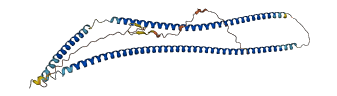
1 structures for Q63279
| Entry ID | Method | Resolution | Chain | Position | Source |
|---|---|---|---|---|---|
| AF-Q63279-F1 | Predicted | AlphaFoldDB |
10 variants for Q63279
| Variant ID(s) | Position | Change | Description | Diseaes Association | Provenance |
|---|---|---|---|---|---|
| rs3321978328 | 3 | S>F | No | EVA | |
| rs3321817161 | 3 | S>T | No | EVA | |
| rs3321890958 | 5 | S>N | No | EVA | |
| rs3321916477 | 6 | Y>F | No | EVA | |
| rs3321629811 | 7 | R>S | No | EVA | |
| rs3321946536 | 128 | R>C | No | EVA | |
| rs3321862778 | 162 | R>H | No | EVA | |
| rs3321941478 | 167 | D>E | No | EVA | |
| rs3321916482 | 279 | D>E | No | EVA | |
| rs3321941397 | 287 | V>D | No | EVA |
No associated diseases with Q63279
4 regional properties for Q63279
| Type | Name | Position | InterPro Accession |
|---|---|---|---|
| domain | Mononegavirales RNA-directed RNA polymerase catalytic domain | 15 - 1105 | IPR014023 |
| domain | Mononegavirus L protein 2-O-ribose methyltransferase | 1662 - 1852 | IPR025786 |
| domain | Mononegavirales mRNA-capping domain V | 1127 - 1333 | IPR026890 |
| domain | RNA-directed RNA polymerase L, C-terminal | 1210 - 2002 | IPR039736 |
10 GO annotations of cellular component
| Name | Definition |
|---|---|
| apicolateral plasma membrane | The apical end of the lateral plasma membrane of epithelial cells. |
| cell periphery | The part of a cell encompassing the cell cortex, the plasma membrane, and any external encapsulating structures. |
| costamere | Regular periodic sub membranous arrays of vinculin in skeletal and cardiac muscle cells, these arrays link Z-discs to the sarcolemma and are associated with links to extracellular matrix. |
| cytoskeleton | A cellular structure that forms the internal framework of eukaryotic and prokaryotic cells. The cytoskeleton includes intermediate filaments, microfilaments, microtubules, the microtrabecular lattice, and other structures characterized by a polymeric filamentous nature and long-range order within the cell. The various elements of the cytoskeleton not only serve in the maintenance of cellular shape but also have roles in other cellular functions, including cellular movement, cell division, endocytosis, and movement of organelles. |
| dystrophin-associated glycoprotein complex | A multiprotein complex that forms a strong mechanical link between the cytoskeleton and extracellular matrix; typical of, but not confined to, muscle cells. The complex is composed of transmembrane, cytoplasmic, and extracellular proteins, including dystrophin, sarcoglycans, dystroglycan, dystrobrevins, syntrophins, sarcospan, caveolin-3, and NO synthase. |
| intermediate filament | A cytoskeletal structure that forms a distinct elongated structure, characteristically 10 nm in diameter, that occurs in the cytoplasm of eukaryotic cells. Intermediate filaments form a fibrous system, composed of chemically heterogeneous subunits and involved in mechanically integrating the various components of the cytoplasmic space. Intermediate filaments may be divided into five chemically distinct classes: Type I, acidic keratins; Type II, basic keratins; Type III, including desmin, vimentin and others; Type IV, neurofilaments and related filaments; and Type V, lamins. |
| plasma membrane | The membrane surrounding a cell that separates the cell from its external environment. It consists of a phospholipid bilayer and associated proteins. |
| sarcolemma | The outer membrane of a muscle cell, consisting of the plasma membrane, a covering basement membrane (about 100 nm thick and sometimes common to more than one fiber), and the associated loose network of collagen fibers. |
| terminal web | An actin-rich cytoskeletal network located beneath the microvilli of the apical plasma membrane of polarized epithelial cells. In addition to actin filaments, the terminal web may contain actin-binding proteins, myosin motor proteins, and intermediate filaments. The terminal web can function as a contractile structure that influences the spatial distribution of microvilli as well as the development and morphogenesis of tissues containing polarized epithelial cells. |
| Z disc | Platelike region of a muscle sarcomere to which the plus ends of actin filaments are attached. |
2 GO annotations of molecular function
| Name | Definition |
|---|---|
| protein-containing complex binding | Binding to a macromolecular complex. |
| structural constituent of muscle | The action of a molecule that contributes to the structural integrity of a muscle fiber. |
6 GO annotations of biological process
| Name | Definition |
|---|---|
| cell differentiation involved in embryonic placenta development | The process in which a relatively unspecialized cell acquires specialized features of the embryonic placenta. |
| epithelial cell differentiation | The process in which a relatively unspecialized cell acquires specialized features of an epithelial cell, any of the cells making up an epithelium. |
| intermediate filament organization | Control of the spatial distribution of intermediate filaments; includes organizing filaments into meshworks, bundles, or other structures, as by cross-linking. |
| Notch signaling pathway | The series of molecular signals initiated by an extracellular ligand binding to the receptor Notch on the surface of a target cell, and ending with the regulation of a downstream cellular process, e.g. transcription. |
| response to estrogen | Any process that results in a change in state or activity of a cell or an organism (in terms of movement, secretion, enzyme production, gene expression, etc.) as a result of stimulus by an estrogen, C18 steroid hormones that can stimulate the development of female sexual characteristics. |
| sarcomere organization | The myofibril assembly process that results in the organization of muscle actomyosin into sarcomeres. The sarcomere is the repeating unit of a myofibril in a muscle cell, composed of an array of overlapping thick and thin filaments between two adjacent Z discs. |
| 10 | 20 | 30 | 40 | 50 | 60 |
| MTSYSYRQSS | AMSSYGGMGG | GPVRFGSGGV | FRAPSIHGGS | GGRGVSVSST | RIVSSSSGGY |
| 70 | 80 | 90 | 100 | 110 | 120 |
| VGGRGGSFSG | ALTVTDGLLG | GNEKITMQNL | NDRLASYLDK | VRALEQANGE | LEVKIRDWYQ |
| 130 | 140 | 150 | 160 | 170 | 180 |
| KQGPGPFRDY | SQYFKTIEDL | RDKILGATIE | NSKIVLQIDN | ARLAADDFRT | KFETEQALRM |
| 190 | 200 | 210 | 220 | 230 | 240 |
| SVEADINGLR | RVLDELTLAR | TDLEMQIENL | KEELAYLKKN | HEEEISALRS | QVGGQVSVEV |
| 250 | 260 | 270 | 280 | 290 | 300 |
| DSTPGIDLAK | ILSEMRSQYE | AMAEKNRKDA | EAWYLTQIDE | LNTQVAVHTT | QIQINKTEVT |
| 310 | 320 | 330 | 340 | 350 | 360 |
| ELRRKVQDLE | IELQSQLSMK | AALEGTVAEI | EARYGAQLSH | IQGVISSIEV | QLSNVRADTE |
| 370 | 380 | 390 | 400 | ||
| RQNQEYQQLM | DIKSRLEQEI | ATYRSLLEGQ | EAHYNSLSIA | KAL |