Q63014
Gene name |
Akap8 (Akap95) |
Protein name |
A-kinase anchor protein 8 |
Names |
AKAP-8, A-kinase anchor protein 95 kDa, AKAP 95 |
Species |
Rattus norvegicus (Rat) |
KEGG Pathway |
rno:116633 |
EC number |
|
Protein Class |
|
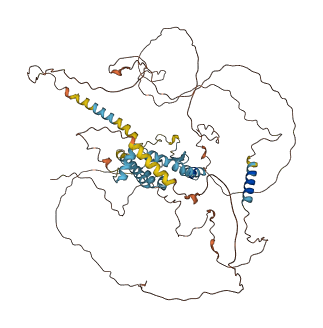
Descriptions
The autoinhibited protein was predicted that may have potential autoinhibitory elements via cis-regPred.
Autoinhibitory domains (AIDs)
Target domain |
|
Relief mechanism |
|
Assay |
cis-regPred |
Accessory elements
No accessory elements
Autoinhibited structure

Activated structure
1 structures for Q63014
| Entry ID | Method | Resolution | Chain | Position | Source |
|---|---|---|---|---|---|
| AF-Q63014-F1 | Predicted | AlphaFoldDB |
4 variants for Q63014
| Variant ID(s) | Position | Change | Description | Diseaes Association | Provenance |
|---|---|---|---|---|---|
| rs3321026652 | 140 | M>I | No | EVA | |
| rs3320903503 | 144 | T>N | No | EVA | |
| rs3320992161 | 149 | S>G | No | EVA | |
| rs3320816779 | 151 | S>G | No | EVA |
No associated diseases with Q63014
1 regional properties for Q63014
| Type | Name | Position | InterPro Accession |
|---|---|---|---|
| domain | GPCR, rhodopsin-like, 7TM | 75 - 326 | IPR017452 |
Functions
8 GO annotations of cellular component
| Name | Definition |
|---|---|
| condensed chromosome | A highly compacted molecule of DNA and associated proteins resulting in a cytologically distinct structure. |
| female pronucleus | The pronucleus originating from the ovum that is being fertilized. |
| Golgi apparatus | A membrane-bound cytoplasmic organelle of the endomembrane system that further processes the core oligosaccharides (e.g. N-glycans) added to proteins in the endoplasmic reticulum and packages them into membrane-bound vesicles. The Golgi apparatus operates at the intersection of the secretory, lysosomal, and endocytic pathways. |
| mitochondrion | A semiautonomous, self replicating organelle that occurs in varying numbers, shapes, and sizes in the cytoplasm of virtually all eukaryotic cells. It is notably the site of tissue respiration. |
| nuclear matrix | The dense fibrillar network lying on the inner side of the nuclear membrane. |
| nucleolus | A small, dense body one or more of which are present in the nucleus of eukaryotic cells. It is rich in RNA and protein, is not bounded by a limiting membrane, and is not seen during mitosis. Its prime function is the transcription of the nucleolar DNA into 45S ribosomal-precursor RNA, the processing of this RNA into 5.8S, 18S, and 28S components of ribosomal RNA, and the association of these components with 5S RNA and proteins synthesized outside the nucleolus. This association results in the formation of ribonucleoprotein precursors; these pass into the cytoplasm and mature into the 40S and 60S subunits of the ribosome. |
| nucleoplasm | That part of the nuclear content other than the chromosomes or the nucleolus. |
| nucleus | A membrane-bounded organelle of eukaryotic cells in which chromosomes are housed and replicated. In most cells, the nucleus contains all of the cell's chromosomes except the organellar chromosomes, and is the site of RNA synthesis and processing. In some species, or in specialized cell types, RNA metabolism or DNA replication may be absent. |
6 GO annotations of molecular function
| Name | Definition |
|---|---|
| DNA binding | Any molecular function by which a gene product interacts selectively and non-covalently with DNA (deoxyribonucleic acid). |
| double-stranded DNA binding | Binding to double-stranded DNA. |
| histone deacetylase binding | Binding to histone deacetylase. |
| NF-kappaB binding | Binding to NF-kappaB, a transcription factor for eukaryotic RNA polymerase II promoters. |
| protein kinase A regulatory subunit binding | Binding to one or both of the regulatory subunits of protein kinase A. |
| zinc ion binding | Binding to a zinc ion (Zn). |
8 GO annotations of biological process
| Name | Definition |
|---|---|
| cell cycle G2/M phase transition | The cell cycle process by which a cell in G2 phase commits to M phase. |
| cellular response to lipopolysaccharide | Any process that results in a change in state or activity of a cell (in terms of movement, secretion, enzyme production, gene expression, etc.) as a result of a lipopolysaccharide stimulus; lipopolysaccharide is a major component of the cell wall of gram-negative bacteria. |
| cellular response to prostaglandin E stimulus | Any process that results in a change in state or activity of a cell (in terms of movement, secretion, enzyme production, gene expression, etc.) as a result of a prostagladin E stimulus. |
| innate immune response | Innate immune responses are defense responses mediated by germline encoded components that directly recognize components of potential pathogens. |
| mitotic chromosome condensation | The cell cycle process in which chromatin structure is compacted prior to and during mitosis in eukaryotic cells. |
| negative regulation of tumor necrosis factor production | Any process that stops, prevents, or reduces the frequency, rate, or extent of tumor necrosis factor production. |
| positive regulation of histone deacetylation | Any process that activates or increases the frequency, rate or extent of the removal of acetyl groups from histones. |
| protein transport | The directed movement of proteins into, out of or within a cell, or between cells, by means of some agent such as a transporter or pore. |
| 10 | 20 | 30 | 40 | 50 | 60 |
| MEQSYGGYGA | WSAGPANTQG | TYGSGVASWQ | GYENYSYYNA | QNTSVPTGTP | YSYGPASWEA |
| 70 | 80 | 90 | 100 | 110 | 120 |
| TKASDGGLAA | GSSAMHVASF | APEPCTDNSD | SLIAKINQRL | DMLSKEGGRG | GISSGGEGMQ |
| 130 | 140 | 150 | 160 | 170 | 180 |
| DRDSSFRFQP | YESYDSRPCM | PEHTPYRPSY | SYDYDFDLGT | DRNGSFGGTF | NDCRDPTPER |
| 190 | 200 | 210 | 220 | 230 | 240 |
| GALDGFLRGR | GQGRFQDRSN | SSTFIRSDPF | MPPSASSEPL | STTWSELNYM | GGRGLGGPST |
| 250 | 260 | 270 | 280 | 290 | 300 |
| NRPPPSLFSQ | SMAPDYSMMG | MQGVGGFGGT | MPYGCGRSQT | RIRDWPRRRG | FERFGPDNMG |
| 310 | 320 | 330 | 340 | 350 | 360 |
| RKRKPFPLYE | EPDAKLARAD | SEGDLSENDD | GAGDLRSGDE | EFRGEDDLCD | SRKQRGEKED |
| 370 | 380 | 390 | 400 | 410 | 420 |
| EDEDVKKRRE | KQRRRDRMRD | RAADRIQFAC | SVCKFRSFED | EEIQKHLQSK | FHKETLRFIS |
| 430 | 440 | 450 | 460 | 470 | 480 |
| TKLPDKTVEF | LQEYIINRNK | KIEKRRQELL | EKESPKPKPD | PFKGIGQEHF | FKRIEAAHCL |
| 490 | 500 | 510 | 520 | 530 | 540 |
| ACDMLIPAQH | QLLQRHLHSV | DHNHNRRLAA | EQFKKTSLHV | AKSVLNNKHI | VKMLEKYLKG |
| 550 | 560 | 570 | 580 | 590 | 600 |
| EDPFVNETAD | LETEGDENLG | EEKETPEEVA | AEVLAEVITA | AVKAVEGDGE | PAAEHSDVLA |
| 610 | 620 | 630 | 640 | 650 | 660 |
| EVEGPVDTAE | AGSDSHTGKL | LEEQTCETAS | ETRNMEDMAR | GEAAEARNEA | AVPAAAAGSP |
| 670 | 680 | ||||
| VPVIAIPGIL | EDELEQTDAE | AKDTPTE |