Q61586
Gene name |
Gpam |
Protein name |
Glycerol-3-phosphate acyltransferase 1, mitochondrial |
Names |
GPAT-1, P90 |
Species |
Mus musculus (Mouse) |
KEGG Pathway |
mmu:14732 |
EC number |
2.3.1.15: Transferring groups other than amino-acyl groups |
Protein Class |
|
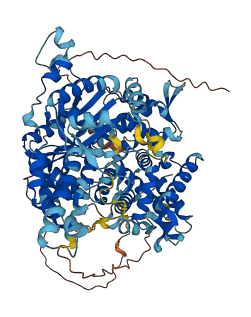
Descriptions
The autoinhibited protein was predicted that may have potential autoinhibitory elements via cis-regPred.
Autoinhibitory domains (AIDs)
Target domain |
|
Relief mechanism |
|
Assay |
cis-regPred |
Accessory elements
No accessory elements
Autoinhibited structure

Activated structure
1 structures for Q61586
| Entry ID | Method | Resolution | Chain | Position | Source |
|---|---|---|---|---|---|
| AF-Q61586-F1 | Predicted | AlphaFoldDB |
30 variants for Q61586
| Variant ID(s) | Position | Change | Description | Diseaes Association | Provenance |
|---|---|---|---|---|---|
| rs3389555936 | 144 | A>V | No | EVA | |
| rs3389559429 | 158 | Q>R | No | EVA | |
| rs3389541250 | 162 | A>V | No | EVA | |
| rs3408323089 | 166 | V>M | No | EVA | |
| rs3389561509 | 180 | T>N | No | EVA | |
| rs3389455529 | 221 | N>S | No | EVA | |
| rs3389503850 | 230 | H>D | No | EVA | |
| rs3409409046 | 241 | F>L | No | EVA | |
| rs3409293579 | 242 | I>S | No | EVA | |
| rs261466571 | 263 | V>I | No | EVA | |
| rs3389513842 | 301 | V>I | No | EVA | |
| rs3389555937 | 404 | F>Y | No | EVA | |
| rs259523607 | 419 | S>P | No | EVA | |
| rs3409453001 | 484 | S>C | No | EVA | |
| rs3389559416 | 495 | R>I | No | EVA | |
| rs3389513830 | 505 | L>H | No | EVA | |
| rs3389513788 | 506 | V>L | No | EVA | |
| rs3389546863 | 520 | D>Y | No | EVA | |
| rs3389556002 | 549 | T>R | No | EVA | |
| rs3389556015 | 560 | S>N | No | EVA | |
| rs213903349 | 675 | Q>P | No | EVA | |
| rs3389540695 | 680 | L>P | No | EVA | |
| rs244554578 | 682 | E>A | No | EVA | |
| rs227383648 | 684 | N>S | No | EVA | |
| rs232705317 | 704 | Y>H | No | EVA | |
| rs3408323141 | 721 | Q>L | No | EVA | |
| rs3389547694 | 732 | S>R | No | EVA | |
| rs3389546432 | 736 | I>F | No | EVA | |
| rs864266855 | 799 | V>E | No | EVA | |
| rs3389547664 | 806 | S>N | No | EVA |
No associated diseases with Q61586
Functions
| Description | ||
|---|---|---|
| EC Number | 2.3.1.15 | Transferring groups other than amino-acyl groups |
| Subcellular Localization |
|
|
| PANTHER Family | ||
| PANTHER Subfamily | ||
| PANTHER Protein Class | ||
| PANTHER Pathway Category | No pathway information available | |
6 GO annotations of cellular component
| Name | Definition |
|---|---|
| integral component of membrane | The component of a membrane consisting of the gene products and protein complexes having at least some part of their peptide sequence embedded in the hydrophobic region of the membrane. |
| mitochondrial inner membrane | The inner, i.e. lumen-facing, lipid bilayer of the mitochondrial envelope. It is highly folded to form cristae. |
| mitochondrial membrane | Either of the lipid bilayers that surround the mitochondrion and form the mitochondrial envelope. |
| mitochondrial outer membrane | The outer, i.e. cytoplasm-facing, lipid bilayer of the mitochondrial envelope. |
| mitochondrion | A semiautonomous, self replicating organelle that occurs in varying numbers, shapes, and sizes in the cytoplasm of virtually all eukaryotic cells. It is notably the site of tissue respiration. |
| plasma membrane | The membrane surrounding a cell that separates the cell from its external environment. It consists of a phospholipid bilayer and associated proteins. |
2 GO annotations of molecular function
| Name | Definition |
|---|---|
| glycerol-3-phosphate O-acyltransferase activity | Catalysis of the reaction: acyl-CoA + sn-glycerol 3-phosphate = CoA + 1-acyl-sn-glycerol 3-phosphate. |
| sn-1-glycerol-3-phosphate C16:0-DCA-CoA acyl transferase activity | Catalysis of the reaction: hexadecanedioyl-CoA + sn-glycerol 3-phosphate = coenzyme A + 1-C16:0-alpha,omega-dicarboxyl-2-lysophosphatidate. |
24 GO annotations of biological process
| Name | Definition |
|---|---|
| activated T cell proliferation | The expansion of a T cell population following activation by an antigenic stimulus. |
| activation-induced cell death of T cells | A T cell apoptotic process that occurs towards the end of the expansion phase following the initial activation of mature T cells by antigen and is triggered by T cell receptor stimulation and signals transmitted via various surface-expressed members of the TNF receptor family such as Fas ligand, Fas, and TNF and the p55 and p75 TNF receptors. |
| acyl-CoA metabolic process | The chemical reactions and pathways involving acyl-CoA, any derivative of coenzyme A in which the sulfhydryl group is in thiolester linkage with an acyl group. |
| CDP-diacylglycerol biosynthetic process | The chemical reactions and pathways resulting in the formation of CDP-diacylglycerol, CDP-1,2-diacylglycerol, a substance composed of diacylglycerol in glycosidic linkage with cytidine diphosphate. |
| cellular response to insulin stimulus | Any process that results in a change in state or activity of a cell (in terms of movement, secretion, enzyme production, gene expression, etc.) as a result of an insulin stimulus. Insulin is a polypeptide hormone produced by the islets of Langerhans of the pancreas in mammals, and by the homologous organs of other organisms. |
| defense response to virus | Reactions triggered in response to the presence of a virus that act to protect the cell or organism. |
| diacylglycerol biosynthetic process | The chemical reactions and pathways resulting in the formation of diacylglycerol, a glyceride in which any two of the R groups (positions not specified) are acyl groups while the remaining R group can be either H or an alkyl group. |
| fatty acid homeostasis | Any process involved in the maintenance of an internal steady state of fatty acid within an organism or cell. |
| fatty acid metabolic process | The chemical reactions and pathways involving fatty acids, aliphatic monocarboxylic acids liberated from naturally occurring fats and oils by hydrolysis. |
| glycerol-3-phosphate metabolic process | The chemical reactions and pathways involving glycerol-3-phosphate, a phosphoric monoester of glycerol. |
| glycerophospholipid metabolic process | The chemical reactions and pathways involving glycerophospholipids, any derivative of glycerophosphate that contains at least one O-acyl, O-alkyl, or O-alkenyl group attached to the glycerol residue. |
| negative regulation of activation-induced cell death of T cells | Any process that stops, prevents, or reduces the frequency, rate or extent of activation-induced cell death of T cells. |
| phosphatidic acid biosynthetic process | The chemical reactions and pathways resulting in the formation of phosphatidic acid, any derivative of glycerol phosphate in which both the remaining hydroxyl groups of the glycerol moiety are esterified with fatty acids. |
| phosphatidylglycerol biosynthetic process | The chemical reactions and pathways resulting in the formation of phosphatidylglycerols, any of a class of phospholipids in which the phosphatidyl group is esterified to the hydroxyl group of glycerol. |
| phospholipid biosynthetic process | The chemical reactions and pathways resulting in the formation of a phospholipid, a lipid containing phosphoric acid as a mono- or diester. |
| phospholipid homeostasis | Any process involved in the maintenance of an internal steady state of phospholipid within an organism or cell. |
| positive regulation of activated T cell proliferation | Any process that activates or increases the rate or extent of activated T cell proliferation. |
| positive regulation of multicellular organism growth | Any process that activates or increases the frequency, rate or extent of growth of an organism to reach its usual body size. |
| positive regulation of triglyceride biosynthetic process | Any process that increases the rate, frequency, or extent of triglyceride biosynthesis. Triglyceride biosynthesis is the collection of chemical reactions and pathways resulting in the formation of triglyceride, any triester of glycerol. |
| regulation of cytokine production | Any process that modulates the frequency, rate, or extent of production of a cytokine. |
| response to activity | Any process that results in a change in state or activity of a cell or an organism (in terms of movement, secretion, enzyme production, gene expression, etc.) as a result of an activity stimulus. |
| response to glucose | Any process that results in a change in state or activity of a cell or an organism (in terms of movement, secretion, enzyme production, gene expression, etc.) as a result of a glucose stimulus. |
| triglyceride biosynthetic process | The chemical reactions and pathways resulting in the formation of a triglyceride, any triester of glycerol. |
| triglyceride metabolic process | The chemical reactions and pathways involving triglyceride, any triester of glycerol. The three fatty acid residues may all be the same or differ in any permutation. Triglycerides are important components of plant oils, animal fats and animal plasma lipoproteins. |
1 homologous proteins in AiPD
| UniProt AC | Gene Name | Protein Name | Species | Evidence Code |
|---|---|---|---|---|
| P98192 | Gnpat | Dihydroxyacetone phosphate acyltransferase | Mus musculus (Mouse) | PR |
| 10 | 20 | 30 | 40 | 50 | 60 |
| MEESSVTVGT | IDVSYLPSSS | EYSLGRCKHT | SEDWVDCGFK | PTFFRSATLK | WKESLMSRKR |
| 70 | 80 | 90 | 100 | 110 | 120 |
| PFVGRCCYSC | TPQSWERFFN | PSIPSLGLRN | VIYINETHTR | HRGWLARRLS | YILFVQERDV |
| 130 | 140 | 150 | 160 | 170 | 180 |
| HKGMFATSVT | ENVLSSSRVQ | EAIAEVAAEL | NPDGSAQQQS | KAIQKVKRKA | RKILQEMVAT |
| 190 | 200 | 210 | 220 | 230 | 240 |
| VSPGMIRLTG | WVLLKLFNSF | FWNIQIHKGQ | LEMVKAATET | NLPLLFLPVH | RSHIDYLLLT |
| 250 | 260 | 270 | 280 | 290 | 300 |
| FILFCHNIKA | PYIASGNNLN | IPVFSTLIHK | LGGFFIRRRL | DETPDGRKDI | LYRALLHGHV |
| 310 | 320 | 330 | 340 | 350 | 360 |
| VELLRQQQFL | EIFLEGTRSR | SGKTSCARAG | LLSVVVDTLS | SNTIPDILVI | PVGISYDRII |
| 370 | 380 | 390 | 400 | 410 | 420 |
| EGHYNGEQLG | KPKKNESLWS | VARGVIRMLR | KNYGYVRVDF | AQPFSLKEYL | EGQSQKPVSA |
| 430 | 440 | 450 | 460 | 470 | 480 |
| PLSLEQALLP | AILPSRPNDV | ADEHQDLSSN | ESRNPADEAF | RRRLIANLAE | HILFTASKSC |
| 490 | 500 | 510 | 520 | 530 | 540 |
| AIMSTHIVAC | LLLYRHRQGI | HLSTLVEDFF | VMKEEVLARD | FDLGFSGNSE | DVVMHAIQLL |
| 550 | 560 | 570 | 580 | 590 | 600 |
| GNCVTITHTS | RKDEFFITPS | TTVPSVFELN | FYSNGVLHVF | IMEAIIACSI | YAVLNKRCSG |
| 610 | 620 | 630 | 640 | 650 | 660 |
| GSAGGLGNLI | SQEQLVRKAA | SLCYLLSNEG | TISLPCQTFY | QVCHETVGKF | IQYGILTVAE |
| 670 | 680 | 690 | 700 | 710 | 720 |
| QDDQEDVSPG | LAEQQWDKKL | PELNWRSDEE | DEDSDFGEEQ | RDCYLKVSQS | KEHQQFITFL |
| 730 | 740 | 750 | 760 | 770 | 780 |
| QRLLGPLLEA | YSSAAIFVHN | FSGPVPESEY | LQKLHRYLIT | RTERNVAVYA | ESATYCLVKN |
| 790 | 800 | 810 | 820 | ||
| AVKMFKDIGV | FKETKQKRVS | VLELSSTFLP | QCNRQKLLEY | ILSFVVL |