P98192
Gene name |
Gnpat |
Protein name |
Dihydroxyacetone phosphate acyltransferase |
Names |
DAP-AT, DHAP-AT, Acyl-CoA:dihydroxyacetonephosphateacyltransferase, Glycerone-phosphate O-acyltransferase |
Species |
Mus musculus (Mouse) |
KEGG Pathway |
mmu:14712 |
EC number |
2.3.1.42: Transferring groups other than amino-acyl groups |
Protein Class |
|
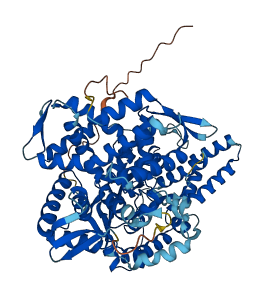
Descriptions
The autoinhibited protein was predicted that may have potential autoinhibitory elements via cis-regPred.
Autoinhibitory domains (AIDs)
Target domain |
|
Relief mechanism |
|
Assay |
cis-regPred |
Accessory elements
No accessory elements
Autoinhibited structure

Activated structure
1 structures for P98192
| Entry ID | Method | Resolution | Chain | Position | Source |
|---|---|---|---|---|---|
| AF-P98192-F1 | Predicted | AlphaFoldDB |
32 variants for P98192
| Variant ID(s) | Position | Change | Description | Diseaes Association | Provenance |
|---|---|---|---|---|---|
| rs3389019567 | 15 | S>* | No | EVA | |
| rs3389014635 | 71 | K>N | No | EVA | |
| rs3389020152 | 88 | S>F | No | EVA | |
| rs3399234891 | 107 | E>* | No | EVA | |
| rs3399234887 | 107 | E>A | No | EVA | |
| rs232985742 | 149 | A>V | No | EVA | |
| rs3388989211 | 165 | I>S | No | EVA | |
| rs3389021477 | 201 | R>S | No | EVA | |
| rs3389021661 | 203 | S>F | No | EVA | |
| rs3389014656 | 269 | R>I | No | EVA | |
| rs238797300 | 299 | V>I | No | EVA | |
| rs232701116 | 304 | E>D | No | EVA | |
| rs3389008362 | 322 | S>R | No | EVA | |
| rs3389017734 | 327 | F>L | No | EVA | |
| rs3413147386 | 337 | A>P | No | EVA | |
| rs226298950 | 342 | N>S | No | EVA | |
| rs3399804326 | 372 | M>T | No | EVA | |
| rs242775050 | 414 | V>L | No | EVA | |
| rs13470293 | 421 | F>L | No | EVA | |
| rs3389018487 | 451 | Q>* | No | EVA | |
| rs3389017767 | 455 | K>I | No | EVA | |
| rs3399419841 | 462 | Q>H | No | EVA | |
| rs3389001501 | 478 | S>T | No | EVA | |
| rs3388989235 | 486 | N>S | No | EVA | |
| rs3389013760 | 522 | D>N | No | EVA | |
| rs3399825800 | 529 | G>E | No | EVA | |
| rs3389021737 | 542 | L>M | No | EVA | |
| rs3412536961 | 550 | M>I | No | EVA | |
| rs3389025397 | 581 | L>V | No | EVA | |
| rs3389021675 | 630 | L>* | No | EVA | |
| rs3389008358 | 641 | K>R | No | EVA | |
| rs6372367 | 644 | V>I | No | EVA |
No associated diseases with P98192
Functions
| Description | ||
|---|---|---|
| EC Number | 2.3.1.42 | Transferring groups other than amino-acyl groups |
| Subcellular Localization |
|
|
| PANTHER Family | ||
| PANTHER Subfamily | ||
| PANTHER Protein Class | ||
| PANTHER Pathway Category | No pathway information available | |
5 GO annotations of cellular component
| Name | Definition |
|---|---|
| mitochondrial membrane | Either of the lipid bilayers that surround the mitochondrion and form the mitochondrial envelope. |
| mitochondrion | A semiautonomous, self replicating organelle that occurs in varying numbers, shapes, and sizes in the cytoplasm of virtually all eukaryotic cells. It is notably the site of tissue respiration. |
| peroxisomal matrix | The volume contained within the membranes of a peroxisome; in many cells the matrix contains a crystalloid core largely composed of urate oxidase. |
| peroxisomal membrane | The lipid bilayer surrounding a peroxisome. |
| peroxisome | A small organelle enclosed by a single membrane, and found in most eukaryotic cells. Contains peroxidases and other enzymes involved in a variety of metabolic processes including free radical detoxification, lipid catabolism and biosynthesis, and hydrogen peroxide metabolism. |
2 GO annotations of molecular function
| Name | Definition |
|---|---|
| catalytic activity | Catalysis of a biochemical reaction at physiological temperatures. In biologically catalyzed reactions, the reactants are known as substrates, and the catalysts are naturally occurring macromolecular substances known as enzymes. Enzymes possess specific binding sites for substrates, and are usually composed wholly or largely of protein, but RNA that has catalytic activity (ribozyme) is often also regarded as enzymatic. |
| glycerone-phosphate O-acyltransferase activity | Catalysis of the reaction: acyl-CoA + glycerone phosphate = 1-acylglycerone 3-phosphate + CoA. |
13 GO annotations of biological process
| Name | Definition |
|---|---|
| cerebellum morphogenesis | The process in which the anatomical structure of the cerebellum is generated and organized. The cerebellum is the portion of the brain in the back of the head between the cerebrum and the pons. The cerebellum controls balance for walking and standing, modulates the force and range of movement and is involved in the learning of motor skills. |
| ether lipid biosynthetic process | The chemical reactions and pathways resulting in the formation of ether lipids, lipids that contain (normally) one lipid alcohol in ether linkage to one of the carbon atoms (normally C-1) of glycerol. |
| fatty acid metabolic process | The chemical reactions and pathways involving fatty acids, aliphatic monocarboxylic acids liberated from naturally occurring fats and oils by hydrolysis. |
| glycerophospholipid metabolic process | The chemical reactions and pathways involving glycerophospholipids, any derivative of glycerophosphate that contains at least one O-acyl, O-alkyl, or O-alkenyl group attached to the glycerol residue. |
| membrane organization | A process which results in the assembly, arrangement of constituent parts, or disassembly of a membrane. A membrane is a double layer of lipid molecules that encloses all cells, and, in eukaryotes, many organelles; may be a single or double lipid bilayer; also includes associated proteins. |
| myelination | The process in which myelin sheaths are formed and maintained around neurons. Oligodendrocytes in the brain and spinal cord and Schwann cells in the peripheral nervous system wrap axons with compact layers of their plasma membrane. Adjacent myelin segments are separated by a non-myelinated stretch of axon called a node of Ranvier. |
| paranodal junction assembly | Formation of the junction between an axon and the glial cell that forms the myelin sheath. Paranodal junctions form at each paranode, i.e. at the ends of the unmyelinated nodes of Ranvier. |
| phospholipid biosynthetic process | The chemical reactions and pathways resulting in the formation of a phospholipid, a lipid containing phosphoric acid as a mono- or diester. |
| response to fatty acid | Any process that results in a change in state or activity of a cell or an organism (in terms of movement, secretion, enzyme production, gene expression, etc.) as a result of a fatty acid stimulus. |
| response to nutrient | Any process that results in a change in state or activity of a cell or an organism (in terms of movement, secretion, enzyme production, gene expression, etc.) as a result of a nutrient stimulus. |
| response to starvation | Any process that results in a change in state or activity of a cell or an organism (in terms of movement, secretion, enzyme production, gene expression, etc.) as a result of a starvation stimulus, deprivation of nourishment. |
| response to xenobiotic stimulus | Any process that results in a change in state or activity of a cell or an organism (in terms of movement, secretion, enzyme production, gene expression, etc.) as a result of a stimulus from a xenobiotic, a compound foreign to the organim exposed to it. It may be synthesized by another organism (like ampicilin) or it can be a synthetic chemical. |
| synapse assembly | The aggregation, arrangement and bonding together of a set of components to form a synapse. This process ends when the synapse is mature (functional). |
1 homologous proteins in AiPD
| UniProt AC | Gene Name | Protein Name | Species | Evidence Code |
|---|---|---|---|---|
| Q61586 | Gpam | Glycerol-3-phosphate acyltransferase 1, mitochondrial | Mus musculus (Mouse) | PR |
| 10 | 20 | 30 | 40 | 50 | 60 |
| MDVPSSSSSR | FSVGSASPSS | VLLYAKDLKK | WDEFEDLLEE | RRHISDFKFA | MKCYTPPLYR |
| 70 | 80 | 90 | 100 | 110 | 120 |
| GITPCKPGDI | KSIVLSSEEI | NYVIKQLSRE | SLTGVDVLRE | EASEILEEMS | HKLRIGAIRF |
| 130 | 140 | 150 | 160 | 170 | 180 |
| FAFVLSKIFK | QIFSKVCVNE | EGIQKLQRAV | QEHPVVLLPS | HRSYIDFLML | SFILYSYDLP |
| 190 | 200 | 210 | 220 | 230 | 240 |
| VPVIAAGMDF | LGMRVVSELL | RMSGAFFMRR | TFGGNKLYWA | VFSEYVKTML | RCGYAPVEFF |
| 250 | 260 | 270 | 280 | 290 | 300 |
| LEGTRSRAAK | TLTPKFGLLN | IVMEPFFKRE | VFDTYFVPIS | ISYDKILEES | LYAYEILGVP |
| 310 | 320 | 330 | 340 | 350 | 360 |
| KPKESTTGLL | KARRILSENF | GSIHVYFGDP | VSLRSLAAGR | LNRNTYNLVP | RCIPQKQPED |
| 370 | 380 | 390 | 400 | 410 | 420 |
| VQAFVTEVAY | KMQLLQIENL | ALSPWLLVVT | ILLQNQLSMD | FDALVEKTLW | LKGVTQVFGG |
| 430 | 440 | 450 | 460 | 470 | 480 |
| FLLWPDNKLP | EEVVQSSILL | HSNLASLVKD | QVVLKMNSGS | SQVVNGLVPE | HIALLMCSAY |
| 490 | 500 | 510 | 520 | 530 | 540 |
| RNQLLNIFAR | PSLVALALHM | TPGLRKEDVF | SCFSFLRNVF | SDEFIFLPGN | TLRDFEEGCY |
| 550 | 560 | 570 | 580 | 590 | 600 |
| LLCKAEAMQM | AGKDIILTDK | GTAVLQFLTS | LFKPFVESYQ | LLCRYLLHEE | DYFGEKEYLV |
| 610 | 620 | 630 | 640 | 650 | 660 |
| AARKFTRQLL | DQGSSQCYDA | LSSELQKNAL | AAFVRLGVVE | KKKVDSKYVY | YVNGPATSKL |
| 670 | |||||
| EEMLGCKKPI | GKPATAKL |