Q61070
Gene name |
Ei24 (Pig8) |
Protein name |
Etoposide-induced protein 2.4 |
Names |
p53-induced gene 8 protein |
Species |
Mus musculus (Mouse) |
KEGG Pathway |
mmu:13663 |
EC number |
|
Protein Class |
|
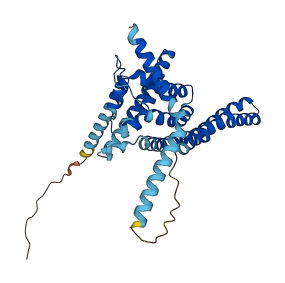
Descriptions
The autoinhibited protein was predicted that may have potential autoinhibitory elements via cis-regPred.
Autoinhibitory domains (AIDs)
Target domain |
|
Relief mechanism |
|
Assay |
cis-regPred |
Accessory elements
No accessory elements
Autoinhibited structure

Activated structure
1 structures for Q61070
| Entry ID | Method | Resolution | Chain | Position | Source |
|---|---|---|---|---|---|
| AF-Q61070-F1 | Predicted | AlphaFoldDB |
9 variants for Q61070
| Variant ID(s) | Position | Change | Description | Diseaes Association | Provenance |
|---|---|---|---|---|---|
| rs3399464290 | 10 | Q>* | No | EVA | |
| rs3389032543 | 42 | R>G | No | EVA | |
| rs3389037664 | 42 | R>Q | No | EVA | |
| rs3389032580 | 64 | E>G | No | EVA | |
| rs3389002204 | 190 | F>Y | No | EVA | |
| rs3389014176 | 216 | C>Y | No | EVA | |
| rs3389008569 | 299 | F>Y | No | EVA | |
| rs3399798318 | 326 | S>L | No | EVA | |
| rs3388984087 | 334 | L>P | No | EVA |
No associated diseases with Q61070
No regional properties for Q61070
| Type | Name | Position | InterPro Accession |
|---|---|---|---|
| No domain, repeats, and functional sites for Q61070 | |||
6 GO annotations of cellular component
| Name | Definition |
|---|---|
| cytosol | The part of the cytoplasm that does not contain organelles but which does contain other particulate matter, such as protein complexes. |
| endoplasmic reticulum | The irregular network of unit membranes, visible only by electron microscopy, that occurs in the cytoplasm of many eukaryotic cells. The membranes form a complex meshwork of tubular channels, which are often expanded into slitlike cavities called cisternae. The ER takes two forms, rough (or granular), with ribosomes adhering to the outer surface, and smooth (with no ribosomes attached). |
| endoplasmic reticulum membrane | The lipid bilayer surrounding the endoplasmic reticulum. |
| Golgi apparatus | A membrane-bound cytoplasmic organelle of the endomembrane system that further processes the core oligosaccharides (e.g. N-glycans) added to proteins in the endoplasmic reticulum and packages them into membrane-bound vesicles. The Golgi apparatus operates at the intersection of the secretory, lysosomal, and endocytic pathways. |
| integral component of membrane | The component of a membrane consisting of the gene products and protein complexes having at least some part of their peptide sequence embedded in the hydrophobic region of the membrane. |
| nuclear membrane | Either of the lipid bilayers that surround the nucleus and form the nuclear envelope; excludes the intermembrane space. |
1 GO annotations of molecular function
| Name | Definition |
|---|---|
| importin-alpha family protein binding | Binding to a member of the importin-alpha family. |
9 GO annotations of biological process
| Name | Definition |
|---|---|
| autophagy | The cellular catabolic process in which cells digest parts of their own cytoplasm; allows for both recycling of macromolecular constituents under conditions of cellular stress and remodeling the intracellular structure for cell differentiation. |
| cellular response to UV-C | Any process that results in a change in state or activity of a cell (in terms of movement, secretion, enzyme production, gene expression, etc.) as a result of a UV-C radiation stimulus. UV-C radiation (UV-C light) spans the wavelengths 100 to 280 nm. |
| intrinsic apoptotic signaling pathway in response to DNA damage | The series of molecular signals in which an intracellular signal is conveyed to trigger the apoptotic death of a cell. The pathway is induced by the detection of DNA damage, and ends when the execution phase of apoptosis is triggered. |
| macroautophagy | The major inducible pathway for the general turnover of cytoplasmic constituents in eukaryotic cells, it is also responsible for the degradation of active cytoplasmic enzymes and organelles during nutrient starvation. Macroautophagy involves the formation of double-membrane-bounded autophagosomes which enclose the cytoplasmic constituent targeted for degradation in a membrane-bounded structure. Autophagosomes then fuse with a lysosome (or vacuole) releasing single-membrane-bounded autophagic bodies that are then degraded within the lysosome (or vacuole). Some types of macroautophagy, e.g. pexophagy, mitophagy, involve selective targeting of the targets to be degraded. |
| negative regulation of cell growth | Any process that stops, prevents, or reduces the frequency, rate, extent or direction of cell growth. |
| negative regulation of protein import into nucleus | Any process that stops, prevents, or reduces the frequency, rate or extent of the movement of proteins from the cytoplasm into the nucleus. |
| neuromuscular process controlling balance | Any process that an organism uses to control its balance, the orientation of the organism (or the head of the organism) in relation to the source of gravity. In humans and animals, balance is perceived through visual cues, the labyrinth system of the inner ears and information from skin pressure receptors and muscle and joint receptors. |
| positive regulation of intrinsic apoptotic signaling pathway | Any process that activates or increases the frequency, rate or extent of intrinsic apoptotic signaling pathway. |
| response to xenobiotic stimulus | Any process that results in a change in state or activity of a cell or an organism (in terms of movement, secretion, enzyme production, gene expression, etc.) as a result of a stimulus from a xenobiotic, a compound foreign to the organim exposed to it. It may be synthesized by another organism (like ampicilin) or it can be a synthetic chemical. |
3 homologous proteins in AiPD
| 10 | 20 | 30 | 40 | 50 | 60 |
| MADSVKTFLQ | DLGRGIKDSI | WGICTISKLD | ARIQQKREEQ | RRRRASSLLA | QRRPQSVERK |
| 70 | 80 | 90 | 100 | 110 | 120 |
| QESEPRIVSR | IFQCCAWNGG | VFWFSLLLFY | RVFIPVLQSV | TARIIGDPSL | HGDVWSWLEF |
| 130 | 140 | 150 | 160 | 170 | 180 |
| FLTSIFSALW | VLPLFVLSKV | VNAIWFQDIA | DLAFEVSGRK | PHPFPSVSKI | IADMLFNLLL |
| 190 | 200 | 210 | 220 | 230 | 240 |
| QALFLIQGMF | VSLFPIHLVG | QLVSLLHMSL | LYSLYCFEYR | WFNKGIEMHQ | RLSNIERNWP |
| 250 | 260 | 270 | 280 | 290 | 300 |
| YYFGFGLPLA | FLTAMQSSYI | ISGCLFSILF | PLFIISANEA | KTPGKAYLFQ | LRLFSLVVFL |
| 310 | 320 | 330 | |||
| SNRLFHKTVY | LQSALSSSSS | AEKFPSPHPS | PAKLKAAAGH |