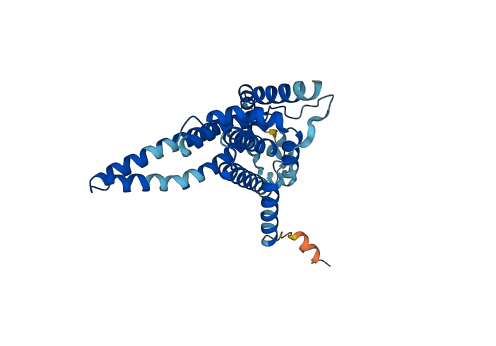
Descriptions
The autoinhibited protein was predicted that may have potential autoinhibitory elements via cis-regPred.
Autoinhibitory domains (AIDs)
Target domain |
|
Relief mechanism |
|
Assay |
cis-regPred |
Accessory elements
No accessory elements
Autoinhibited structure

Activated structure
1 structures for Q20123
| Entry ID | Method | Resolution | Chain | Position | Source |
|---|---|---|---|---|---|
| AF-Q20123-F1 | Predicted | AlphaFoldDB |
No variants for Q20123
| Variant ID(s) | Position | Change | Description | Diseaes Association | Provenance |
|---|---|---|---|---|---|
| No variants for Q20123 | |||||
No associated diseases with Q20123
No regional properties for Q20123
| Type | Name | Position | InterPro Accession |
|---|---|---|---|
| No domain, repeats, and functional sites for Q20123 | |||
2 GO annotations of cellular component
| Name | Definition |
|---|---|
| endoplasmic reticulum | The irregular network of unit membranes, visible only by electron microscopy, that occurs in the cytoplasm of many eukaryotic cells. The membranes form a complex meshwork of tubular channels, which are often expanded into slitlike cavities called cisternae. The ER takes two forms, rough (or granular), with ribosomes adhering to the outer surface, and smooth (with no ribosomes attached). |
| integral component of membrane | The component of a membrane consisting of the gene products and protein complexes having at least some part of their peptide sequence embedded in the hydrophobic region of the membrane. |
No GO annotations of molecular function
| Name | Definition |
|---|---|
| No GO annotations for molecular function |
2 GO annotations of biological process
| Name | Definition |
|---|---|
| macroautophagy | The major inducible pathway for the general turnover of cytoplasmic constituents in eukaryotic cells, it is also responsible for the degradation of active cytoplasmic enzymes and organelles during nutrient starvation. Macroautophagy involves the formation of double-membrane-bounded autophagosomes which enclose the cytoplasmic constituent targeted for degradation in a membrane-bounded structure. Autophagosomes then fuse with a lysosome (or vacuole) releasing single-membrane-bounded autophagic bodies that are then degraded within the lysosome (or vacuole). Some types of macroautophagy, e.g. pexophagy, mitophagy, involve selective targeting of the targets to be degraded. |
| negative regulation of autophagosome assembly | Any process that stops, prevents or reduces the frequency, rate or extent of autophagosome assembly. |
3 homologous proteins in AiPD
| 10 | 20 | 30 | 40 | 50 | 60 |
| MVKFQIIARD | FYHGFIDSFK | GITFVRRIRE | EEAKEVKVEP | PKPVERTVLM | MRREKQGIFK |
| 70 | 80 | 90 | 100 | 110 | 120 |
| RPPEPPKKKD | SFLKKLWQIY | AMNIGFLVLW | QVCILILGLF | FSFFDRTDLG | HNIGYILIIP |
| 130 | 140 | 150 | 160 | 170 | 180 |
| IFFASRIIQA | LWFSDISGAC | MRALKLPPPP | VVPFSSMLAG | TLISALHQIF | FLIQGMLSQY |
| 190 | 200 | 210 | 220 | 230 | 240 |
| LPIPLITPVI | VYLHMALLNS | MYCFDYFFDG | YNLSFLRRKD | IFESHWPYFL | GFGTPLALAC |
| 250 | 260 | 270 | 280 | 290 | 300 |
| SISSNMFVNS | VIFALLFPFF | IITSYPANWN | RKYEEEIPKI | AFCRISYMFT | ELVGKFVKSI |
| 310 | |||||
| TPTNNPTAAR | NNAQN |