Q60710
Gene name |
Samhd1 |
Protein name |
Deoxynucleoside triphosphate triphosphohydrolase SAMHD1 |
Names |
dNTPase, Interferon-gamma-inducible protein Mg11, SAM domain and HD domain-containing protein 1, mSAMHD1 |
Species |
Mus musculus (Mouse) |
KEGG Pathway |
mmu:56045 |
EC number |
|
Protein Class |
|
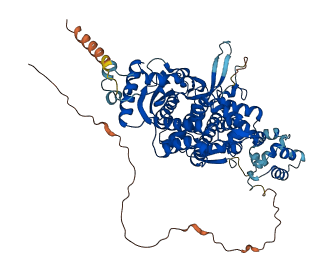
Descriptions
The autoinhibited protein was predicted that may have potential autoinhibitory elements via cis-regPred.
Autoinhibitory domains (AIDs)
Target domain |
|
Relief mechanism |
|
Assay |
cis-regPred |
Accessory elements
No accessory elements
Autoinhibited structure

Activated structure
4 structures for Q60710
| Entry ID | Method | Resolution | Chain | Position | Source |
|---|---|---|---|---|---|
| 6BRG | X-ray | 350 A | A/B/C/D | 1-658 | PDB |
| 6BRH | X-ray | 340 A | A/B | 1-658 | PDB |
| 6BRK | X-ray | 350 A | A | 1-658 | PDB |
| AF-Q60710-F1 | Predicted | AlphaFoldDB |
23 variants for Q60710
| Variant ID(s) | Position | Change | Description | Diseaes Association | Provenance |
|---|---|---|---|---|---|
| rs249086099 | 34 | S>N | No | EVA | |
| rs3388596702 | 41 | A>P | No | EVA | |
| rs3388599608 | 219 | P>R | No | EVA | |
| rs3392412153 | 245 | F>L | No | EVA | |
| rs27308035 | 260 | E>D | No | EVA | |
| rs27308049 | 281 | E>K | No | EVA | |
| rs3388608323 | 304 | I>T | No | EVA | |
| rs3388599566 | 356 | G>V | No | EVA | |
| rs3388590497 | 375 | V>* | No | EVA | |
| rs3388604259 | 384 | T>S | No | EVA | |
| rs254414487 | 473 | V>I | No | EVA | |
| rs27308095 | 480 | Q>K | No | EVA | |
| rs224091530 | 507 | R>H | No | EVA | |
| rs262359778 | 508 | E>K | No | EVA | |
| rs265288633 | 524 | K>N | No | EVA | |
| rs3388601485 | 529 | K>I | No | EVA | |
| rs3392144517 | 547 | V>W | No | EVA | |
| rs3388598429 | 589 | E>K | No | EVA | |
| rs27308112 | 608 | G>R | No | EVA | |
| rs3388609104 | 642 | T>I | No | EVA | |
| rs3388609136 | 650 | S>Y | No | EVA | |
| rs3388607185 | 657 | K>Q | No | EVA | |
| rs3388601522 | 658 | F>I | No | EVA |
No associated diseases with Q60710
5 GO annotations of cellular component
| Name | Definition |
|---|---|
| nucleoplasm | That part of the nuclear content other than the chromosomes or the nucleolus. |
| nucleus | A membrane-bounded organelle of eukaryotic cells in which chromosomes are housed and replicated. In most cells, the nucleus contains all of the cell's chromosomes except the organellar chromosomes, and is the site of RNA synthesis and processing. In some species, or in specialized cell types, RNA metabolism or DNA replication may be absent. |
| plasma membrane | The membrane surrounding a cell that separates the cell from its external environment. It consists of a phospholipid bilayer and associated proteins. |
| site of double-strand break | A region of a chromosome at which a DNA double-strand break has occurred. DNA damage signaling and repair proteins accumulate at the lesion to respond to the damage and repair the DNA to form a continuous DNA helix. |
| tetraspanin-enriched microdomain | A pre-organized unit composed either of adhesion molecules (mainly integrins and members of the Ig superfamily), signaling receptors and/or enzyme-enriched plasma membrane domains that compartmentalizes cellular processes. Tetraspanin-enriched microdomains might be specially suited for the regulation of avidity of adhesion receptors and the compartmentalization of enzymatic activities. |
11 GO annotations of molecular function
| Name | Definition |
|---|---|
| deoxynucleoside triphosphate hydrolase activity | Catalysis of the reaction: dNTP + H2O = 2'-deoxynucleoside + H+ + triphosphate. |
| dGTP binding | Binding to dGTP, deoxyguanosine triphosphate. |
| dGTPase activity | Catalysis of the reaction: dGTP + H(2)O = 2'-deoxyguanosine + 2 H(+) + triphosphate. |
| GTP binding | Binding to GTP, guanosine triphosphate. |
| identical protein binding | Binding to an identical protein or proteins. |
| nucleic acid binding | Binding to a nucleic acid. |
| ribonuclease activity | Catalysis of the hydrolysis of phosphodiester bonds in chains of RNA. |
| RNA binding | Binding to an RNA molecule or a portion thereof. |
| single-stranded DNA binding | Binding to single-stranded DNA. |
| triphosphoric monoester hydrolase activity | Catalysis of the hydrolysis of a triphosphoester to give a triphosphate group and a free hydroxyl group. |
| zinc ion binding | Binding to a zinc ion (Zn). |
12 GO annotations of biological process
| Name | Definition |
|---|---|
| cellular response to DNA damage stimulus | Any process that results in a change in state or activity of a cell (in terms of movement, secretion, enzyme production, gene expression, etc.) as a result of a stimulus indicating damage to its DNA from environmental insults or errors during metabolism. |
| dATP catabolic process | The chemical reactions and pathways resulting in the breakdown of dATP, deoxyadenosine triphosphate (2'-deoxyadenosine 5'-triphosphate). |
| defense response to virus | Reactions triggered in response to the presence of a virus that act to protect the cell or organism. |
| deoxyribonucleotide catabolic process | The chemical reactions and pathways resulting in the breakdown of a deoxyribonucleotide, a compound consisting of deoxyribonucleoside (a base linked to a deoxyribose sugar) esterified with a phosphate group at either the 3' or 5'-hydroxyl group of the sugar. |
| dGTP catabolic process | The chemical reactions and pathways resulting in the breakdown of dGTP, guanosine triphosphate. |
| DNA strand resection involved in replication fork processing | The 5' to 3' exonucleolytic resection of DNA at the site of a stalled replication fork that contributes to replication fork processing. |
| double-strand break repair via homologous recombination | The error-free repair of a double-strand break in DNA in which the broken DNA molecule is repaired using homologous sequences. A strand in the broken DNA searches for a homologous region in an intact chromosome to serve as the template for DNA synthesis. The restoration of two intact DNA molecules results in the exchange, reciprocal or nonreciprocal, of genetic material between the intact DNA molecule and the broken DNA molecule. |
| innate immune response | Innate immune responses are defense responses mediated by germline encoded components that directly recognize components of potential pathogens. |
| negative regulation of type I interferon-mediated signaling pathway | Any process that decreases the rate, frequency or extent of a type I interferon-mediated signaling pathway. |
| protein homotetramerization | The formation of a protein homotetramer, a macromolecular structure consisting of four noncovalently associated identical subunits. |
| regulation of innate immune response | Any process that modulates the frequency, rate or extent of the innate immune response, the organism's first line of defense against infection. |
| somatic hypermutation of immunoglobulin genes | Mutations occurring somatically that result in amino acid changes in the rearranged V regions of immunoglobulins. |
3 homologous proteins in AiPD
| UniProt AC | Gene Name | Protein Name | Species | Evidence Code |
|---|---|---|---|---|
| Q5ZJL9 | SAMHD1 | Deoxynucleoside triphosphate triphosphohydrolase SAMHD1 | Gallus gallus (Chicken) | PR |
| P15723 | dgt | Deoxyguanosinetriphosphate triphosphohydrolase | Escherichia coli (strain K12) | PR |
| Q9Y3Z3 | SAMHD1 | Deoxynucleoside triphosphate triphosphohydrolase SAMHD1 | Homo sapiens (Human) | PR |
| 10 | 20 | 30 | 40 | 50 | 60 |
| MDSLLGCGVS | AAAREPVPRY | LTSQPRVSEV | AMQSAPLEQP | AKRPRCDGSP | RTPPSTPPAT |
| 70 | 80 | 90 | 100 | 110 | 120 |
| ANLSADDDFQ | NTDLRTWEPE | DVCSFLENRG | FREKKVLDIF | RDNKIAGSFL | PFLDEDRLED |
| 130 | 140 | 150 | 160 | 170 | 180 |
| LGVSSLEERK | KMIECIQQLS | QSRIDLMKVF | NDPIHGHIEF | HPLLIRIIDT | PQFQRLRYIK |
| 190 | 200 | 210 | 220 | 230 | 240 |
| QLGGGYYVFP | GASHNRFEHS | LGVGYLAGCL | VRALAEKQPE | LQISERDILC | VQIAGLCHDL |
| 250 | 260 | 270 | 280 | 290 | 300 |
| GHGPFSHMFD | GRFIPRARPE | KKWKHEQGSI | EMFEHLVNSN | ELKLVMKNYG | LVPEEDITFI |
| 310 | 320 | 330 | 340 | 350 | 360 |
| KEQIMGPPIT | PVKDSLWPYK | GRPATKSFLY | EIVSNKRNGI | DVDKWDYFAR | DCHHLGIQNN |
| 370 | 380 | 390 | 400 | 410 | 420 |
| FDYKRFIKFA | RICEVEYKVK | EDKTYIRKVK | HICSREKEVG | NLYDMFHTRN | CLHRRAYQHK |
| 430 | 440 | 450 | 460 | 470 | 480 |
| ISNLIDIMIT | DAFLKADPYV | EITGTAGKKF | RISTAIDDME | AFTKLTDNIF | LEVLHSTDPQ |
| 490 | 500 | 510 | 520 | 530 | 540 |
| LSEAQSILRN | IECRNLYKYL | GETQPKREKI | RKEEYERLPQ | EVAKAKPEKA | PDVELKAEDF |
| 550 | 560 | 570 | 580 | 590 | 600 |
| IVDVINVDYG | MEDKNPIDRV | HFYCKSNSKQ | AVRINKEQVS | QLLPEKFAEQ | LIRVYCKKKD |
| 610 | 620 | 630 | 640 | 650 | |
| GKSLDAAGKH | FVQWCALRDF | TKPQDGDIIA | PLITPLKWNN | KTSSCLQEVS | KVKTCLKF |