Q5XIH0
Gene name |
Maf1 |
Protein name |
Repressor of RNA polymerase III transcription MAF1 homolog |
Names |
|
Species |
Rattus norvegicus (Rat) |
KEGG Pathway |
rno:315093 |
EC number |
|
Protein Class |
|
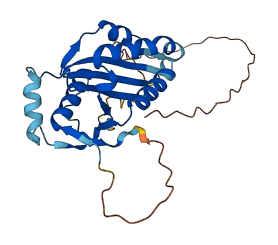
Descriptions
The autoinhibited protein was predicted that may have potential autoinhibitory elements via cis-regPred.
Autoinhibitory domains (AIDs)
Target domain |
|
Relief mechanism |
|
Assay |
cis-regPred |
Accessory elements
No accessory elements
Autoinhibited structure

Activated structure
1 structures for Q5XIH0
| Entry ID | Method | Resolution | Chain | Position | Source |
|---|---|---|---|---|---|
| AF-Q5XIH0-F1 | Predicted | AlphaFoldDB |
No variants for Q5XIH0
| Variant ID(s) | Position | Change | Description | Diseaes Association | Provenance |
|---|---|---|---|---|---|
| No variants for Q5XIH0 | |||||
No associated diseases with Q5XIH0
No regional properties for Q5XIH0
| Type | Name | Position | InterPro Accession |
|---|---|---|---|
| No domain, repeats, and functional sites for Q5XIH0 | |||
8 GO annotations of cellular component
| Name | Definition |
|---|---|
| axon | The long process of a neuron that conducts nerve impulses, usually away from the cell body to the terminals and varicosities, which are sites of storage and release of neurotransmitter. |
| cytoplasm | The contents of a cell excluding the plasma membrane and nucleus, but including other subcellular structures. |
| cytosol | The part of the cytoplasm that does not contain organelles but which does contain other particulate matter, such as protein complexes. |
| dendrite | A neuron projection that has a short, tapering, morphology. Dendrites receive and integrate signals from other neurons or from sensory stimuli, and conduct nerve impulses towards the axon or the cell body. In most neurons, the impulse is conveyed from dendrites to axon via the cell body, but in some types of unipolar neuron, the impulse does not travel via the cell body. |
| inhibitory synapse | A synapse in which an action potential in the presynaptic cell reduces the probability of an action potential occurring in the postsynaptic cell. |
| nucleus | A membrane-bounded organelle of eukaryotic cells in which chromosomes are housed and replicated. In most cells, the nucleus contains all of the cell's chromosomes except the organellar chromosomes, and is the site of RNA synthesis and processing. In some species, or in specialized cell types, RNA metabolism or DNA replication may be absent. |
| perinuclear region of cytoplasm | Cytoplasm situated near, or occurring around, the nucleus. |
| plasma membrane | The membrane surrounding a cell that separates the cell from its external environment. It consists of a phospholipid bilayer and associated proteins. |
5 GO annotations of molecular function
| Name | Definition |
|---|---|
| GABA receptor binding | Binding to a gamma-aminobutyric acid (GABA, 4-aminobutyrate) receptor. |
| RNA polymerase III core binding | Binding to an RNA polymerase III core enzyme, a multisubunit eukaryotic nuclear RNA polymerase typically composed of seventeen subunits. |
| RNA polymerase III type 1 promoter sequence-specific DNA binding | Binding to a sequence of DNA that is a part of a type 1 promoter that controls transcription by RNA polymerase III. Type 1 promoters are found in 5S rRNA genes, downstream of the transcription start site within the sequence of the mature RNA, and require TFIIIA for recognition. |
| RNA polymerase III type 2 promoter sequence-specific DNA binding | Binding to a sequence of DNA that is a part of a type 2 promoter that controls transcription by RNA polymerase III. Type 2 promoters consist of an A box and a B box downstream of the transcription start site within the sequence within the sequence of the mature RNA. Type 2 promoters are found in many tRNA genes as well as in other small RNAs. |
| RNA polymerase III type 3 promoter sequence-specific DNA binding | Binding to a sequence of DNA that is a part of a type 3 promoter that controls transcription by RNA polymerase III (Pol III). A type 3 Pol III promoter is composed of elements upstream of the transcription start site, including a TATA box. The human U6 snRNA gene has a type 3 promoter. Type 3 Pol III promoters have not been observed in S. cerevisiae. |
2 GO annotations of biological process
| Name | Definition |
|---|---|
| negative regulation of transcription by RNA polymerase I | Any process that stops, prevents, or reduces the frequency, rate or extent of transcription mediated by RNA polymerase I. |
| negative regulation of transcription by RNA polymerase III | Any process that stops, prevents, or reduces the frequency, rate or extent of transcription mediated by RNA polymerase III. |
| 10 | 20 | 30 | 40 | 50 | 60 |
| MKLLENSSFE | AINSQLTVET | GDAHIIGRIE | SYSCKMAGDD | KHMFKQFCQE | GQPHVLEALS |
| 70 | 80 | 90 | 100 | 110 | 120 |
| PPQTSGLSPS | RLSKSQGGED | ESPLSDKCSR | KTLFYLIATL | NESFRPDYDF | STARSHEFSR |
| 130 | 140 | 150 | 160 | 170 | 180 |
| EPSLRWVVNA | VNCSLFSAVR | EDFKALKPQL | WNAVDEEICL | AECDIYSYNP | DLDSDPFGED |
| 190 | 200 | 210 | 220 | 230 | 240 |
| GSLWSFNYFF | YNKRLKRIVF | FSCRSISGST | YTPSEAGNAL | DLELGAEEVD | EESGGGGGGG |
| 250 | |||||
| EGRAEETSTM | EEDRVPVICM |