Q5XIG8
Gene name |
Strap (Unrip) |
Protein name |
Serine-threonine kinase receptor-associated protein |
Names |
UNR-interacting protein |
Species |
Rattus norvegicus (Rat) |
KEGG Pathway |
rno:297699 |
EC number |
|
Protein Class |
|
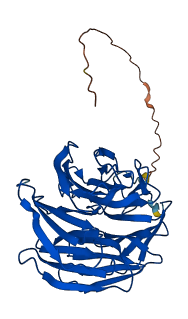
Descriptions
The autoinhibited protein was predicted that may have potential autoinhibitory elements via cis-regPred.
Autoinhibitory domains (AIDs)
Target domain |
|
Relief mechanism |
|
Assay |
cis-regPred |
Accessory elements
No accessory elements
Autoinhibited structure

Activated structure
1 structures for Q5XIG8
| Entry ID | Method | Resolution | Chain | Position | Source |
|---|---|---|---|---|---|
| AF-Q5XIG8-F1 | Predicted | AlphaFoldDB |
No variants for Q5XIG8
| Variant ID(s) | Position | Change | Description | Diseaes Association | Provenance |
|---|---|---|---|---|---|
| No variants for Q5XIG8 | |||||
No associated diseases with Q5XIG8
5 GO annotations of cellular component
| Name | Definition |
|---|---|
| cytoplasm | The contents of a cell excluding the plasma membrane and nucleus, but including other subcellular structures. |
| cytosol | The part of the cytoplasm that does not contain organelles but which does contain other particulate matter, such as protein complexes. |
| nucleus | A membrane-bounded organelle of eukaryotic cells in which chromosomes are housed and replicated. In most cells, the nucleus contains all of the cell's chromosomes except the organellar chromosomes, and is the site of RNA synthesis and processing. In some species, or in specialized cell types, RNA metabolism or DNA replication may be absent. |
| SMN complex | A protein complex that contains the survival motor neuron (SMN) protein and at least eight additional integral components, including the Gemin2-8 and Unrip proteins; the complex is found in the cytoplasm and in nuclear Gems, and is involved in spliceosomal snRNP assembly in the cytoplasm and in pre-mRNA splicing in the nucleus. |
| SMN-Sm protein complex | A protein complex formed by the association of several methylated Sm proteins with the SMN complex; the latter contains the survival motor neuron (SMN) protein and at least eight additional integral components, including the Gemin2-8 and unrip proteins; additional proteins, including galectin-1 and galectin-3, are also found in the SMN-SM complex. The SMN-Sm complex is involved in spliceosomal snRNP assembly in the cytoplasm. |
4 GO annotations of molecular function
| Name | Definition |
|---|---|
| mRNA binding | Binding to messenger RNA (mRNA), an intermediate molecule between DNA and protein. mRNA includes UTR and coding sequences, but does not contain introns. |
| RNA binding | Binding to an RNA molecule or a portion thereof. |
| signaling receptor binding | Binding to one or more specific sites on a receptor molecule, a macromolecule that undergoes combination with a hormone, neurotransmitter, drug or intracellular messenger to initiate a change in cell function. |
| U2 snRNP binding | Binding to a U2 small nuclear ribonucleoprotein particle. |
8 GO annotations of biological process
| Name | Definition |
|---|---|
| alternative mRNA splicing, via spliceosome | The process of generating multiple mRNA molecules from a given set of exons by differential use of exons from the primary transcript(s) to form multiple mature mRNAs that vary in their exon composition. |
| anatomical structure development | The biological process whose specific outcome is the progression of an anatomical structure from an initial condition to its mature state. This process begins with the formation of the structure and ends with the mature structure, whatever form that may be including its natural destruction. An anatomical structure is any biological entity that occupies space and is distinguished from its surroundings. Anatomical structures can be macroscopic such as a carpel, or microscopic such as an acrosome. |
| maintenance of gastrointestinal epithelium | Protection of epithelial surfaces of the gastrointestinal tract from proteolytic and caustic digestive agents. |
| negative regulation of transcription by RNA polymerase II | Any process that stops, prevents, or reduces the frequency, rate or extent of transcription mediated by RNA polymerase II. |
| negative regulation of transforming growth factor beta receptor signaling pathway | Any process that stops, prevents, or reduces the frequency, rate or extent of any TGF-beta receptor signaling pathway. |
| neuron differentiation | The process in which a relatively unspecialized cell acquires specialized features of a neuron. |
| ribonucleoprotein complex assembly | The aggregation, arrangement and bonding together of proteins and RNA molecules to form a ribonucleoprotein complex. |
| spliceosomal snRNP assembly | The aggregation, arrangement and bonding together of one or more snRNA and multiple protein components to form a ribonucleoprotein complex that is involved in formation of the spliceosome. |
| 10 | 20 | 30 | 40 | 50 | 60 |
| MAMRQTPLTC | SGHTRPVVDL | AFSGITPYGY | FLISACKDGK | PMLRQGDTGD | WIGTFLGHKG |
| 70 | 80 | 90 | 100 | 110 | 120 |
| AVWGATLNKD | ATKAATAAAD | FTAKVWDAVS | GDELMTLAHK | HIVKTVDFTQ | DSNYLLTGGQ |
| 130 | 140 | 150 | 160 | 170 | 180 |
| DKLLRIYDLN | KPEAEPKEIS | GHTSGIKKAL | WCSEDKQILS | ADDKTVRLWD | HATMTEVKSL |
| 190 | 200 | 210 | 220 | 230 | 240 |
| NFNMSVSSME | YIPEGEILVI | TYGRSIAFHS | AVSLEPIKSF | EAPATINSAS | LHPEKEFLVA |
| 250 | 260 | 270 | 280 | 290 | 300 |
| GGEDFKLYKY | DYNSGEELES | YKGHFGPIHC | VRFSPDGELY | ASGSEDGTLR | LWQTVVGKTY |
| 310 | 320 | 330 | 340 | ||
| GLWKCVLPEE | DSGELAKPKI | GFPETAEEEL | EEIASENSDS | IYSSTPEVKA |