Q5U300
Gene name |
Uba1 |
Protein name |
Ubiquitin-like modifier-activating enzyme 1 |
Names |
Ubiquitin-activating enzyme E1 |
Species |
Rattus norvegicus (Rat) |
KEGG Pathway |
rno:314432 |
EC number |
6.2.1.45: Acid--thiol ligases |
Protein Class |
|
Descriptions
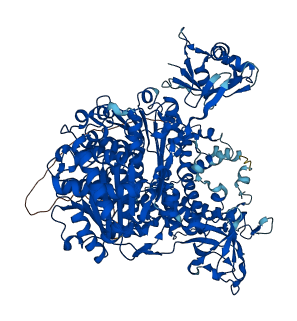
The autoinhibited protein was predicted that may have potential autoinhibitory elements via cis-regPred.
Autoinhibitory domains (AIDs)
Target domain |
|
Relief mechanism |
|
Assay |
cis-regPred |
Accessory elements
No accessory elements
Autoinhibited structure

Activated structure
1 structures for Q5U300
| Entry ID | Method | Resolution | Chain | Position | Source |
|---|---|---|---|---|---|
| AF-Q5U300-F1 | Predicted | AlphaFoldDB |
No variants for Q5U300
| Variant ID(s) | Position | Change | Description | Diseaes Association | Provenance |
|---|---|---|---|---|---|
| No variants for Q5U300 | |||||
No associated diseases with Q5U300
1 regional properties for Q5U300
| Type | Name | Position | InterPro Accession |
|---|---|---|---|
| domain | GPCR, rhodopsin-like, 7TM | 51 - 324 | IPR017452 |
Functions
| Description | ||
|---|---|---|
| EC Number | 6.2.1.45 | Acid--thiol ligases |
| Subcellular Localization |
|
|
| PANTHER Family | ||
| PANTHER Subfamily | ||
| PANTHER Protein Class | ||
| PANTHER Pathway Category | No pathway information available | |
9 GO annotations of cellular component
| Name | Definition |
|---|---|
| cytoplasm | The contents of a cell excluding the plasma membrane and nucleus, but including other subcellular structures. |
| desmosome | A cell-cell junction in which: on the cytoplasmic surface of each interacting plasma membrane is a dense plaque composed of a mixture of intracellular anchor proteins; a bundle of keratin intermediate filaments is attached to the surface of each plaque; transmembrane adhesion proteins of the cadherin family bind to the plaques and interact through their extracellular domains to hold the adjacent membranes together by a Ca2+-dependent mechanism. |
| endosome membrane | The lipid bilayer surrounding an endosome. |
| heterochromatin | A compact and highly condensed form of chromatin that is refractory to transcription. |
| lysosomal membrane | The lipid bilayer surrounding the lysosome and separating its contents from the cell cytoplasm. |
| mitochondrion | A semiautonomous, self replicating organelle that occurs in varying numbers, shapes, and sizes in the cytoplasm of virtually all eukaryotic cells. It is notably the site of tissue respiration. |
| nucleoplasm | That part of the nuclear content other than the chromosomes or the nucleolus. |
| nucleus | A membrane-bounded organelle of eukaryotic cells in which chromosomes are housed and replicated. In most cells, the nucleus contains all of the cell's chromosomes except the organellar chromosomes, and is the site of RNA synthesis and processing. In some species, or in specialized cell types, RNA metabolism or DNA replication may be absent. |
| rough endoplasmic reticulum membrane | The lipid bilayer surrounding the rough endoplasmic reticulum. |
2 GO annotations of molecular function
| Name | Definition |
|---|---|
| ATP binding | Binding to ATP, adenosine 5'-triphosphate, a universally important coenzyme and enzyme regulator. |
| ubiquitin activating enzyme activity | Catalysis of the reaction: E1 + ubiquitin + ATP--> E1-ubiquitin + AMP + PPi, where the E1-ubiquitin linkage is a thioester bond between the C-terminal glycine of Ub and a sulfhydryl side group of an E1 cysteine residue. This is the first step in a cascade of reactions in which ubiquitin is ultimately added to a protein substrate. |
4 GO annotations of biological process
| Name | Definition |
|---|---|
| cellular response to DNA damage stimulus | Any process that results in a change in state or activity of a cell (in terms of movement, secretion, enzyme production, gene expression, etc.) as a result of a stimulus indicating damage to its DNA from environmental insults or errors during metabolism. |
| protein modification by small protein conjugation | A protein modification process in which one or more groups of a small protein, such as ubiquitin or a ubiquitin-like protein, are covalently attached to a target protein. |
| protein ubiquitination | The process in which one or more ubiquitin groups are added to a protein. |
| ubiquitin-dependent protein catabolic process | The chemical reactions and pathways resulting in the breakdown of a protein or peptide by hydrolysis of its peptide bonds, initiated by the covalent attachment of a ubiquitin group, or multiple ubiquitin groups, to the protein. |
4 homologous proteins in AiPD
| UniProt AC | Gene Name | Protein Name | Species | Evidence Code |
|---|---|---|---|---|
| P22314 | UBA1 | Ubiquitin-like modifier-activating enzyme 1 | Homo sapiens (Human) | PR |
| P31254 | Uba1y | Ubiquitin-like modifier-activating enzyme 1 Y | Mus musculus (Mouse) | PR |
| Q02053 | Uba1 | Ubiquitin-like modifier-activating enzyme 1 | Mus musculus (Mouse) | PR |
| Q99MI7 | Uba3 | NEDD8-activating enzyme E1 catalytic subunit | Rattus norvegicus (Rat) | PR |
| 10 | 20 | 30 | 40 | 50 | 60 |
| MSSSPLSKKR | RVSGPDPKPG | SNCSSAQSVL | SEVSSVPTNG | MAKNGSEADI | DESLYSRQLY |
| 70 | 80 | 90 | 100 | 110 | 120 |
| VLGHEAMKML | QTSSVLVSGL | RGLGVEIAKN | IILGGVKAVT | LHDQGTTQWA | DLSSQFYLRE |
| 130 | 140 | 150 | 160 | 170 | 180 |
| EDIGKNRAEV | SQPRLAELNS | YVPVTAYTGP | LVEDFLSGFQ | VVVLTNSPLE | EQLRVGEFCH |
| 190 | 200 | 210 | 220 | 230 | 240 |
| SRGIKLVVAD | TRGLFGQLFC | DFGEEMVLTD | SNGEQPLSAM | VSMVTKDNPG | VVTCLDEARH |
| 250 | 260 | 270 | 280 | 290 | 300 |
| GFETGDFVSF | SEVQGMVQLN | GCQPIEIKVL | GPYTFSICDT | SNFSDYIRGG | IVSQVKVPKK |
| 310 | 320 | 330 | 340 | 350 | 360 |
| ISFKSLPASL | AEPDFVMTDF | AKYSRPAQLH | IGFQALHQFC | AQHNRPPRPR | NEEDATELVT |
| 370 | 380 | 390 | 400 | 410 | 420 |
| LAQAVNARSP | PAVQQDNVDE | DLIRKLAYVA | AGDLAPINAF | IGGLAAQEVM | KACSGKFMPI |
| 430 | 440 | 450 | 460 | 470 | 480 |
| MQWLYFDALE | CLPEDKEALT | EDKCLPRQNR | YDGQVAVFGS | DLQEKLGKQK | YFLVGAGAIG |
| 490 | 500 | 510 | 520 | 530 | 540 |
| CELLKNFAMI | GLGCGEGGEV | VVTDMDTIEK | SNLNRQFLFR | PWDVTKLKSD | TAAAAVRQMN |
| 550 | 560 | 570 | 580 | 590 | 600 |
| PYIQVTSHQN | RVGPDTERIY | DDDFFQNLDG | VANALDNVDA | RMYMDRRCVY | YRKPLLESGT |
| 610 | 620 | 630 | 640 | 650 | 660 |
| LGTKGNVQVV | IPFLTESYSS | SQDPPEKSIP | ICTLKNFPNA | IEHTLQWARD | EFEGLFKQPA |
| 670 | 680 | 690 | 700 | 710 | 720 |
| ENVNQYLTDS | KFVERTLRLA | GTQPLEVLEA | VQRSLVLQRP | QTWGDCVTWA | CHHWHTQYCN |
| 730 | 740 | 750 | 760 | 770 | 780 |
| NIRQLLHNFP | PDQLTSSGAP | FWSGPKRCPH | PLTFDVNNTL | HLDYVMAAAN | LFAQTYGLTG |
| 790 | 800 | 810 | 820 | 830 | 840 |
| SQDRAAVASL | LQSVQVPEFT | PKSGVKIHVS | DQELQSANAS | VDDSRLEELK | ATLPSPDKLP |
| 850 | 860 | 870 | 880 | 890 | 900 |
| GFKMYPIDFE | KDDDSNFHMD | FIVAASNLRA | ENYDISPADR | HKSKLIAGKI | IPAIATTTAA |
| 910 | 920 | 930 | 940 | 950 | 960 |
| VVGLVCLELY | KVVQGHQQLD | SYKNGFLNLA | LPFFGFSEPL | AAPRHQYYNQ | EWTLWDRFEV |
| 970 | 980 | 990 | 1000 | 1010 | 1020 |
| QGLQPNGEEM | TLKQFLDYFK | TEHKLEITML | SQGVSMLYSF | FMPAAKLKER | LDQPMTEIVS |
| 1030 | 1040 | 1050 | |||
| RVSKRKLGRH | VRALVLELCC | NDESGEDVEV | PYVRYTIR |