Q5TYV0
Gene name |
emc7 (si:ch211-150c22.3) |
Protein name |
ER membrane protein complex subunit 7 |
Names |
|
Species |
Danio rerio (Zebrafish) (Brachydanio rerio) |
KEGG Pathway |
dre:561549 |
EC number |
|
Protein Class |
|
Descriptions
The autoinhibited protein was predicted that may have potential autoinhibitory elements via cis-regPred.
Autoinhibitory domains (AIDs)
Target domain |
|
Relief mechanism |
|
Assay |
cis-regPred |
Accessory elements
No accessory elements
Autoinhibited structure

Activated structure
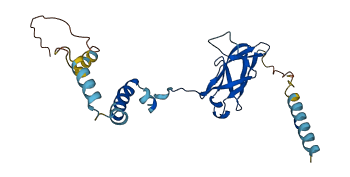
1 structures for Q5TYV0
| Entry ID | Method | Resolution | Chain | Position | Source |
|---|---|---|---|---|---|
| AF-Q5TYV0-F1 | Predicted | AlphaFoldDB |
No variants for Q5TYV0
| Variant ID(s) | Position | Change | Description | Diseaes Association | Provenance |
|---|---|---|---|---|---|
| No variants for Q5TYV0 | |||||
No associated diseases with Q5TYV0
4 regional properties for Q5TYV0
| Type | Name | Position | InterPro Accession |
|---|---|---|---|
| domain | RNA recognition motif domain | 58 - 129 | IPR000504-1 |
| domain | RNA recognition motif domain | 131 - 209 | IPR000504-2 |
| domain | RNA recognition motif domain | 220 - 298 | IPR000504-3 |
| domain | Ribonucleoprotein PTB-binding 2, RNA recognition motif 2 | 132 - 208 | IPR034636 |
3 GO annotations of cellular component
| Name | Definition |
|---|---|
| EMC complex | A transmembrane protein complex located in the endoplasmic reticulum (ER) involved in the insertion of newly synthesized proteins in the membrane of the ER. In S. cerevisiae, it has six members: EMC1, EMC2, AIM27, EMC4, KRE27, and EMC6. |
| integral component of endoplasmic reticulum membrane | The component of the endoplasmic reticulum membrane consisting of the gene products and protein complexes having at least some part of their peptide sequence embedded in the hydrophobic region of the membrane. |
| integral component of membrane | The component of a membrane consisting of the gene products and protein complexes having at least some part of their peptide sequence embedded in the hydrophobic region of the membrane. |
1 GO annotations of molecular function
| Name | Definition |
|---|---|
| carbohydrate binding | Binding to a carbohydrate, which includes monosaccharides, oligosaccharides and polysaccharides as well as substances derived from monosaccharides by reduction of the carbonyl group (alditols), by oxidation of one or more hydroxy groups to afford the corresponding aldehydes, ketones, or carboxylic acids, or by replacement of one or more hydroxy group(s) by a hydrogen atom. Cyclitols are generally not regarded as carbohydrates. |
2 GO annotations of biological process
| Name | Definition |
|---|---|
| protein insertion into ER membrane by stop-transfer membrane-anchor sequence | A process of protein insertion into the endoplasmic reticulum (ER) membrane in which stop-transfer membrane-anchor sequences become an ER membrane spanning helix. |
| tail-anchored membrane protein insertion into ER membrane | A process of protein insertion into the endoplasmic reticulum (ER) membrane in which a tail-anchored (TA) transmembrane protein is incorporated into an endoplasmic reticulum (ER) membrane. TA transmembrane protein, also named type II transmembrane proteins, contain a single C- terminal transmembrane region. |
4 homologous proteins in AiPD
| UniProt AC | Gene Name | Protein Name | Species | Evidence Code |
|---|---|---|---|---|
| A5PJA8 | EMC7 | ER membrane protein complex subunit 7 | Bos taurus (Bovine) | PR |
| Q9NPA0 | EMC7 | ER membrane protein complex subunit 7 | Homo sapiens (Human) | PR |
| Q9EP72 | Emc7 | ER membrane protein complex subunit 7 | Mus musculus (Mouse) | PR |
| Q0IHY5 | emc7 | ER membrane protein complex subunit 7 | Xenopus tropicalis (Western clawed frog) (Silurana tropicalis) | PR |
| 10 | 20 | 30 | 40 | 50 | 60 |
| MPHIKRLLDV | YIALQALFAL | SWGFSDPEPG | PVAASQSNGD | RFKIEGRAIV | PGVKTQDWIS |
| 70 | 80 | 90 | 100 | 110 | 120 |
| TARVLVEGEE | YVGFLKTDGS | FAVNDVPSGS | YVVEIVSPSF | RFEPVRVDIT | SKGKMRARLV |
| 130 | 140 | 150 | 160 | 170 | 180 |
| NYIKTSEVIR | QPYPLQIRAG | GPHTYFMKRE | TWGWTDFLMN | PMVMMMVLPL | LIIVLLPKVV |
| 190 | 200 | 210 | 220 | 230 | |
| NTNDPEMRKE | MEQSMNMLNP | NPELPDVSEF | MTKLFSKGSS | KSGGGNKGSR | SVATKRR |