Q5SSL4
Gene name |
Abr |
Protein name |
Active breakpoint cluster region-related protein |
Names |
|
Species |
Mus musculus (Mouse) |
KEGG Pathway |
mmu:109934 |
EC number |
|
Protein Class |
|
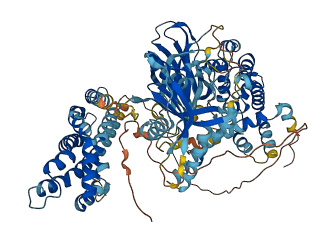
Descriptions
The autoinhibited protein was predicted that may have potential autoinhibitory elements via cis-regPred.
Autoinhibitory domains (AIDs)
Target domain |
|
Relief mechanism |
|
Assay |
cis-regPred |
Accessory elements
No accessory elements
Autoinhibited structure

Activated structure
1 structures for Q5SSL4
| Entry ID | Method | Resolution | Chain | Position | Source |
|---|---|---|---|---|---|
| AF-Q5SSL4-F1 | Predicted | AlphaFoldDB |
37 variants for Q5SSL4
| Variant ID(s) | Position | Change | Description | Diseaes Association | Provenance |
|---|---|---|---|---|---|
| rs3389185719 | 67 | G>S | No | EVA | |
| rs3389185687 | 70 | S>N | No | EVA | |
| rs3401818406 | 77 | E>* | No | EVA | |
| rs3389156073 | 140 | F>L | No | EVA | |
| rs3389144315 | 142 | K>M | No | EVA | |
| rs3389177821 | 151 | K>E | No | EVA | |
| rs3389185672 | 162 | Q>H | No | EVA | |
| rs3389182820 | 169 | T>N | No | EVA | |
| rs3402224806 | 235 | L>Q | No | EVA | |
| rs3402081658 | 235 | L>V | No | EVA | |
| rs3389117965 | 282 | N>Y | No | EVA | |
| rs3389181733 | 293 | T>I | No | EVA | |
| rs3389117929 | 345 | D>Y | No | EVA | |
| rs3389175529 | 378 | E>D | No | EVA | |
| rs3389144253 | 385 | S>Y | No | EVA | |
| rs3389179730 | 387 | L>H | No | EVA | |
| rs3402449396 | 431 | N>D | No | EVA | |
| rs3402081675 | 432 | R>W | No | EVA | |
| rs3402752589 | 433 | N>Y | No | EVA | |
| rs3402449398 | 442 | S>* | No | EVA | |
| rs3389192042 | 553 | E>K | No | EVA | |
| rs3389152170 | 619 | K>N | No | EVA | |
| rs3389185696 | 624 | M>V | No | EVA | |
| rs3389181522 | 639 | K>E | No | EVA | |
| rs3389189259 | 653 | T>S | No | EVA | |
| rs3389180504 | 672 | E>G | No | EVA | |
| rs3389175479 | 683 | R>G | No | EVA | |
| rs3389117949 | 696 | A>T | No | EVA | |
| rs3389177779 | 712 | M>L | No | EVA | |
| rs3389180487 | 725 | F>Y | No | EVA | |
| rs3389182836 | 761 | L>P | No | EVA | |
| rs3389181491 | 794 | H>R | No | EVA | |
| rs3389156089 | 813 | K>T | No | EVA | |
| rs3389177799 | 823 | W>R | No | EVA | |
| rs3389190702 | 826 | D>V | No | EVA | |
| rs3389180422 | 838 | L>Q | No | EVA | |
| rs3389144326 | 849 | K>M | No | EVA |
No associated diseases with Q5SSL4
6 regional properties for Q5SSL4
| Type | Name | Position | InterPro Accession |
|---|---|---|---|
| domain | C2 domain | 484 - 613 | IPR000008 |
| domain | Rho GTPase-activating protein domain | 647 - 845 | IPR000198 |
| domain | Dbl homology (DH) domain | 91 - 284 | IPR000219 |
| conserved_site | Guanine-nucleotide dissociation stimulator, CDC24, conserved site | 232 - 257 | IPR001331 |
| domain | Pleckstrin homology domain | 301 - 461 | IPR001849 |
| domain | Active breakpoint cluster region-related protein, PH domain | 277 - 460 | IPR037865 |
9 GO annotations of cellular component
| Name | Definition |
|---|---|
| anchoring junction | A cell junction that mechanically attaches a cell (and its cytoskeleton) to neighboring cells or to the extracellular matrix. |
| axon | The long process of a neuron that conducts nerve impulses, usually away from the cell body to the terminals and varicosities, which are sites of storage and release of neurotransmitter. |
| cytosol | The part of the cytoplasm that does not contain organelles but which does contain other particulate matter, such as protein complexes. |
| dendritic spine | A small, membranous protrusion from a dendrite that forms a postsynaptic compartment, typically receiving input from a single presynapse. They function as partially isolated biochemical and an electrical compartments. Spine morphology is variable:they can be thin, stubby, mushroom, or branched, with a continuum of intermediate morphologies. They typically terminate in a bulb shape, linked to the dendritic shaft by a restriction. Spine remodeling is though to be involved in synaptic plasticity. |
| glutamatergic synapse | A synapse that uses glutamate as a neurotransmitter. |
| membrane | A lipid bilayer along with all the proteins and protein complexes embedded in it an attached to it. |
| plasma membrane | The membrane surrounding a cell that separates the cell from its external environment. It consists of a phospholipid bilayer and associated proteins. |
| postsynaptic density, intracellular component | A network of proteins adjacent to the postsynaptic membrane forming an electron dense disc. Its major components include neurotransmitter receptors and the proteins that spatially and functionally organize neurotransmitter receptors in the adjacent membrane, such as anchoring and scaffolding molecules, signaling enzymes and cytoskeletal components. |
| Schaffer collateral - CA1 synapse | A synapse between the Schaffer collateral axon of a CA3 pyramidal cell and a CA1 pyramidal cell. |
2 GO annotations of molecular function
| Name | Definition |
|---|---|
| GTPase activator activity | Binds to and increases the activity of a GTPase, an enzyme that catalyzes the hydrolysis of GTP. |
| guanyl-nucleotide exchange factor activity | Stimulates the exchange of GDP to GTP on a signaling GTPase, changing its conformation to its active form. Guanine nucleotide exchange factors (GEFs) act by stimulating the release of guanosine diphosphate (GDP) to allow binding of guanosine triphosphate (GTP), which is more abundant in the cell under normal cellular physiological conditions. |
20 GO annotations of biological process
| Name | Definition |
|---|---|
| actin cytoskeleton organization | A process that is carried out at the cellular level which results in the assembly, arrangement of constituent parts, or disassembly of cytoskeletal structures comprising actin filaments and their associated proteins. |
| activation of GTPase activity | Any process that initiates the activity of an inactive GTPase through the replacement of GDP by GTP. |
| brain development | The process whose specific outcome is the progression of the brain over time, from its formation to the mature structure. Brain development begins with patterning events in the neural tube and ends with the mature structure that is the center of thought and emotion. The brain is responsible for the coordination and control of bodily activities and the interpretation of information from the senses (sight, hearing, smell, etc.). |
| cell migration | The controlled self-propelled movement of a cell from one site to a destination guided by molecular cues. Cell migration is a central process in the development and maintenance of multicellular organisms. |
| establishment of localization in cell | Any process, occuring in a cell, that localizes a substance or cellular component. This may occur via movement, tethering or selective degradation. |
| inner ear morphogenesis | The process in which the anatomical structures of the inner ear are generated and organized. The inner ear is the structure in vertebrates that contains the organs of balance and hearing. It consists of soft hollow sensory structures (the membranous labyrinth) containing fluid (endolymph) surrounded by fluid (perilymph) and encased in a bony cavity (the bony labyrinth). It consists of two chambers, the sacculus and utriculus, from which arise the cochlea and semicircular canals respectively. |
| intracellular signal transduction | The process in which a signal is passed on to downstream components within the cell, which become activated themselves to further propagate the signal and finally trigger a change in the function or state of the cell. |
| macrophage migration | The orderly movement of a macrophage from one site to another. |
| modulation of chemical synaptic transmission | Any process that modulates the frequency or amplitude of synaptic transmission, the process of communication from a neuron to a target (neuron, muscle, or secretory cell) across a synapse. Amplitude, in this case, refers to the change in postsynaptic membrane potential due to a single instance of synaptic transmission. |
| negative regulation of blood vessel remodeling | Any process that decreases the rate, frequency or extent of blood vessel remodeling, the reorganization or renovation of existing blood vessels. |
| negative regulation of cellular extravasation | Any process that stops, prevents, or reduces the frequency, rate, or extent of cellular extravasation. |
| negative regulation of inflammatory response | Any process that stops, prevents, or reduces the frequency, rate or extent of the inflammatory response. |
| negative regulation of macrophage migration | Any process that stops, prevents or reduces the frequency, rate or extent of macrophage migration. |
| negative regulation of neutrophil degranulation | Any process that stops, prevents, or reduces the rate of neutrophil degranulation. |
| neuromuscular process controlling balance | Any process that an organism uses to control its balance, the orientation of the organism (or the head of the organism) in relation to the source of gravity. In humans and animals, balance is perceived through visual cues, the labyrinth system of the inner ears and information from skin pressure receptors and muscle and joint receptors. |
| neutrophil degranulation | The regulated exocytosis of secretory granules containing preformed mediators such as proteases, lipases, and inflammatory mediators by a neutrophil. |
| phagocytosis | A vesicle-mediated transport process that results in the engulfment of external particulate material by phagocytes and their delivery to the lysosome. The particles are initially contained within phagocytic vacuoles (phagosomes), which then fuse with primary lysosomes to effect digestion of the particles. |
| positive regulation of phagocytosis | Any process that activates or increases the frequency, rate or extent of phagocytosis. |
| regulation of vascular permeability | Any process that modulates the extent to which blood vessels can be pervaded by fluid. |
| response to lipopolysaccharide | Any process that results in a change in state or activity of an organism (in terms of movement, secretion, enzyme production, gene expression, etc.) as a result of a lipopolysaccharide stimulus; lipopolysaccharide is a major component of the cell wall of gram-negative bacteria. |
4 homologous proteins in AiPD
| UniProt AC | Gene Name | Protein Name | Species | Evidence Code |
|---|---|---|---|---|
| Q6ZUM4 | ARHGAP27 | Rho GTPase-activating protein 27 | Homo sapiens (Human) | PR |
| Q12979 | ABR | Active breakpoint cluster region-related protein | Homo sapiens (Human) | PR |
| A2AB59 | Arhgap27 | Rho GTPase-activating protein 27 | Mus musculus (Mouse) | PR |
| Q6TLK4 | Arhgap27 | Rho GTPase-activating protein 27 | Rattus norvegicus (Rat) | PR |
| 10 | 20 | 30 | 40 | 50 | 60 |
| MEPLSHRGLP | RLSWIDTLYS | NFSYGAEDYD | AEGHEEQKGP | PEGSETMPYI | DESPTMSPQL |
| 70 | 80 | 90 | 100 | 110 | 120 |
| SARSQGGGDS | VSPTPPEGLA | PGVEAGKGLE | MRKLVLSGFL | ASEEIYINQL | EALLLPMKPL |
| 130 | 140 | 150 | 160 | 170 | 180 |
| KATATTSQPV | LTIQQIETIF | YKIQDIYEIH | KEFYDNLCPK | VQQWDSQVTM | GHLFQKLASQ |
| 190 | 200 | 210 | 220 | 230 | 240 |
| LGVYKAFVDN | YKVALETAEK | CSQSNNQFQK | ISEELKVKGP | KDSKDSHTSV | TMEALLYKPI |
| 250 | 260 | 270 | 280 | 290 | 300 |
| DRVTRSTLVL | HDLLKHTPVD | HPDYPLLQDA | LRISQNFLSS | INEDIDPRRT | AVTTPKGETR |
| 310 | 320 | 330 | 340 | 350 | 360 |
| QLVKDGFLVE | MSESSRKLRH | VFLFTDVLLC | AKLKKTSAGK | HQQYDCKWYI | PLADLVFPSP |
| 370 | 380 | 390 | 400 | 410 | 420 |
| EESEASPQVH | PFPDHELEDM | KTKISALKSE | IQKEKANKGQ | SRAIERLKKK | MFENEFLLLL |
| 430 | 440 | 450 | 460 | 470 | 480 |
| NSPTIPFRIH | NRNGKSYLFL | LSSDYERSEW | REAIQKLQKK | DLQAFVLSSV | ELQVLTGSCF |
| 490 | 500 | 510 | 520 | 530 | 540 |
| KLRTVHNIPV | TSNKDDDESP | GLYGFLHVIV | HSAKGFKQSA | NLYCTLEVDS | FGYFVSKAKT |
| 550 | 560 | 570 | 580 | 590 | 600 |
| RVFRDTTEPK | WDEEFEIELE | GSQSLRILCY | EKCYDKTKVN | KDNNEIVDKI | MGKGQIQLDP |
| 610 | 620 | 630 | 640 | 650 | 660 |
| QTVESKNWHT | DVIEMNGIKV | EFSMKFTSRD | MSLKRTPSKK | QTGVFGVKIS | VVTKRERSKV |
| 670 | 680 | 690 | 700 | 710 | 720 |
| PYIVRQCIEE | VEKRGIEEVG | IYRISGVATD | IQALKAVFDA | NNKDILLMLS | DMDINAIAGT |
| 730 | 740 | 750 | 760 | 770 | 780 |
| LKLYFRELPE | PLLTDRLYPA | FMEGIALSDP | AAKENCMMHL | LRSLPDPNLI | TFLFLLEHLK |
| 790 | 800 | 810 | 820 | 830 | 840 |
| RVAEKEPINK | MSLHNLATVF | GPTLLRPSEV | ESKAHLTSAA | DIWSHDVMAQ | VQVLLYYLQH |
| 850 | |||||
| PPISFAELKR | NTLYFSTDV |