Q5IBH7
Gene name |
Spdya |
Protein name |
Speedy protein A |
Names |
Protein expressed in male leptotene and zygotene spermatocytes 465, MLZ-465, Rapid inducer of G2/M progression in oocytes A, RINGO A, mSpy/Ringo A, Speedy-1, Spy1 |
Species |
Mus musculus (Mouse) |
KEGG Pathway |
mmu:70891 |
EC number |
|
Protein Class |
|
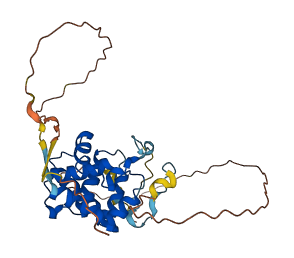
Descriptions
The autoinhibited protein was predicted that may have potential autoinhibitory elements via cis-regPred.
Autoinhibitory domains (AIDs)
Target domain |
|
Relief mechanism |
|
Assay |
cis-regPred |
Accessory elements
No accessory elements
Autoinhibited structure

Activated structure
1 structures for Q5IBH7
| Entry ID | Method | Resolution | Chain | Position | Source |
|---|---|---|---|---|---|
| AF-Q5IBH7-F1 | Predicted | AlphaFoldDB |
13 variants for Q5IBH7
| Variant ID(s) | Position | Change | Description | Diseaes Association | Provenance |
|---|---|---|---|---|---|
| rs49839657 | 42 | S>C | No | EVA | |
| rs246036062 | 51 | Q>H | No | EVA | |
| rs3406104962 | 59 | R>S | No | EVA | |
| rs3407993608 | 59 | R>T | No | EVA | |
| rs233512479 | 64 | I>M | No | EVA | |
| rs3389437586 | 99 | L>I | No | EVA | |
| rs1133920087 | 104 | F>L | No | EVA | |
| rs3389481438 | 136 | E>D | No | EVA | |
| rs3389484966 | 159 | F>Y | No | EVA | |
| rs3389473980 | 175 | I>F | No | EVA | |
| rs215884310 | 252 | G>V | No | EVA | |
| rs33645336 | 258 | D>G | No | EVA | |
| rs226070210 | 271 | A>T | No | EVA |
No associated diseases with Q5IBH7
No regional properties for Q5IBH7
| Type | Name | Position | InterPro Accession |
|---|---|---|---|
| No domain, repeats, and functional sites for Q5IBH7 | |||
2 GO annotations of cellular component
| Name | Definition |
|---|---|
| nucleoplasm | That part of the nuclear content other than the chromosomes or the nucleolus. |
| nucleus | A membrane-bounded organelle of eukaryotic cells in which chromosomes are housed and replicated. In most cells, the nucleus contains all of the cell's chromosomes except the organellar chromosomes, and is the site of RNA synthesis and processing. In some species, or in specialized cell types, RNA metabolism or DNA replication may be absent. |
2 GO annotations of molecular function
| Name | Definition |
|---|---|
| protein kinase activator activity | Binds to and increases the activity of a protein kinase, an enzyme which phosphorylates a protein. |
| protein kinase binding | Binding to a protein kinase, any enzyme that catalyzes the transfer of a phosphate group, usually from ATP, to a protein substrate. |
6 GO annotations of biological process
| Name | Definition |
|---|---|
| cellular response to DNA damage stimulus | Any process that results in a change in state or activity of a cell (in terms of movement, secretion, enzyme production, gene expression, etc.) as a result of a stimulus indicating damage to its DNA from environmental insults or errors during metabolism. |
| G1/S transition of mitotic cell cycle | The mitotic cell cycle transition by which a cell in G1 commits to S phase. The process begins with the build up of G1 cyclin-dependent kinase (G1 CDK), resulting in the activation of transcription of G1 cyclins. The process ends with the positive feedback of the G1 cyclins on the G1 CDK which commits the cell to S phase, in which DNA replication is initiated. |
| male meiotic nuclear division | A cell cycle process by which the cell nucleus divides as part of a meiotic cell cycle in the male germline. |
| positive regulation of cell population proliferation | Any process that activates or increases the rate or extent of cell proliferation. |
| positive regulation of cyclin-dependent protein serine/threonine kinase activity | Any process that activates or increases the frequency, rate or extent of CDK activity. |
| positive regulation of protein kinase activity | Any process that activates or increases the frequency, rate or extent of protein kinase activity. |
| 10 | 20 | 30 | 40 | 50 | 60 |
| MRHNQMYCET | PPTVTIHVKS | GSNRSHQTRK | PISLKRPILK | DSWEASENNA | QNNKSKRPRG |
| 70 | 80 | 90 | 100 | 110 | 120 |
| PCLIIQRQEM | TAFFKLFDDD | LIQDFLWMDC | CCKIADKYLL | AMTFVYFKRA | KFTINEHTRI |
| 130 | 140 | 150 | 160 | 170 | 180 |
| NFFIALYLAN | TVEEDEEEAK | YEIFPWALGK | NWRKLFPNFL | KLRDQLWDRI | DYRAIVSRRC |
| 190 | 200 | 210 | 220 | 230 | 240 |
| CEEVMAIAPT | HYIWQRERSV | HHSGAVRNYN | RDEVHLPRGP | SATPVDCSLC | GKKGRYVRLG |
| 250 | 260 | 270 | 280 | 290 | 300 |
| LSSSSSSSSD | TGELMEKDSQ | ELHSAFSVDT | AGDPPHTYSQ | VANDHQSNKE | NETNFVKKNK |
| SVEWFAESEE |